Clear Sky Science · en
Stress and microseismic activity in hard roof thick coal seams under varying mining rates
Why mine speed matters underground
Deep below ground, large coal mines move forward every day, carving long tunnels through thick rock. How fast this cutting front advances might sound like a simple productivity choice, but it also changes how the rock overhead bends, cracks, and stores energy. In mines with a strong, stiff roof above thick coal seams, the wrong pace can make the rock behave like a loaded spring, increasing the risk of sudden violent failures known as rock bursts. This study explores how changing the mining rate affects stress in the rock and tiny underground tremors, and how adjusting speed can keep both miners and equipment safer while still getting coal out efficiently.
The challenge of a heavy stone ceiling
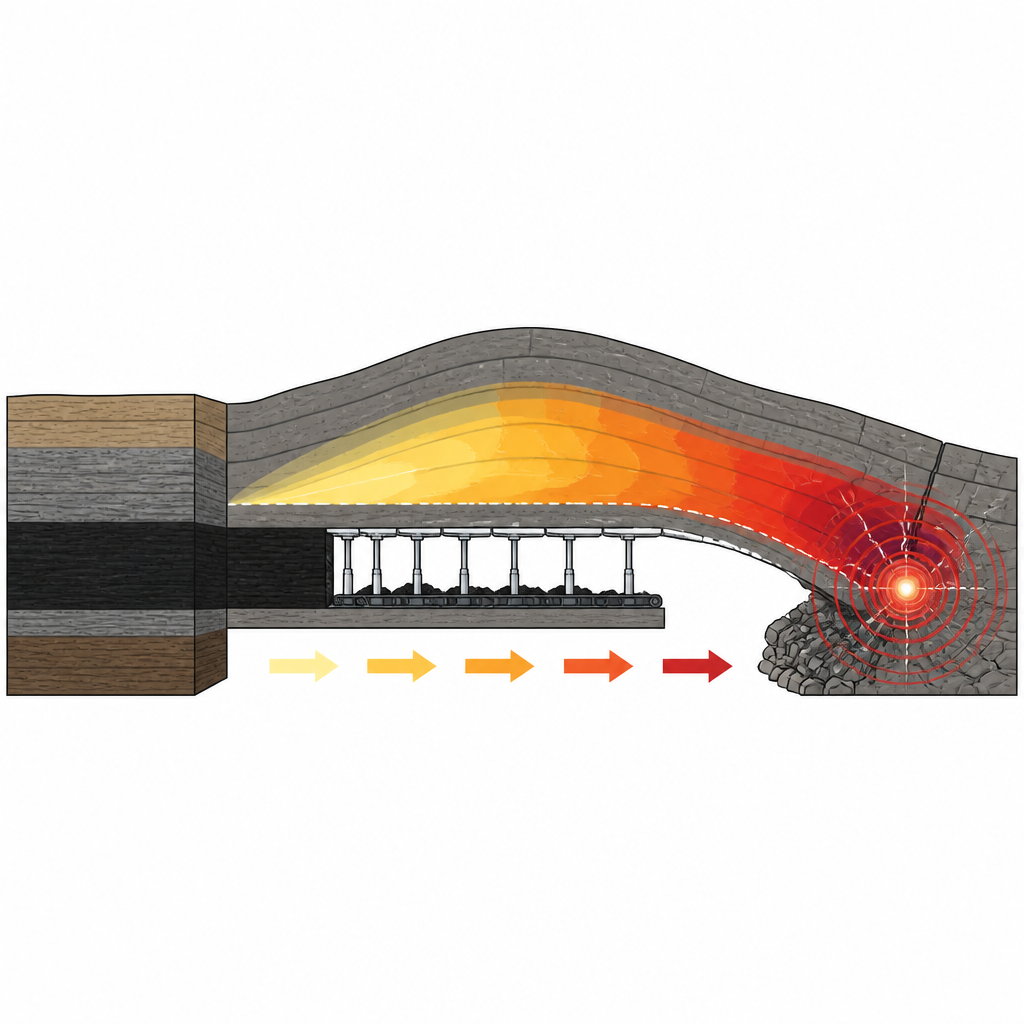
The research focuses on a coal mine in China where a thick, hard sandstone layer sits above a more than five meter thick coal seam. This tough roof does not break and fall in easily as coal is removed. Instead, it hangs over the empty space, forming long overhanging beams. As mining continues, these beams bend and lock in large amounts of elastic energy. If too much energy builds up, parts of the roof or nearby coal can break suddenly, releasing bursts of energy that feel like small earthquakes and can cause serious damage. Because modern mines also work at great depth, the natural pressure from the overlying rock is already very high, making it even more important to understand how mining pace changes the stress pattern.
Using models and sensors to watch the roof
To study this problem, the team combined computer simulations with real-world measurements. They built a three dimensional model of the mine panel and surrounding rock, then simulated mining at different advance rates, from slow to fast. The model tracked how vertical stress in the hard roof shifted and how much elastic energy accumulated as the face advanced. In parallel, the mine used a network of sensitive underground sensors to record microseismic events, tiny tremors caused by small slips or fractures in the rock. By comparing simulated stress and energy maps with the patterns of recorded tremors, the researchers could see how mine speed changed both the buildup of energy and where and when the rock was most likely to fail.
What happens when mining goes faster
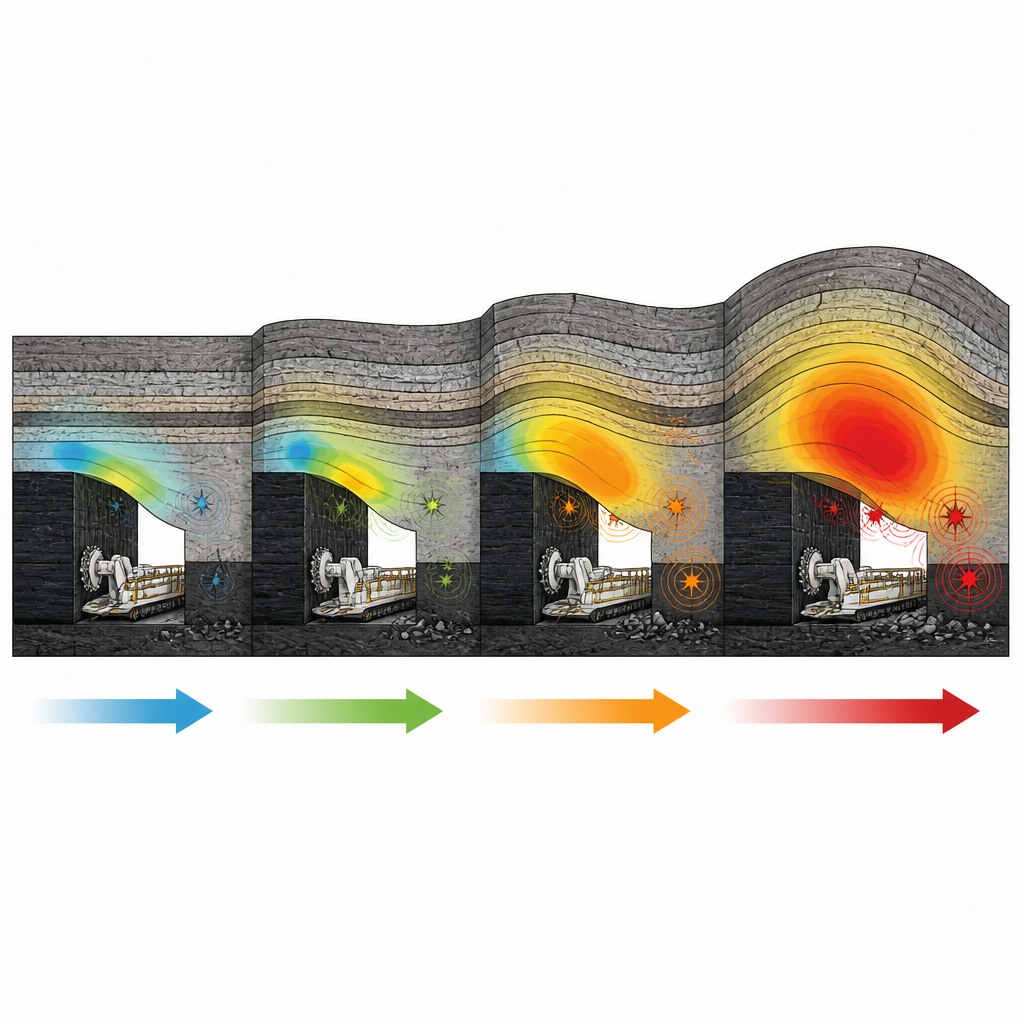
The simulations showed that faster mining leaves less time for stress in the roof to spread out and relax. As the advance rate increases, the peak pressure in front of the coal wall moves closer to the mined out space, and the stress pattern in the roof becomes less even. At the same time, the stored elastic energy in the hard roof grows sharply with speed, following an almost exponential trend. The goaf, or mined out zone, also plays a key role: near its edge, energy in the roof is highest, and that energy rises quickly as mining speeds up. These conditions make it easier for high energy failures to occur in the stiff roof and nearby coal, setting the stage for strong microseismic events and potential rock bursts.
How tiny tremors reveal hidden danger
The microseismic records confirmed the model results. As daily advance increased, both the number and total energy of tremors generally rose. At low advance rates, more events occurred ahead of the working face, in front of the coal wall. At higher speeds, events shifted to concentrate behind the face, where the hanging roof spans are largest and energy accumulation is strongest. When daily advance was below about 4.8 meters, tremor counts and energies tended to climb as speed increased. Above that, the overall level remained high, and the chance of very energetic events grew. By tracking how these patterns changed over time and space, the team could link certain ranges of mining speed to higher or lower risk in different parts of the panel.
Choosing safer speeds for different risk zones
Using geological information, roof behavior, and the influence of nearby mined out areas, the researchers divided the panel into zones with low, moderate, and high rock burst risk. They then analyzed how tremor energy and frequency changed with daily advance in each zone. The results showed clear thresholds: in low risk areas, keeping the advance below 6.4 meters per day kept tremor energy and counts at relatively modest levels, while going faster led to sharp increases. In moderate risk areas, similar behavior appeared at about 4.8 meters per day. Based on this, the team recommended maximum advance rates of 6.4, 4.8, and 3.2 meters per day for low, moderate, and high risk zones, respectively.
Practical takeaways for safer mining
When the mine followed these tailored speed limits in different zones, both the frequency and energy of microseismic events stayed relatively low, and no high energy rock bursts occurred during the study period. For a lay person, the main message is that mine speed is not just about production targets. In thick coal seams with a hard roof, the rate at which the mining front moves can turn the rock overhead into a dangerously wound spring or allow it to release energy more gently. By carefully tuning mining rates to the local risk level, operators can balance efficiency with safety and reduce the chance of sudden, damaging rock failures underground.
Citation: Gu, ST., Guo, ZY., Jiang, BY. et al. Stress and microseismic activity in hard roof thick coal seams under varying mining rates. Sci Rep 16, 15117 (2026). https://doi.org/10.1038/s41598-026-44826-5
Keywords: coal mining, rock burst, microseismic monitoring, mining rate, roof stress