Clear Sky Science · en
Alkalinity enrichment stimulates calcification and linear extension in Acropora cervicornis
Why Faster Coral Growth Matters
Coral reefs are sometimes called the rainforests of the sea, yet many of them are shrinking under the pressure of warming oceans, disease, and pollution. In the Caribbean, a once-abundant branching coral named Acropora cervicornis has been hit especially hard. To rebuild reefs, scientists now grow coral fragments in nurseries and then move them back to the ocean. This study asks a practical question with big implications: can a simple tweak to the water chemistry—similar to what home aquarium hobbyists already do—make these nursery corals grow faster and stronger?
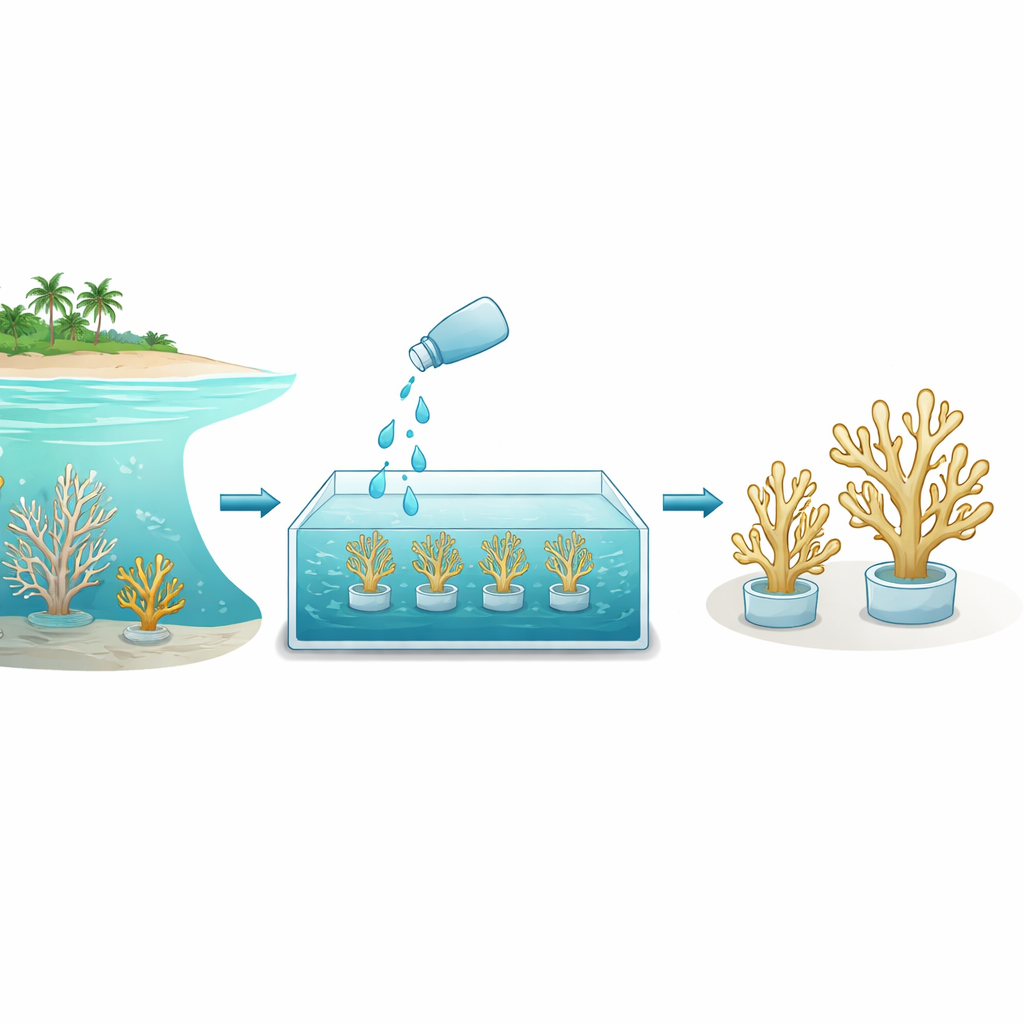
A Simple Idea From Home Aquariums
Many reef keepers who maintain saltwater aquariums routinely adjust a property of the water called alkalinity, which helps corals build their hard skeletons. Alkalinity reflects the amount of certain dissolved particles that corals use as building blocks for calcium carbonate, the mineral that forms their stony framework. Hobbyists have long noticed that corals often grow better when alkalinity is kept slightly higher than in the open ocean, but this has not been rigorously tested for Caribbean species that are central to restoration. The researchers set out to test whether boosting alkalinity in carefully controlled tanks could speed up the growth of A. cervicornis, and whether that growth came in the form of longer branches, denser skeletons, or both.
Testing Coral Growth in Enriched Water
The team collected forty small, single-branch fragments of A. cervicornis from an offshore nursery and moved them to a land-based lab. Each fragment was placed in its own small beaker within temperature-controlled tanks and fed regularly, mimicking conditions in coral farms. Using an automated system, the scientists supplied plain seawater to some beakers and seawater enriched with a baking-soda-and-soda-ash solution to others, creating four levels of alkalinity from natural to strongly elevated. Over 33 days, they weighed the corals in water to track how much skeleton they added and used standardized photographs to measure how far each branch tip extended.
Stronger Skeletons and Early Growth Spurts
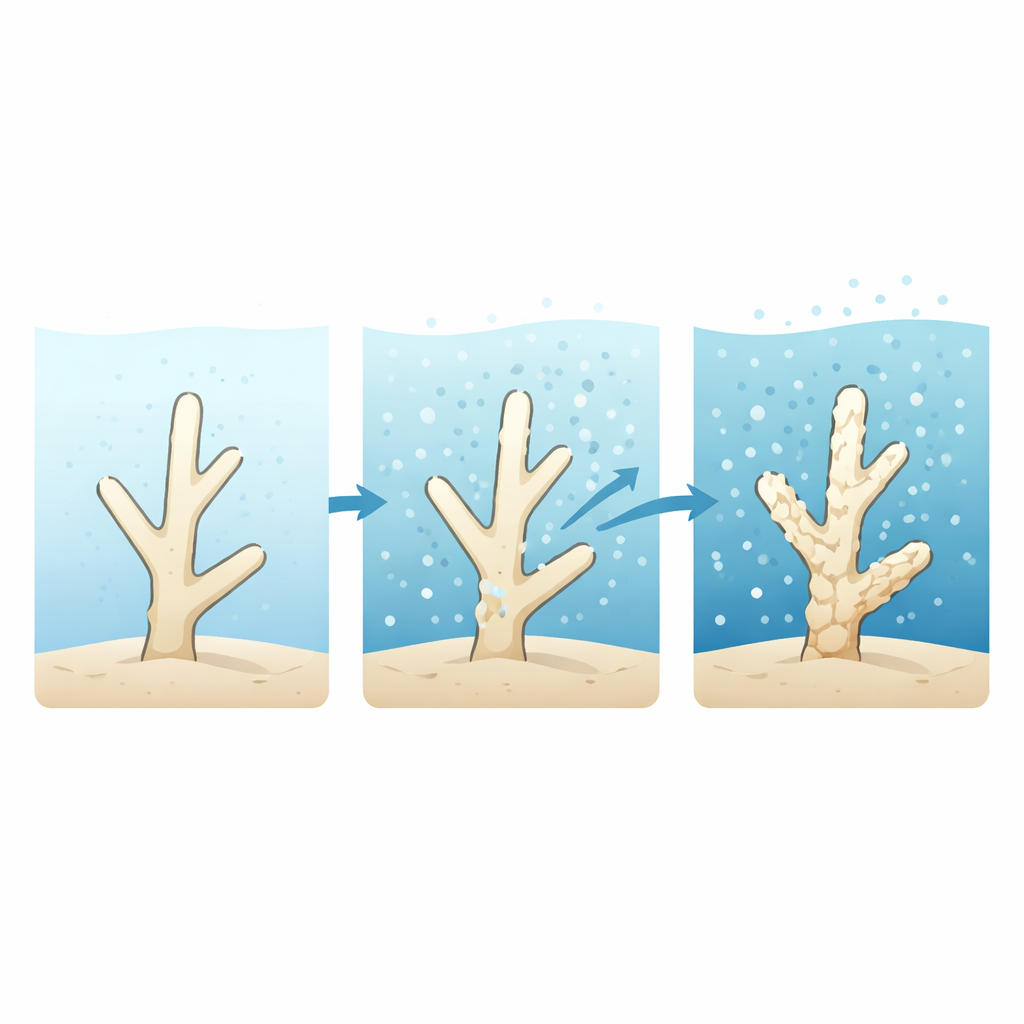
Raising alkalinity had a striking effect on how much skeleton the corals produced. Across the enriched treatments, total calcification—how much solid material was laid down—more than doubled compared with corals kept in normal seawater, with the biggest increase reaching about 125 percent. That boost appeared to level off once alkalinity was roughly one-and-a-half to just under twice typical seawater values, suggesting there is a practical “sweet spot” beyond which extra enrichment brings little additional benefit. Branch length also grew faster at first: during the first half of the experiment, corals in the highest alkalinity treatment extended their branches by up to 98 percent more than those in normal water. However, after about three weeks, branch extension slowed almost to a halt in all groups, likely because of other limitations in the tank system, even though corals continued to add mass to their skeletons.
What This Means for Coral Nurseries
The study showed that corals could safely handle these higher alkalinity levels without obvious signs of stress. The animals kept their color, survival remained high, and a key measure of their internal algae’s photosynthetic health did not differ between treatments. Even when branch length gains faded later in the trial, corals in enriched water still built more skeleton overall, which could mean thicker or denser branches. For restoration programs, that could translate into sturdier corals that better resist storms and breakage, or into a greater volume of material that can be cut into new fragments. Importantly, the enrichment was achieved using inexpensive, widely available salts, pointing toward a relatively low-cost strategy that could be adopted by many land-based coral nurseries.
A Practical Tool With Wider Implications
For a layperson, the take-home message is that a common aquarium practice—raising alkalinity—can significantly speed up coral skeleton formation for a threatened Caribbean species, at least over weeks to months. Used thoughtfully, this approach could help nurseries grow more and stronger coral fragments in less time, improving the odds that restoration efforts keep pace with reef decline. The results also offer a window into how future, large-scale attempts to increase the ocean’s alkalinity to absorb more carbon dioxide might affect coral reefs: at levels similar to those tested here, corals like A. cervicornis may actually build skeleton faster, rather than suffer. Together, these findings suggest that careful management of seawater chemistry is a promising, practical lever for helping reefs recover.
Citation: Cooke, K.M., Palacio-Castro, A.M., Boyd, A. et al. Alkalinity enrichment stimulates calcification and linear extension in Acropora cervicornis. Sci Rep 16, 14512 (2026). https://doi.org/10.1038/s41598-026-44817-6
Keywords: coral restoration, reef aquaculture, seawater alkalinity, coral calcification, Acropora cervicornis