Clear Sky Science · en
Influence of navier-slip boundary conditions, magnetic field, and porous medium on the stability of two-dimensional channel flow
Why tiny slips at walls matter
From cooling the electronics in our devices to cleaning water in filters, engineers often send fluids through narrow channels packed with porous materials. Whether that flow stays smooth or turns chaotic can make the difference between efficient, predictable systems and wasteful, unstable ones. This study asks a subtle but powerful question: how do tiny "slips" of fluid along the walls, together with a magnetic field and the drag from a porous filling, work together to keep such flows stable or push them toward turbulence?
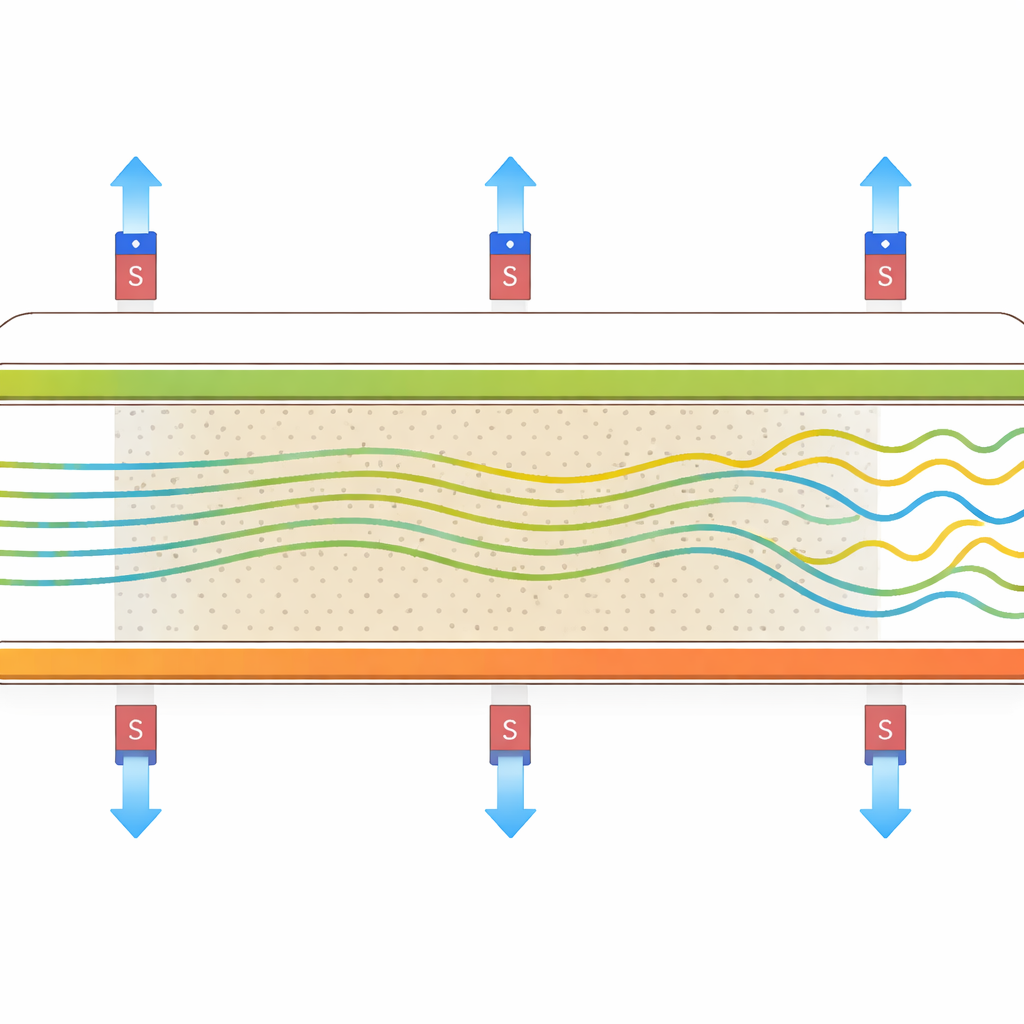
Flows in narrow, crowded passages
The researchers focus on liquid moving through a flat channel whose interior is filled with a uniform porous material, something like a very fine sponge. A pressure difference drives the fluid along the channel, while a magnetic field is applied across it, straight through the walls. This configuration is common in technologies that handle electrically conducting fluids, such as liquid-metal cooling systems, magnetohydrodynamic (MHD) generators, and some microfluidic devices. The central issue is whether small disturbances in the flow remain harmless ripples or grow into large, energy-wasting motions.
When walls let the fluid slip
Textbook fluid mechanics assumes that the fluid molecules in contact with a wall are locked in place: a "no-slip" condition. But at very small scales, or on specially coated or textured surfaces, this breaks down. The wall can behave more like a smooth conveyor belt, allowing the fluid to slide past with a finite tangential speed, a behavior known as slip. The team explores several realistic possibilities: both walls slipping by the same amount (symmetric slip), only one wall slipping (asymmetric slip), or each wall having a different slip property. These scenarios mimic coated or patterned surfaces used in modern microfluidics and energy devices.
Probing stability with mathematics
To test how these ingredients affect stability, the authors build a mathematical model of the flow and its tiny disturbances. They start from standard equations for viscous fluids and include terms for the resistance of the porous matrix and the braking effect of the magnetic field. The resulting “base” velocity profile depends sensitively on how much the walls allow slip. They then linearize the equations around this base state to obtain a stability equation that predicts whether small waves in the flow grow or decay over time. This equation is solved numerically using a powerful technique called the Chebyshev spectral collocation method, which represents the solution in terms of smooth basis functions and delivers highly accurate eigenvalues—numbers that reveal the growth rates and speeds of disturbance waves.
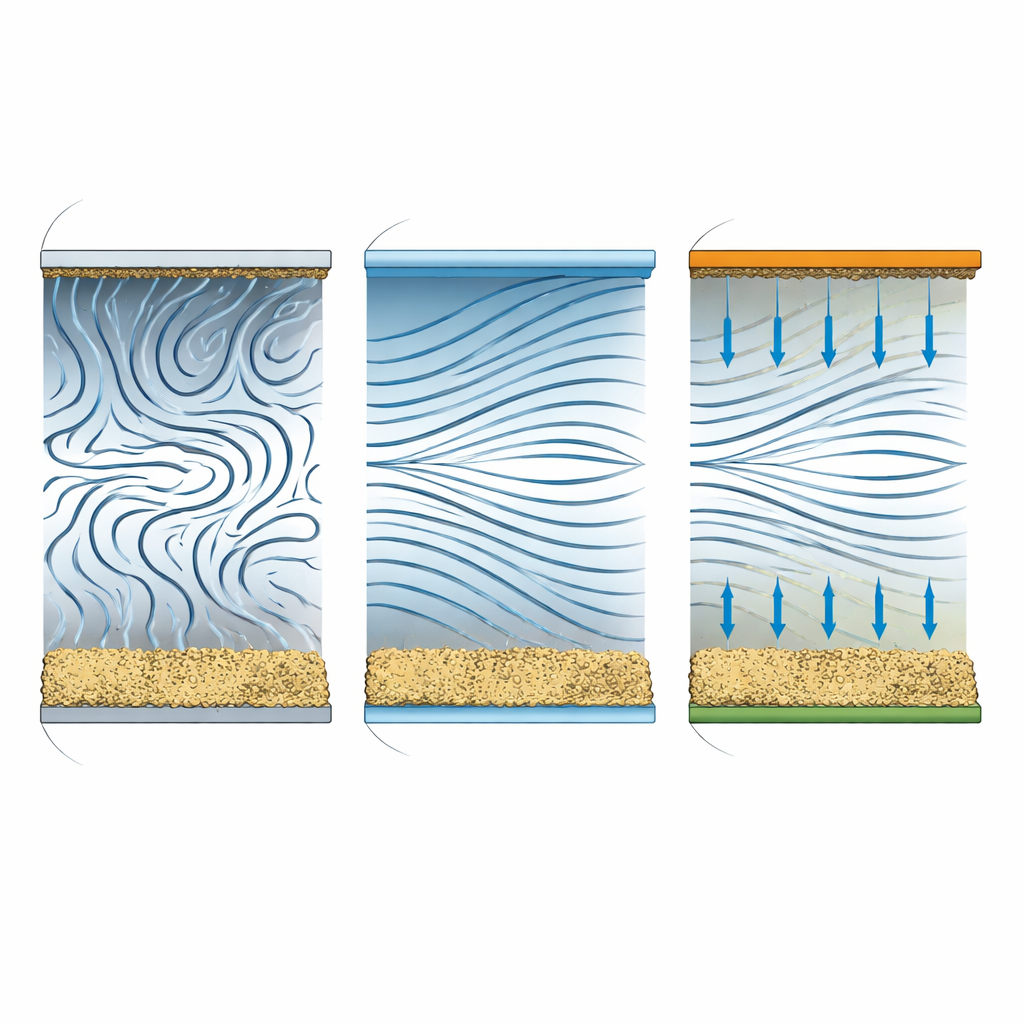
How slip, drag, and magnetism compete
The calculations show that wall conditions are not a minor detail: they strongly reshape both the velocity profile and the onset of instability. Allowing equal slip on both walls flattens the profile and lowers the friction at the boundaries, which sounds good for reducing drag but actually makes the flow more prone to instability. In fact, symmetric slip can reduce wall shear stress by 20–30 percent while lowering the threshold at which disturbances start to grow. By contrast, introducing a porous medium and a transverse magnetic field both tend to stabilize the flow. The porous matrix increases drag throughout the channel, and the magnetic field damps motion of the conducting fluid, effectively raising the critical flow speed needed for instability.
Asymmetry as a stabilizing design tool
An intriguing finding is that treating the two walls differently can improve stability. When slip is applied at only one wall, or when the slip lengths at the two walls are unequal, the flow profile becomes asymmetric, but the growth of disturbances is actually suppressed. In these cases, combined with the drag of the porous matrix and magnetic damping, the system requires much higher flow rates before any linear instability appears. This overturns the simple idea that “more slip is always more dangerous” and shows that carefully patterned wall properties can be used as a design knob for flow control.
Implications for cleaner and smarter technologies
In plain terms, the study finds that smooth, slippery walls are a double-edged sword: they can cut friction but may also invite instability if used symmetrically. Adding a porous structure and applying a magnetic field help to calm the flow, and deliberately making the two walls behave differently can further enhance stability. These insights give designers of MHD energy systems, microfluidic chips, filters, and cooling channels a roadmap for balancing efficiency and reliability. By engineering how fluids slip at boundaries and how they interact with porous materials and magnetic fields, we can build more stable, energy-efficient, and environmentally friendly flow systems.
Citation: P, P.A., Katagi, N.N., Bhat, A. et al. Influence of navier-slip boundary conditions, magnetic field, and porous medium on the stability of two-dimensional channel flow. Sci Rep 16, 14251 (2026). https://doi.org/10.1038/s41598-026-44816-7
Keywords: channel flow stability, slip boundary conditions, magnetohydrodynamics, porous media flow, energy-efficient fluid systems