Clear Sky Science · en
Factors associated with occupational calling among psychiatric nurses: a Bayesian network model analysis
Why this study matters for mental health care
Psychiatric nurses are on the front lines of mental health care, spending long hours with people in deep distress while managing safety risks and emotional strain. Whether they see their work as a meaningful “calling” can shape how well they cope, how long they stay in their jobs, and the quality of care they provide. This study asks a deceptively simple question: what helps or harms that sense of calling for psychiatric nurses, and how do those influences link together?

Looking at the web around nurses’ sense of purpose
The researchers surveyed 216 psychiatric nurses in a large hospital in southwest China. Each nurse answered questions about their sense of calling, how involved they felt in their work, how strongly they identified as a professional nurse, and how much their job clashed with family life. The team also collected basic background information such as education level, job position, professional title, and employment type (permanent or contract). Instead of looking at these factors one by one, the researchers used modern statistical tools to see which ones really mattered and how they fit together in a network of influences.
From long lists of factors to the key players
First, the team used a screening method called LASSO regression to sift through twelve possible influences at once. This method gradually shrinks weak links toward zero, leaving the most important ones standing. It highlighted seven factors connected with nurses’ sense of calling: education level, job position, professional title, employment type, job involvement, professional identity, and work–family conflict. Among these, professional identity—how proud and committed nurses felt to their profession—was most strongly tied to feeling that nursing is a meaningful life mission. Job involvement also showed a solid positive connection, while work–family conflict was consistently linked to a weaker sense of calling.
A network view of how these factors interact
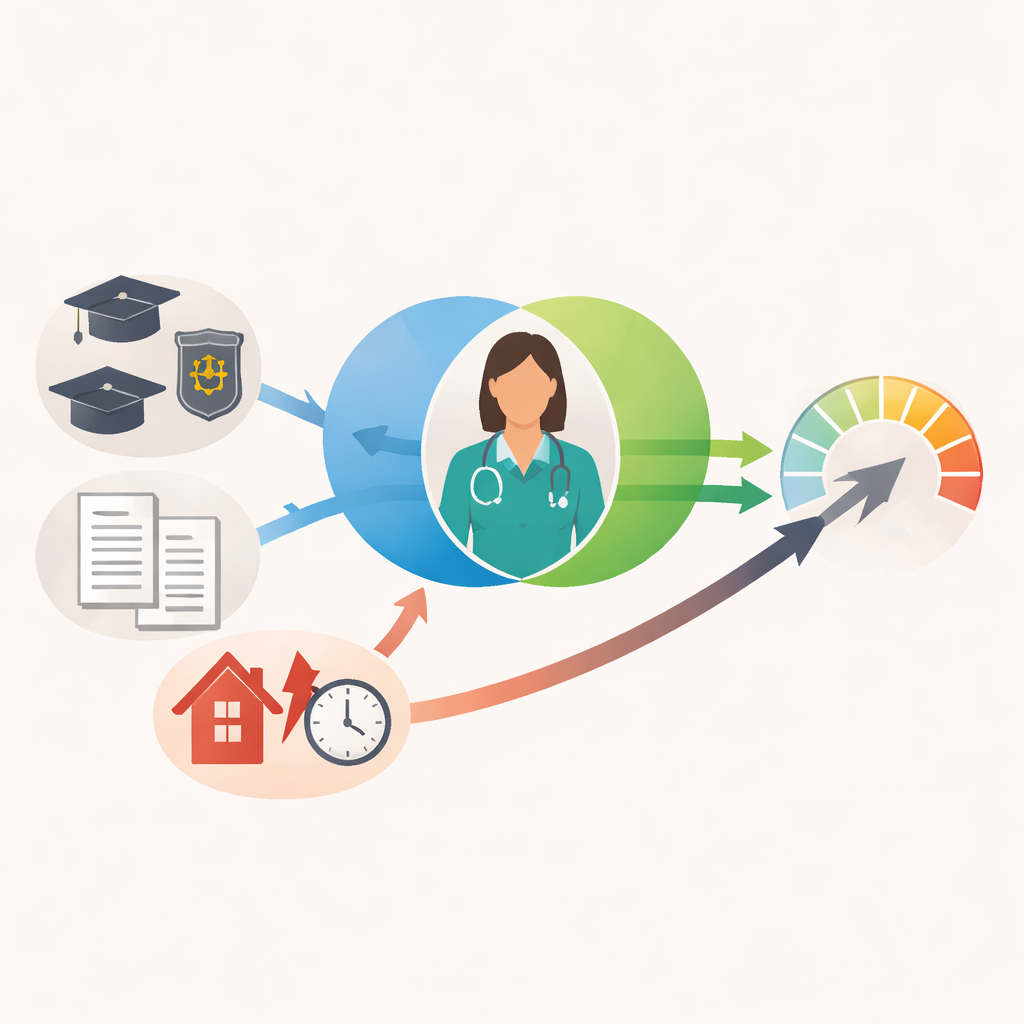
Next, the researchers built a Bayesian network, a kind of map that shows how different factors are probabilistically linked. In this map, job position, professional title, job involvement, professional identity, and work–family conflict all had direct paths to occupational calling. Education and employment type mattered too, but more indirectly: higher education mainly influenced calling through its impact on professional identity, and employment type worked through job involvement. A stability check using repeated resampling showed that the tightest, most reliable cluster in the network centered on professional identity, job involvement, work–family conflict, and calling itself—suggesting that these psychological and work–life experiences are more central than basic demographic details.
Who is at greater risk of losing their sense of calling?
By feeding different combinations of factors into the network, the team estimated the probability that a nurse would report a low sense of calling. Staff nurses with heavy work–family conflicts had a notably high chance of low calling compared with team leaders and head nurses. Nurses with lower professional identity or low job involvement were also much more likely to feel that their work lacked deeper meaning. Certain groups appeared especially vulnerable: contract-based staff, junior-title nurses, and those with higher education levels who may face high expectations but limited recognition. These patterns point to specific frontline groups who may need extra attention and support.
What this means for supporting psychiatric nurses
In plain terms, this study shows that psychiatric nurses’ sense of calling is not a fixed personal trait but a product of workplace realities and how those realities are experienced. Feeling respected as a professional, being deeply engaged in the work, and having manageable tensions between job and home life all nurture a stronger sense of purpose. In contrast, persistent work–family conflict and weak recognition of professional value can quietly erode it. The authors argue that hospital leaders can strengthen nurses’ calling—and thereby improve care quality and staff stability—by fostering professional identity, supporting meaningful job involvement, easing work–family strain, and paying special attention to contract staff, junior-title nurses, and highly educated nurses who may be underused or overstressed.
Citation: Ai, Y., Liao, Q. & Shen, X. Factors associated with occupational calling among psychiatric nurses: a Bayesian network model analysis. Sci Rep 16, 13960 (2026). https://doi.org/10.1038/s41598-026-44809-6
Keywords: psychiatric nursing, occupational calling, professional identity, job involvement, work–family conflict