Clear Sky Science · en
Integrated approach for edge coverage enhancement based on IRS phase shift control and AP selection in dense user communication system
Bringing Strong Signals to the Network’s Edge
Anyone who has watched a video freeze at the edge of town or lost a call in a crowded area has experienced the limits of today’s wireless networks. As we move toward smarter cities packed with connected cars, cameras, and sensors, these weak spots become more than annoyances—they can affect safety and traffic flow. This paper explores a new way to reshape the airwaves themselves so that high‑speed, reliable coverage reaches even the hard‑to‑serve corners of the network while using energy more efficiently. 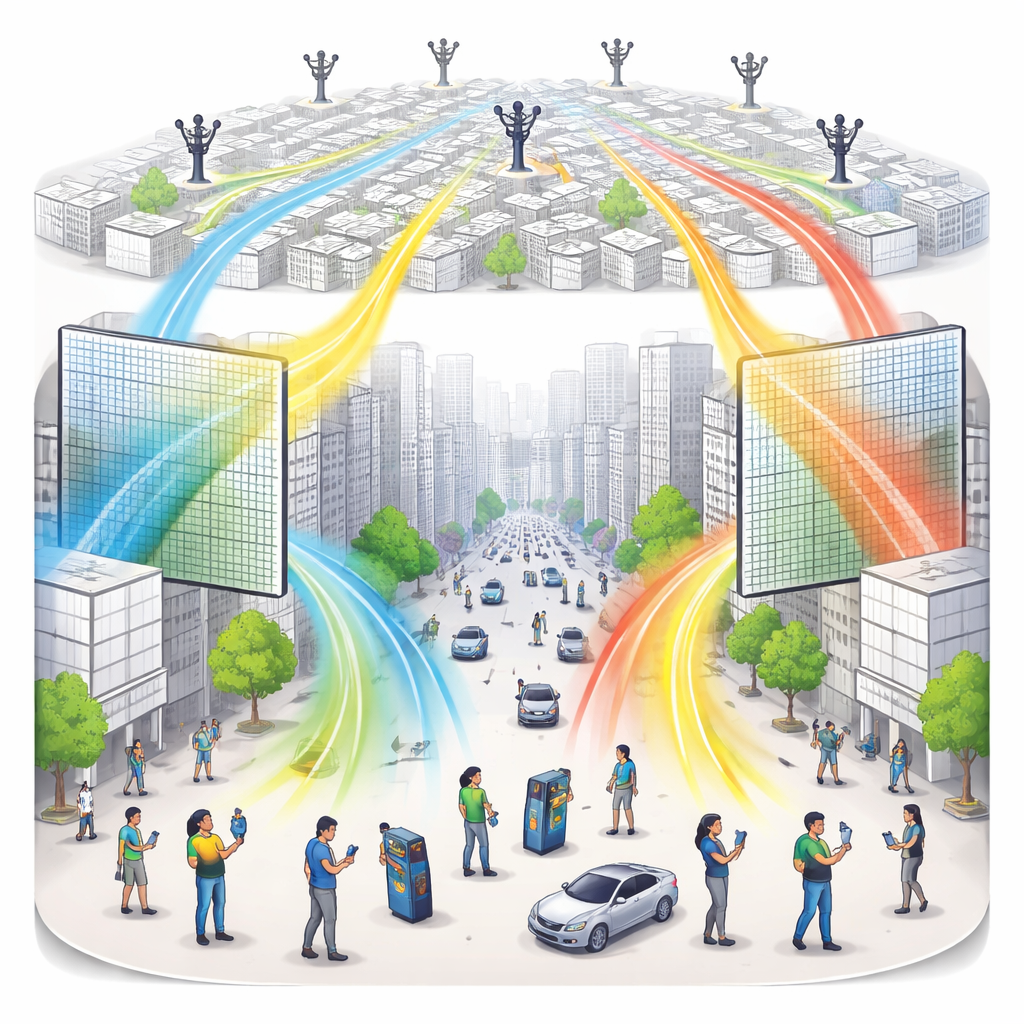
Why Today’s Networks Fall Short
Conventional cellular systems are built around fixed “cells,” each served by a base station. Users near the center of a cell usually enjoy strong connections, while those at the edges wrestle with fading signals and interference from neighboring cells. As user numbers soar, especially in dense urban or roadside environments, operators must pour in more power and hardware just to keep up. This approach is costly, power‑hungry, and still leaves “blind” zones where buildings, vehicles, or terrain block the signal.
Reshaping the Air with Smart Surfaces and Shared Antennas
The authors combine three emerging ideas to tackle these problems at once. First, instead of a few powerful towers, they use many small access points spread across an area in a “cell‑free” fashion. All of these points cooperate to serve every user, so there are no hard cell borders and fewer edge users are left behind. Second, they add intelligent reflecting surfaces—flat panels made of many tiny elements that can be tuned to bounce radio waves in chosen directions, like adjustable mirrors for wireless signals. Mounted on building walls or poles, these panels can redirect signals around obstacles to light up dead zones without transmitting any power of their own. Third, they use a sharing method called power‑domain multiplexing, where users share the same time and frequency but receive different power levels so that strong users can peel off interference and weaker users still get a fair slice of capacity.
Fine‑Tuning Reflections and Picking the Right Helpers
To unlock the full benefit of these smart surfaces, the phases of the reflected waves must be carefully coordinated so that signals add up rather than cancel out. The paper studies two mathematical strategies for choosing these phase settings. One, called alternating optimization, tweaks each reflecting element step by step and converges quickly with modest computational cost, though it finds only a local best solution. The other, based on semidefinite relaxation, frames the task as a more complex but globally optimized problem on a relaxed version of the system. While this second method can, in theory, approach the best possible performance, it is far more computationally demanding and does not scale well when the reflecting panels become large. Simulations show that the simpler method actually delivers higher data rates in practice for the scenarios considered, because it converges faster and is easier to implement.
Smarter Use of Access Points and Power
Beyond steering reflections, the authors design an access point selection algorithm that decides which small base stations should actually serve each user. Instead of having every point talk to everyone—wasting power and creating unnecessary interference—the algorithm picks a subset of helpers for each user based on long‑term channel strength and pairing rules that favor effective sharing. 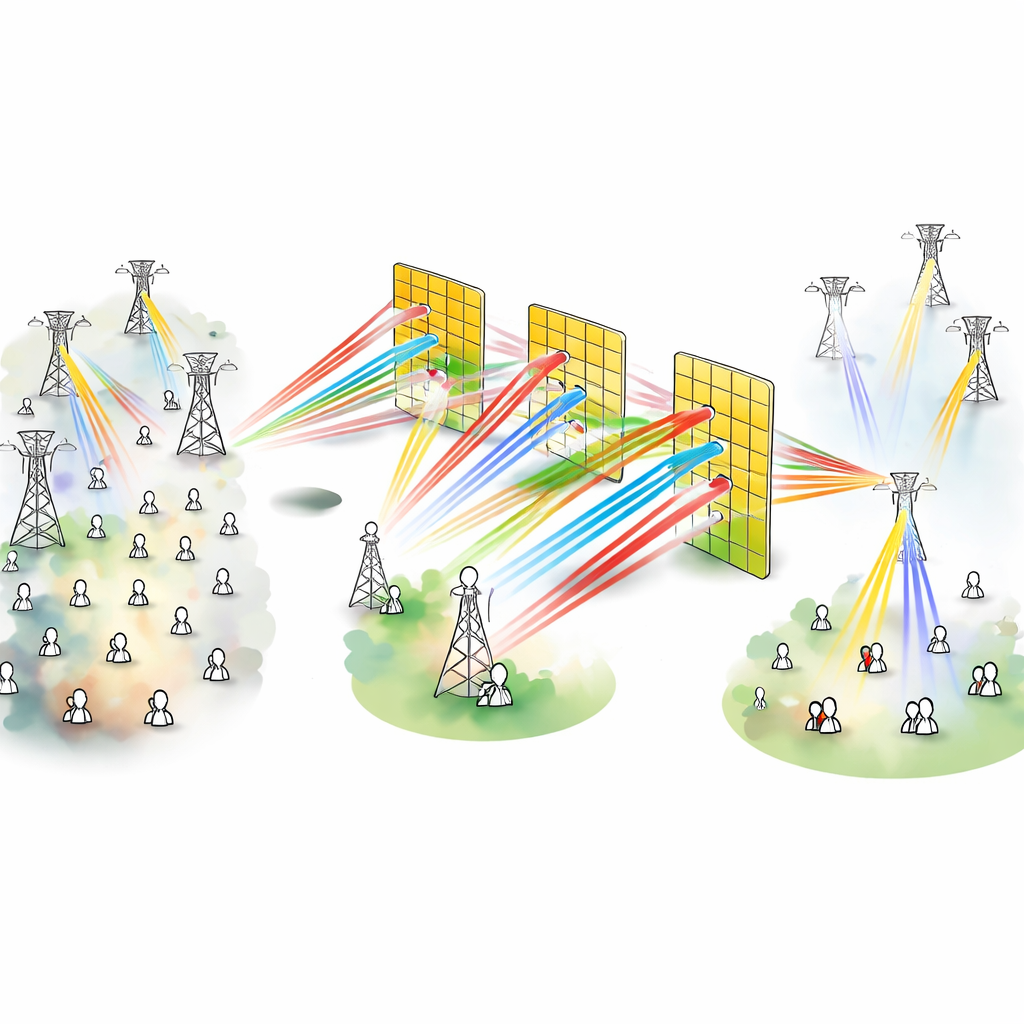
From Equations to Smarter Roads
To illustrate how this plays out in the real world, the paper envisions a busy highway lined with cameras, roadside units, and drones watching traffic from above. Distributed access points along the road and intelligent reflecting panels on signs or lamp posts keep vehicles and sensors connected, even in curved sections or under overpasses where signals would normally fade. Multiple users and sensors can share the same bandwidth with carefully chosen power levels, and emergency vehicles can be favored when needed. Compared with a traditional massive antenna system, the proposed design delivers markedly higher data rates—especially for vehicles at the edges of coverage—without simply cranking up transmit power.
What This Means for Everyday Connectivity
In simple terms, this work shows how a network can stop treating the environment as an obstacle and start using it as a tool. By spreading out smaller antennas, adding steerable reflective panels, and intelligently choosing which transmitters and power levels to use, the system fills in weak spots and serves more users with less wasted energy. While challenges remain—such as the need for accurate channel information and the complexity of controlling many devices—the approach points toward future 5G‑and‑beyond systems that feel more uniform to users: fast, stable connections whether you are at the heart of the network or right at its edge.
Citation: Shrivastava, S., Taneja, A., Alqahtani, N. et al. Integrated approach for edge coverage enhancement based on IRS phase shift control and AP selection in dense user communication system. Sci Rep 16, 14339 (2026). https://doi.org/10.1038/s41598-026-44807-8
Keywords: cell-free massive MIMO, intelligent reflecting surface, non-orthogonal multiple access, edge coverage, wireless energy efficiency