Clear Sky Science · en
Automated detection of physical contact events in youth ice hockey: a player-centric deep learning approach
Why this matters for young players
Parents, coaches, and leagues worry about the hidden toll of hard hits in youth ice hockey, but it is unrealistic to have experts watching every second of every game. This study shows how ordinary game video can be turned into an automated helper that spots moments of physical contact, making it faster to find possible head impacts and opening the door to better injury tracking in community rinks.
The problem of unseen hits
Ice hockey is full of collisions, from routine bumps to big crashes into the boards. Many of these hits never lead to obvious symptoms, yet repeated impacts may still affect the brain over time. Youth players are thought to be especially vulnerable because their bodies and balance are still developing and because community leagues rarely have the medical staff, sensors, and specialized tools used in professional arenas. Today, building a high quality record of when and how kids are hit typically means watching hours of video by hand, a time consuming task that is hard to scale beyond a handful of teams.
Turning raw video into player stories
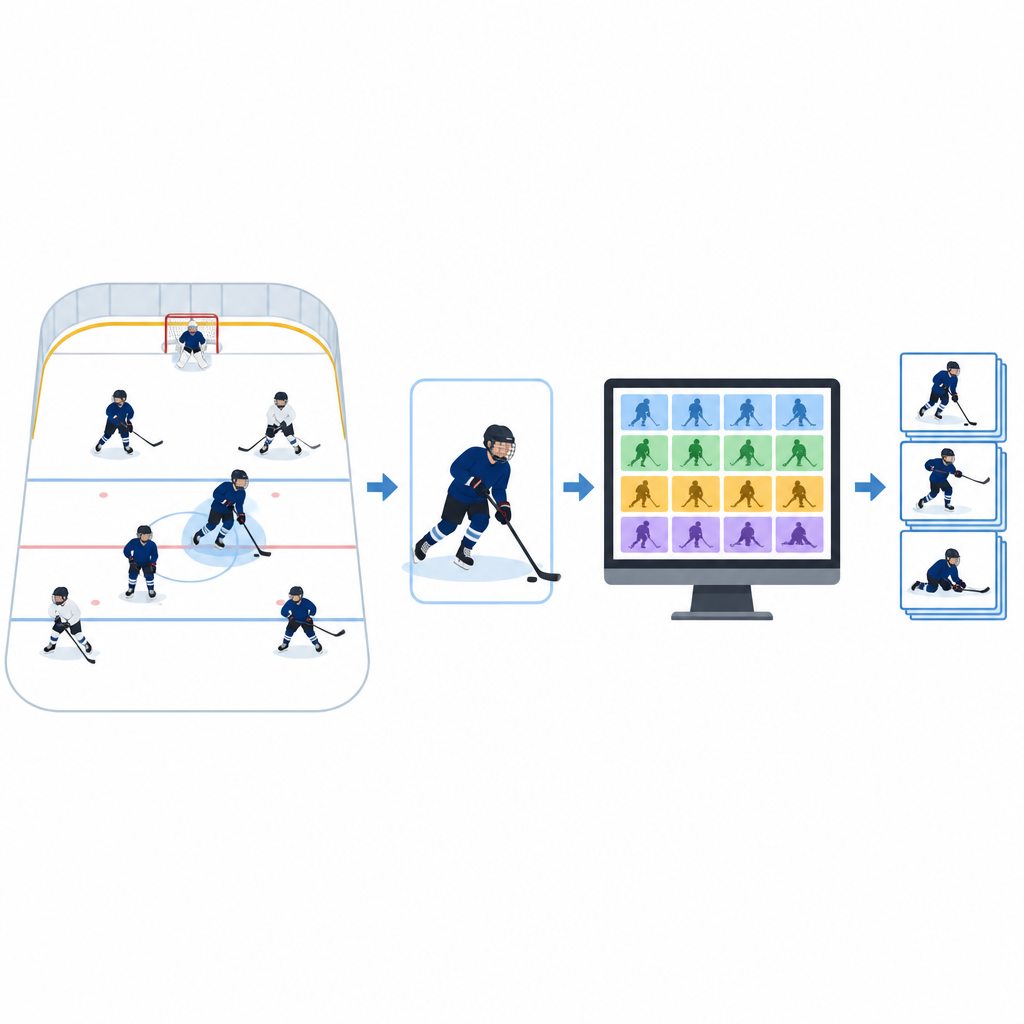
The researchers designed a pipeline that takes a single standard game video and converts it into short, player focused clips that can be labeled as contact or non contact. First, a computer vision system trained specifically on youth hockey detects every skater, goalie, and referee in each frame. A tracking step then links those detections over time so that the system can follow each player even when they cross paths or briefly pass behind someone else. When the tracker loses sight of a player for a moment, the software fills small gaps and smooths the path so the bounding box around that player stays stable from frame to frame.
Teaching the system what a hit looks like
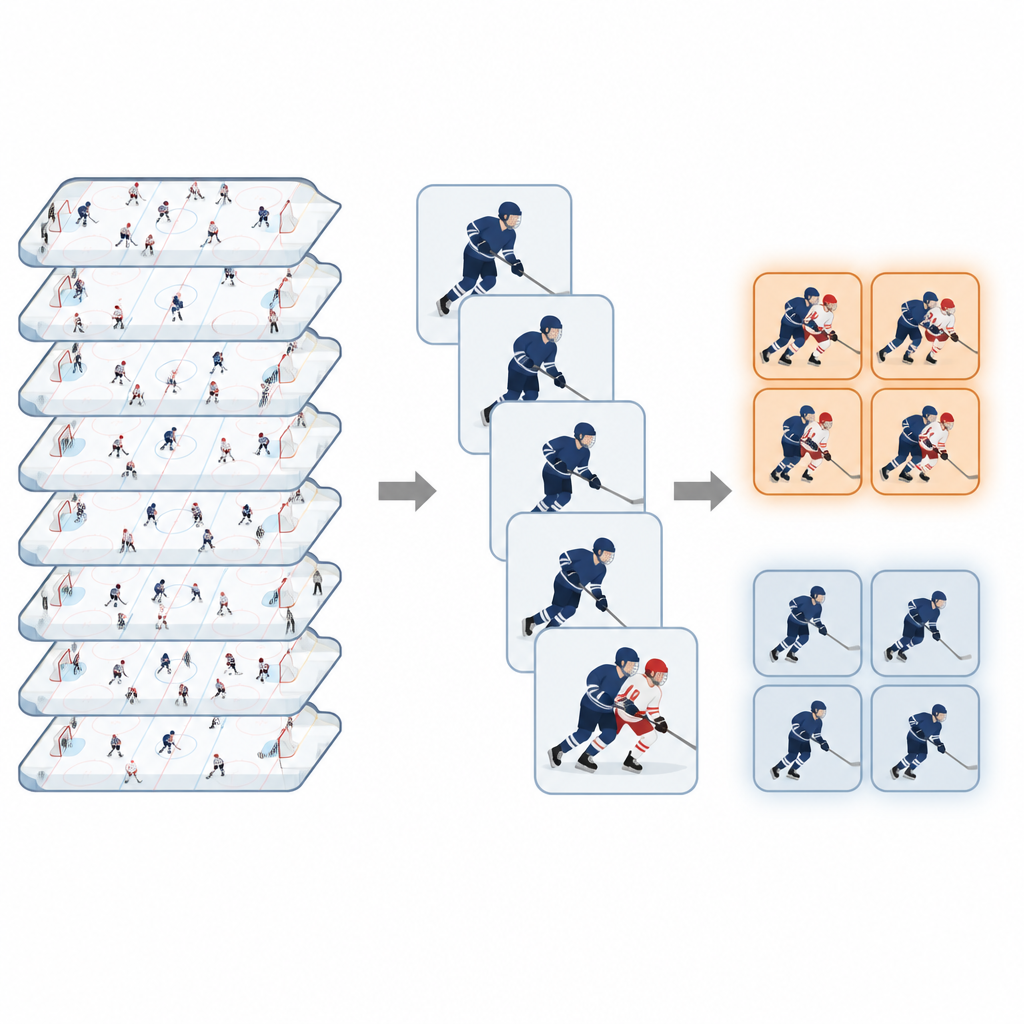
To train the contact detector, the team manually reviewed 20 youth games from different age groups and carefully marked 1,467 clear contact events such as strong player to player collisions, hard falls onto the ice, and visible impacts with the boards, glass, stick, or puck. Around each event, they cut out a one second window of video centered on the hit, zoomed in on the involved player, and reduced the clip to 30 evenly spaced frames. They also sampled many one second clips from normal play where no contact had been marked. These examples were used to train a deep learning model that learns motion patterns over time, with experiments showing that a moderately enlarged crop around the player captures enough context to see the interaction without being distracted by background clutter.
How well the approach works in real games
Once the best configuration was found, the researchers tested it on full, unedited recordings of two new Under 13 games. The system divided each game into one second chunks, detected and tracked every player, built a clip for each tracked player, and classified each clip as contact or non contact. In this realistic setting, true contact moments were rare compared with routine skating, yet the model still performed far better than random guessing. At a standard decision setting, it caught most contact clips while keeping mistaken flags relatively low. Crucially for head injury work, when the team separately annotated all head impacts in these two games, 19 out of 22 were found inside clips the system had marked as contact, cutting expert review time from more than three hours per game to under thirty minutes.
What this means for safer youth hockey
For families and leagues who already record games, this kind of AI assistant could turn everyday video into a useful safety tool. Instead of asking staff to scan entire games in search of a handful of concerning plays, the system highlights a manageable set of short clips where meaningful contact likely occurred. Analysts can then focus their attention where it is needed most, refine head impact counts, and start to understand how often and in what situations young players experience collisions. While the method does not diagnose concussions or pinpoint exact injury mechanics, it provides a scalable way to monitor contact exposure in youth hockey and lays groundwork for data informed decisions about rules, coaching, and protective gear.
Citation: Azadi, A., Dehghan, P., Hussein, R.M.A.H. et al. Automated detection of physical contact events in youth ice hockey: a player-centric deep learning approach. Sci Rep 16, 14908 (2026). https://doi.org/10.1038/s41598-026-44805-w
Keywords: youth ice hockey, head impacts, sports video analysis, injury surveillance, deep learning