Clear Sky Science · en
Material and fabrication factors governing rice seedling growth in seed rope direct seeding systems
Why rice farmers might care about seed ropes
Rice farmers around the world are eager for methods that save water and labour without sacrificing yield. This study looks at an emerging approach called seed rope direct seeding, where rice seeds are embedded in a biodegradable ribbon instead of being scattered or transplanted by hand. By testing different rope materials and how tightly they are twisted, the researchers explore how to keep sowing simple for machines while still giving young rice plants a healthy start.
How seed ropes change the way rice is planted
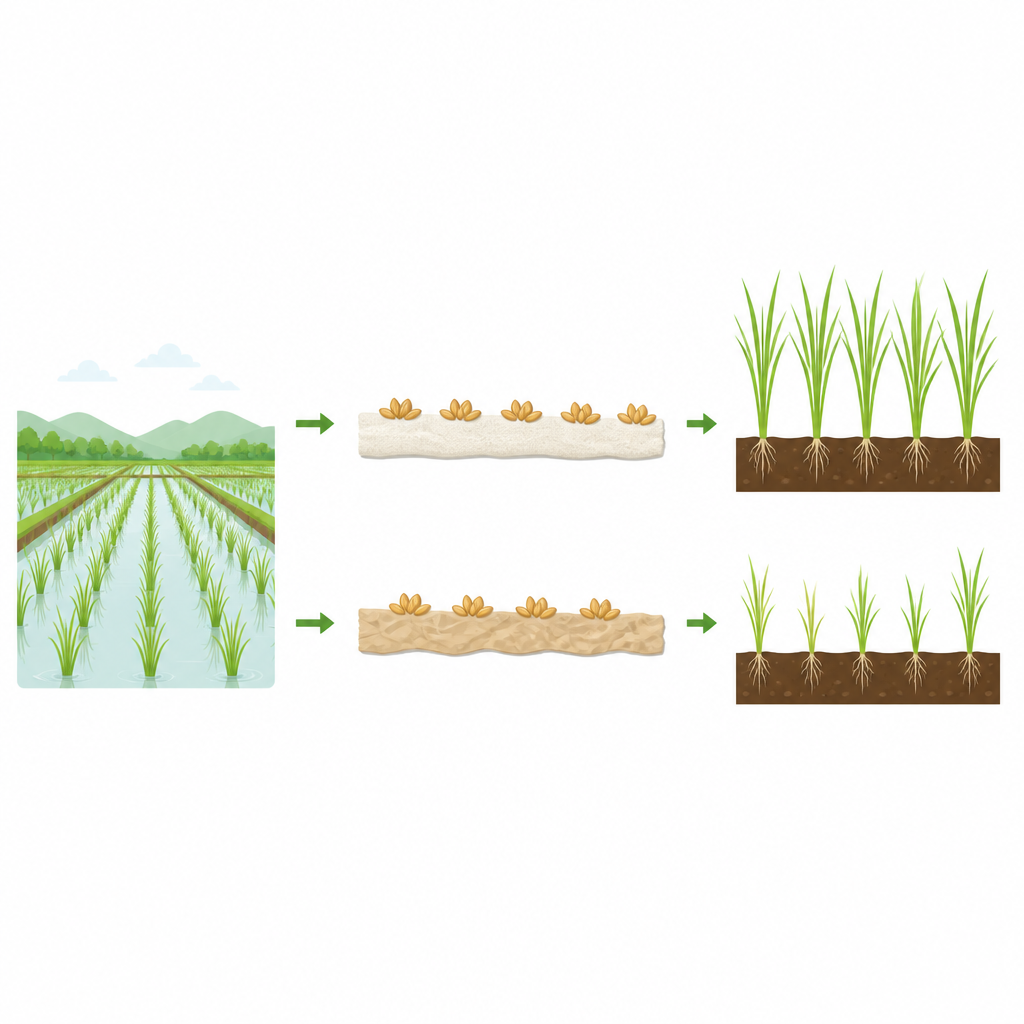
Traditional transplanting of rice seedlings is time consuming and uses large amounts of water. Direct seeding avoids some of this effort but can suffer from uneven spacing, bird damage and machine limits at high speed. Seed ropes offer a middle path. Seeds are fixed at regular intervals along a strip that can be unrolled by a planter, keeping hill spacing consistent and protecting seeds from pests. The authors focus on two common wrapping materials, a polylactic acid nonwoven fabric and an agricultural wrinkled paper, and ask how each one affects the first weeks of seedling growth.
Testing fabric and paper ropes in pots
To compare options, the team grew rice in pots under three conditions: ordinary direct seeding without ropes, seed ropes made from polylactic nonwoven fabric, and seed ropes made from wrinkled paper. In the ropes, seeds were clustered into small hills, and the strips were twisted to different degrees, from slightly twisted to quite tight. Over several weeks they tracked how many seeds emerged, how tall the seedlings grew, and how their roots developed. They also measured how strong and puncture resistant the materials were, and how well they held heat and moisture around the seeds.
What happened to seedling shoots and roots
Fabric seed ropes produced seedling emergence and height very similar to normal direct seeding across all twist levels. On average, fabric treatments were only slightly below the control in emergence and often matched it in shoot height, suggesting that this material does not greatly hinder young plants. Paper ropes told a different story. When the paper strips were only gently twisted, seedlings emerged and grew almost as well as the control. As the twisting became tighter, emergence rates dropped, plants grew shorter, and their roots became shorter and thicker with fewer fine branches. This pattern implies that dense, tightly wound paper creates more resistance for sprouts and roots to push through.
Inside the rope: structure, strength and the seed microclimate
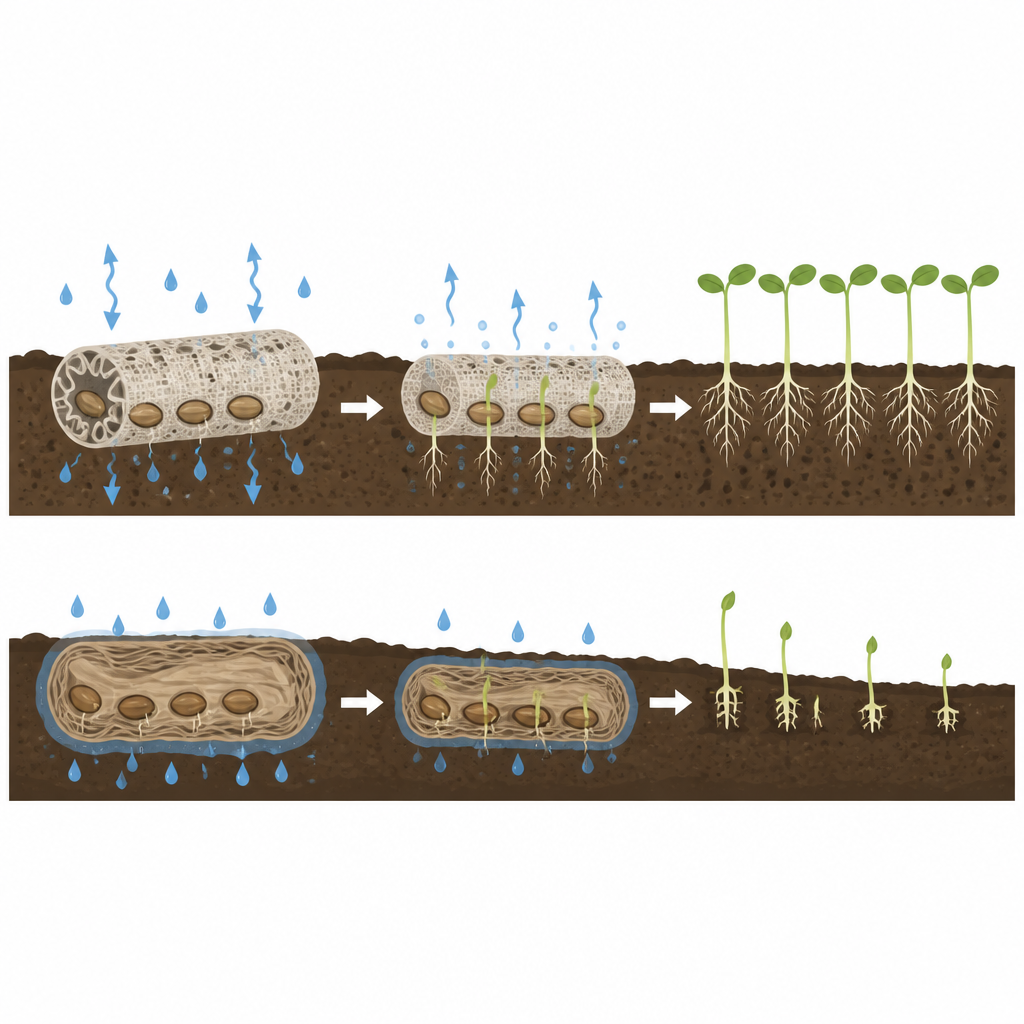
Microscope images showed that the nonwoven fabric is a loose web of fibres with many tiny gaps that let air and water move freely, while the wrinkled paper is denser and more compact. Mechanical tests confirmed that twisting makes the fabric rope stronger without greatly raising the force needed for a shoot to pierce it, which is good for machine handling. In contrast, the paper rope became mechanically weaker as twisting increased but still formed tighter layers around the seeds. Sensors placed beside the seeds revealed that both rope types slightly warmed and moistened the seed zone compared with bare soil, with paper holding the most moisture and a bit more heat. However, in tightly twisted paper ropes, this extra water came at the cost of poorer air flow and less oxygen for germinating seeds.
What this means for future rice fields
For growers and equipment designers, the take home message is that seed ropes can work for rice, but the choice of material and its twisting matters. Polylactic nonwoven fabric supports seedling growth about as well as normal direct seeding while adding benefits such as regular spacing, good rope strength for machines and modest protection from temperature and humidity swings. Wrinkled paper may be useful at low twisting levels but tends to restrict growth when wrapped too tightly. Overall, the study supports seed rope direct seeding as a practical path toward more precise, less labour intensive rice planting, with soft, breathable fabric ropes emerging as the most farmer friendly option.
Citation: Liu, D., Yang, B., Cao, Y. et al. Material and fabrication factors governing rice seedling growth in seed rope direct seeding systems. Sci Rep 16, 14937 (2026). https://doi.org/10.1038/s41598-026-44788-8
Keywords: rice seeding, seed rope, direct seeding, nonwoven fabric, seedling growth