Clear Sky Science · en
Mirrorless open cavities enabled by boundary incompatibility between perfect electric conductor and perfect magnetic conductor parallel-plate waveguides
Light Trapped Without Mirrors
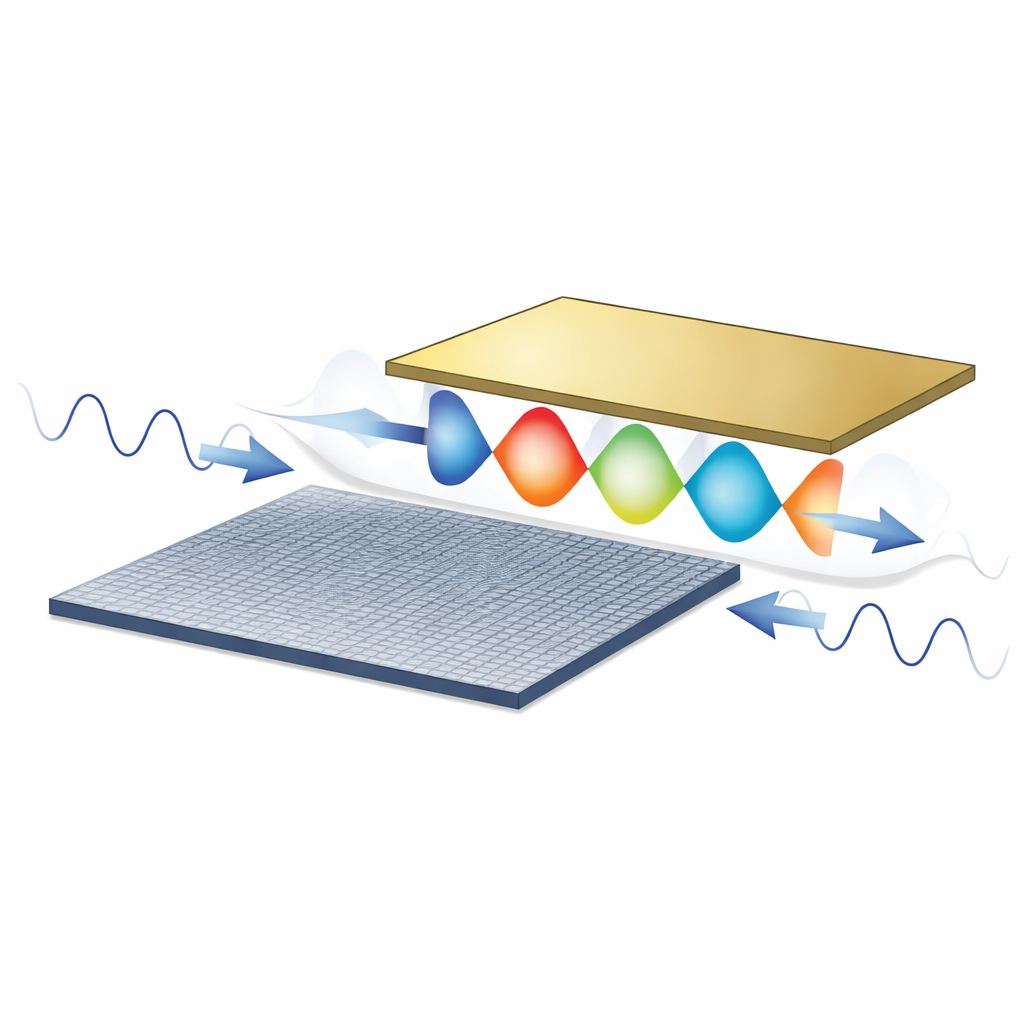
When we think about trapping light or radio waves, we usually imagine it bouncing between shiny mirrors inside a closed box. This study shows that you can confine electromagnetic waves in open space without traditional mirrors or walls at all. Instead, the authors use a clever clash of boundary conditions at specially engineered metal surfaces to build an "invisible box" where energy is tightly trapped while the surrounding space remains fully open and accessible.
How Waves Usually Get Blocked
In many modern devices, from fiber-optic networks to microwave antennas, waves are steered and confined by creating frequency regions where they simply cannot travel, known as mode gaps. Normally, these gaps come from repeating structures, carefully chosen materials, or particular shapes that make certain waves cancel themselves out. Photonic crystals, waveguides with cutoffs, and metamaterials all rely on this basic idea: sculpt the material or geometry so unwanted waves are forbidden from propagating.
A Clash at the Boundary Creates an Invisible Wall
The authors focus on a very different route to a mode gap: a mismatch in the rules that electric and magnetic fields must obey at two neighboring metal surfaces. One surface behaves like a perfect electric conductor, forcing the electric field to vanish along it; the other behaves like a perfect magnetic conductor, forcing the magnetic field to vanish. When two plate-shaped waveguides of these different types sit side by side with a small air gap between them, no simple traveling wave can satisfy both sets of rules across the junction. Below a certain frequency, transmission across that junction is blocked, and the interface acts like a “virtual wall” even though there is no physical barrier there.
Building a Mirrorless Open Cavity
To turn this invisible wall into a useful device, the team arranges metal patches of the electric-conductor type above and below a region that mimics a magnetic conductor using a patterned “artificial magnetic conductor” surface made from metallic grooves. The air gap between the patches remains physically open, but electromagnetic fields see closed boundaries formed by the virtual walls at the patch edges. Numerical simulations show that energy piles up in the air region between the patches in well-defined resonant patterns, just as in a conventional metal box, even though no solid enclosure exists. The researchers also analyze how the resonant frequency depends on the patch size and gap height and confirm excellent agreement between simple formulas and full-wave simulations.
Enhancing Tiny Magnetic Emitters
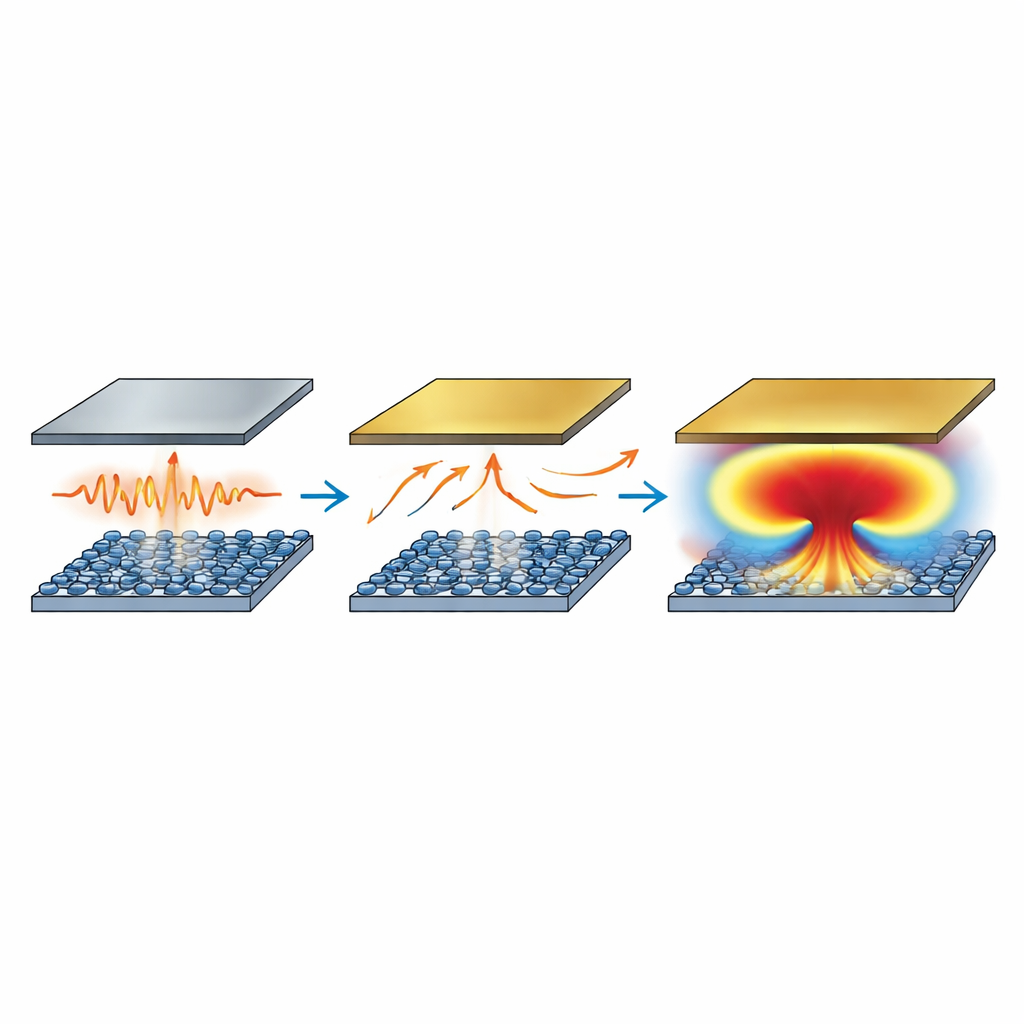
A major motivation for this design is to strengthen the interaction between confined fields and tiny magnetic sources, such as magnetic dipole transitions in atoms, quantum dots, or nanoparticles. In a good cavity, the spontaneous emission rate of such emitters can be boosted by the Purcell effect, which grows when the energy is stored for a long time (high quality factor) and compressed into a small volume. The open cavity proposed here offers both: strong localization in the air gap and, in the ideal lossless case, a quality factor that increases sharply as the gap is reduced. The authors derive simple expressions showing how the enhancement scales with cavity dimensions and confirm that, even with realistic metal and dielectric losses, the system can reach quality factors of about one hundred and magnetic-emission enhancements around a thousand.
From Ideal Theory to Real Devices
Real materials introduce resistance and absorption, which limit how long energy can circulate in the open cavity. The team studies how these losses cap the quality factor and finds that beyond a point, shrinking the gap no longer helps because material loss dominates over leakage. They also test how the cavity couples to nearby open waveguides, showing sharp transmission resonances that behave like those of standard resonator–waveguide systems, but now in a fully open geometry. Practical challenges include precisely fabricating the groove pattern that imitates a magnetic conductor and maintaining low loss as the concept is scaled from microwave to higher frequencies such as terahertz or even optical light.
Why This Matters for Future Technologies
The most striking feature of these mirrorless cavities is that nothing solid blocks access to the confined field region. Atoms, molecules, quantum dots, and even biological nanoparticles like viruses can freely enter the high-field zone and interact strongly with the trapped energy. This makes the platform especially attractive for quantum experiments, sensing, and bio-integrated devices where it is hard or impossible to place delicate samples inside a closed metal or glass box. By using boundary incompatibility rather than traditional mirrors, the work opens a new route to controlling light and other electromagnetic waves in open, accessible environments.
Citation: Kim, SH., Kee, CS. Mirrorless open cavities enabled by boundary incompatibility between perfect electric conductor and perfect magnetic conductor parallel-plate waveguides. Sci Rep 16, 14269 (2026). https://doi.org/10.1038/s41598-026-44787-9
Keywords: open electromagnetic cavities, artificial magnetic conductors, wave confinement without mirrors, Purcell enhancement, microwave photonics