Clear Sky Science · en
Remaining useful life prediction method based on gated dilation causal convolution
Why knowing machine “lifespan” matters
From jet engines to train wheels, many machines rely on small metal rings called rolling bearings to spin smoothly. When these bearings wear out unexpectedly, they can halt production lines or cause dangerous failures. Being able to estimate how much useful life a bearing has left—its remaining useful life, or RUL—lets engineers schedule maintenance before trouble strikes, saving money and improving safety. This paper presents a new way to read the subtle patterns in vibration data from bearings, using advanced neural networks, to predict how long they will keep running reliably.
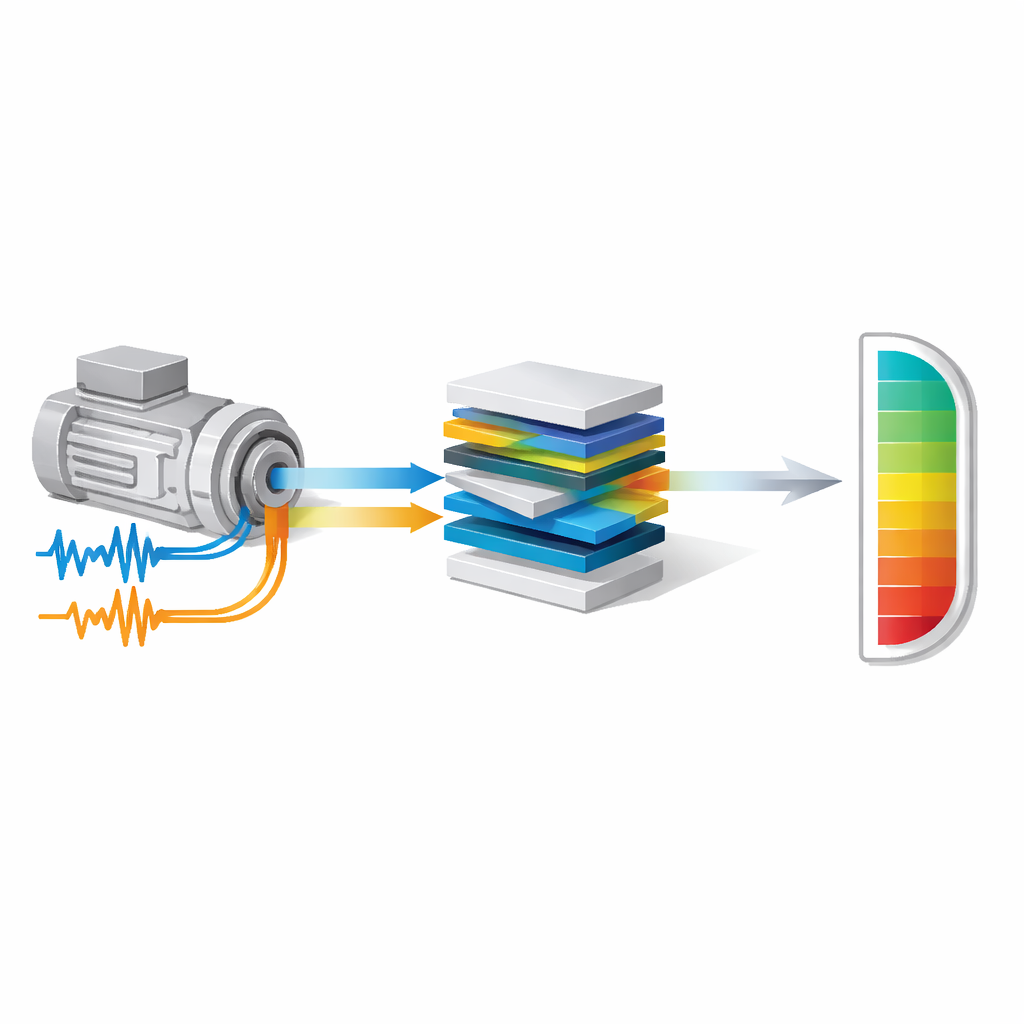
Listening to the heartbeat of a bearing
Modern machines are often fitted with sensors that continually record vibration signals as the equipment runs. For a bearing, these measurements form long, noisy time-series—like a detailed history of its “heartbeat” from birth to failure. The challenge is that real wear and crack growth in bearings is irregular and difficult to model with traditional physics alone. Instead, data-driven methods try to learn the hidden relationships directly from these sensor records, turning raw vibration into a numerical estimate of how close the bearing is to the end of its life.
Limits of older prediction tools
Earlier deep-learning approaches for RUL prediction often relied on recurrent networks, such as long short-term memory (LSTM) models, or on standard convolutional neural networks (CNNs). While LSTMs can, in principle, remember long histories, they process data step-by-step and are slow on long recordings. Classic CNNs are fast and can run in parallel, but they see only local neighborhoods unless they are stacked very deeply, which can cause training problems. Even more recent architectures that add attention mechanisms or graph structures can capture long-range effects, but they tend to be complex, computationally heavy, and require carefully designed model layouts.
A smarter way to follow change over time
The authors propose a new prediction framework that combines several ideas to better track how a bearing degrades over its full lifetime. First, they compress and fuse the raw sensor features, then pass them through a multi-scale encoding unit (MSEU). This unit looks at the data from both a close-up and a zoomed-out viewpoint, strengthening informative patterns while suppressing random noise and unhelpful signals. Next, they add sinusoidal positional information to the data. This step gives the network an explicit sense of where each moment lies in the overall timeline, helping it link events that are far apart in time but important for understanding the trend of wear.
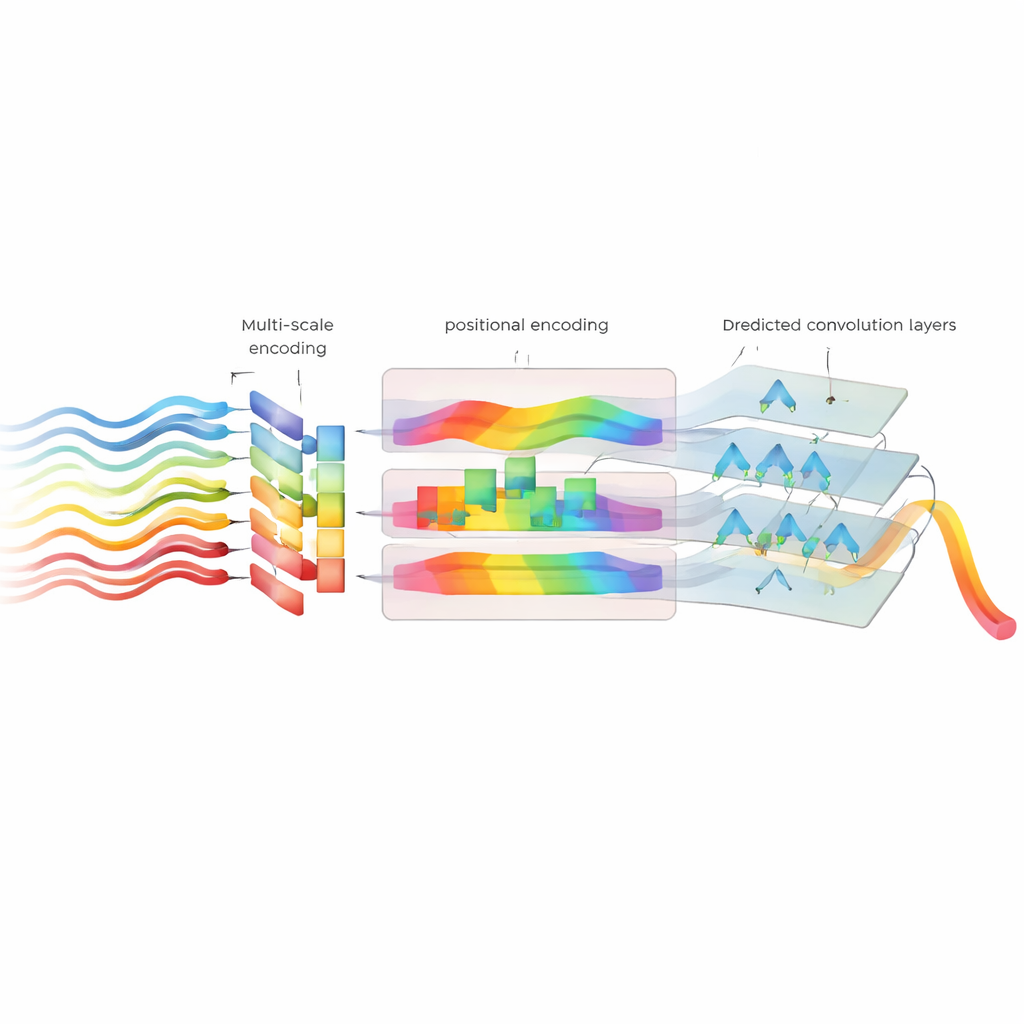
Gates that guide information flow
At the heart of the framework is a new gated dilated causal convolution (GDCC) network. “Causal” means the model predicts the future using only past and present data, just like a real monitoring system must. “Dilated” convolutions allow the model to skip over some time points, so each layer can see further back without having to stack dozens of layers. The gating mechanism acts like adjustable valves that decide how much information from each path should pass forward. One path remains linear to keep gradients flowing smoothly during training, while the gate preserves nonlinearity so the network can still capture complex behavior. By stacking several of these GDCC modules, the model can follow both short-term fluctuations and long-term degradation without becoming unstable.
Putting the method to the test
The researchers tested their approach on two demanding datasets of bearings run to failure under different loads and speeds, including the well-known PHM 2012 challenge data and the more complex XJTU-SY data. They used standard measures of prediction error, as well as a scoring rule that penalizes over-optimistic predictions more harshly than conservative ones, reflecting the real-world danger of overestimating remaining life. Across multiple “leave-one-out” experiments—where each bearing in turn is treated as unseen test data—the new method consistently achieved lower errors and better scores than several advanced baselines, including strong CNN–LSTM hybrids and attention-enhanced temporal convolutional models. Ablation studies showed that removing either positional information or the multi-scale unit noticeably worsened performance, confirming that each piece plays an important role.
What this means for real machines
For non-specialists, the key message is that the authors have built a more reliable “early warning” system for rotating machinery by carefully redesigning how a neural network digests time-series sensor data. By combining multi-scale feature filtering, a built-in sense of time order, and gated convolutions that can see far into the past without losing stability, their framework provides more accurate and robust estimates of how much life remains in a bearing. In practical terms, this could help factories, power plants, and transportation systems plan maintenance more intelligently, avoiding both premature part replacement and costly, possibly dangerous, unexpected failures.
Citation: He, J., Sun, W. & Zhang, C. Remaining useful life prediction method based on gated dilation causal convolution. Sci Rep 16, 10809 (2026). https://doi.org/10.1038/s41598-026-44784-y
Keywords: remaining useful life prediction, rolling bearings, time series deep learning, predictive maintenance, vibration monitoring