Clear Sky Science · en
Conservation insights for the Critically Endangered Black Softshell Turtle (Nilssonia nigricans) through landscape genetics approach in South Asia
A hidden turtle on the brink
The Black Softshell Turtle, once thought to have vanished from the wild, is quietly clinging to survival in the rivers and ponds of India, Bangladesh, and Nepal. This study combines cutting-edge DNA work with computer models of climate and habitat to ask a simple question with far-reaching consequences: where can this rare turtle still live today, and how can we keep its scattered populations connected in a rapidly changing world?
Ancient reptile in modern trouble
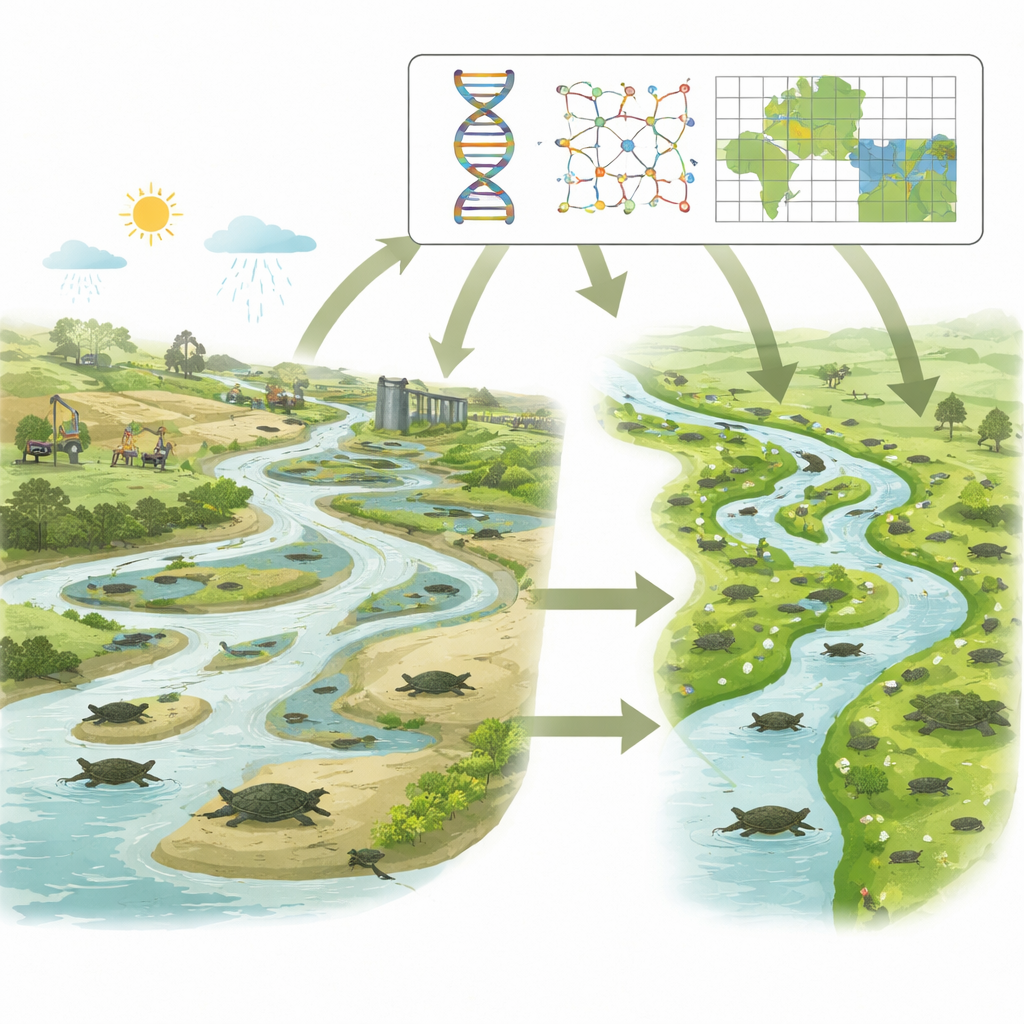
Turtles belong to one of the oldest lineages of reptiles, and the Black Softshell Turtle is among the most threatened of them all. After years of confusion over its identity and range, it was even listed as “Extinct in the Wild” before new surveys found surviving animals in temple ponds and riverine wetlands across Northeast India. Despite strict legal protection, the species still faces shrinking natural habitat, pollution, hunting, and pressure from the illegal wildlife trade. At the same time, the low-lying Brahmaputra and Ganges basins that it depends on are being rapidly reshaped by floods, dams, and climate change, making it urgent to pinpoint where the turtle can persist and how human actions are fragmenting its home.
Reading the turtle’s genetic story
To untangle the Black Softshell Turtle’s past and present, the researchers collected small blood samples from wild individuals and analyzed both mitochondrial and nuclear DNA. They compared these sequences with those of related softshell turtles. The genetic data confirmed that the Black Softshell is a distinct species, closely related to but clearly separate from its cousins. Within the species, subtle genetic differences among individuals suggest that populations have been partially isolated from each other, likely by distance and long-term changes in where turtles can live, rather than by modern barriers such as roads or dams alone. Statistical tests showed that turtles found farther apart are often more genetically distinct, pointing to “isolation by distance” as an important pattern.
Mapping where the turtle can still thrive
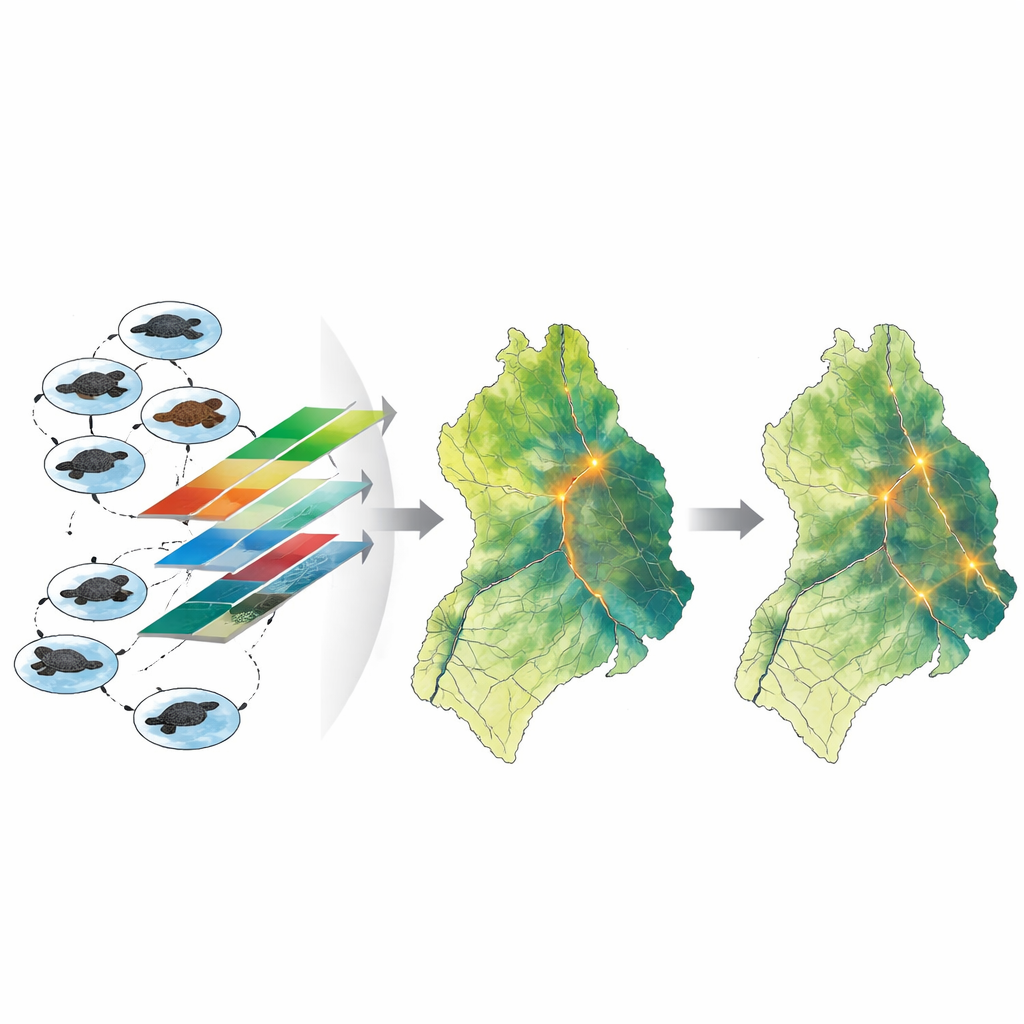
The team then turned to species distribution models, which use records of where animals are found and combine them with maps of climate, elevation, and land features to estimate suitable habitat. For the Black Softshell Turtle, living near slow-moving rivers and wetlands is crucial: distance to water and low-lying elevation emerged as the strongest predictors of suitable conditions. Under today’s climate, the models revealed that only about one-eighth of the broader study area offers suitable habitat, concentrated in parts of the Brahmaputra and Ganges floodplains and the Barak and Meghna basins. When future climate scenarios were simulated, an intriguing result appeared: instead of losing ground, the turtle’s potential habitat actually expanded, especially along major river systems, reflecting the species’ ability to use a variety of warm, lowland water bodies.
More habitat, weaker links
More space does not necessarily mean a safer future. Using a technique borrowed from electrical circuit theory, the authors mapped how easily turtles could move between suitable patches, identifying four main corridors: the Terai landscape near the Himalayan foothills, the western and eastern arms of the Brahmaputra, and the Kaziranga–Dhansiri wetlands. Today, these riverine belts act as the best remaining pathways for movement and gene flow. However, when future climates were factored in, connectivity along all corridors declined, even as the overall area of suitable habitat grew. In essence, the landscape is projected to become a looser archipelago of good spots separated by stretches of less hospitable terrain, raising the risk that already small populations will become even more isolated.
Planning for safe havens and wildlife highways
By overlaying habitat forecasts with administrative maps, the study highlights specific districts in India, Bangladesh, and Nepal that should be at the center of conservation action. Places such as Golaghat, Majuli, Lakhimpur, Dibrugarh, Dhemaji, Cachar, and Kokrajhar in India; Moulvibazar and Sylhet in Bangladesh; and the Koshi region in Nepal contain large tracts of current or future suitable habitat. Many of these areas already host reintroduction efforts from temple ponds into protected wetlands. The authors recommend using genetic screening to choose healthy, diverse turtles for release, while also curbing threats like sand mining, destructive fishing practices, and quarrying along riverbanks. They argue that keeping key corridors intact—by protecting sandbars, riparian vegetation, and marshy side channels—will be essential for allowing turtles to move, mix, and adapt as the climate continues to change.
A roadmap to rescue a lost-and-found species
For non-specialists, the main message is clear: the Black Softshell Turtle is not gone, but its survival depends on smart, forward-looking planning. By blending DNA evidence with computer maps of present and future riverscapes, this study draws a detailed map of where to focus limited conservation resources—both for protecting existing strongholds and for building “wildlife highways” between them. In doing so, it offers not just a lifeline for one elusive turtle, but also a template for rescuing other freshwater species facing the double squeeze of habitat loss and climate upheaval.
Citation: Abedin, I., Das, K.C., Kang, HE. et al. Conservation insights for the Critically Endangered Black Softshell Turtle (Nilssonia nigricans) through landscape genetics approach in South Asia. Sci Rep 16, 14192 (2026). https://doi.org/10.1038/s41598-026-44769-x
Keywords: freshwater turtles, habitat connectivity, climate change impacts, wildlife genetics, South Asian rivers