Clear Sky Science · en
Emergence time of CO2-forced European summer climate trends
Why European Summers Are Changing
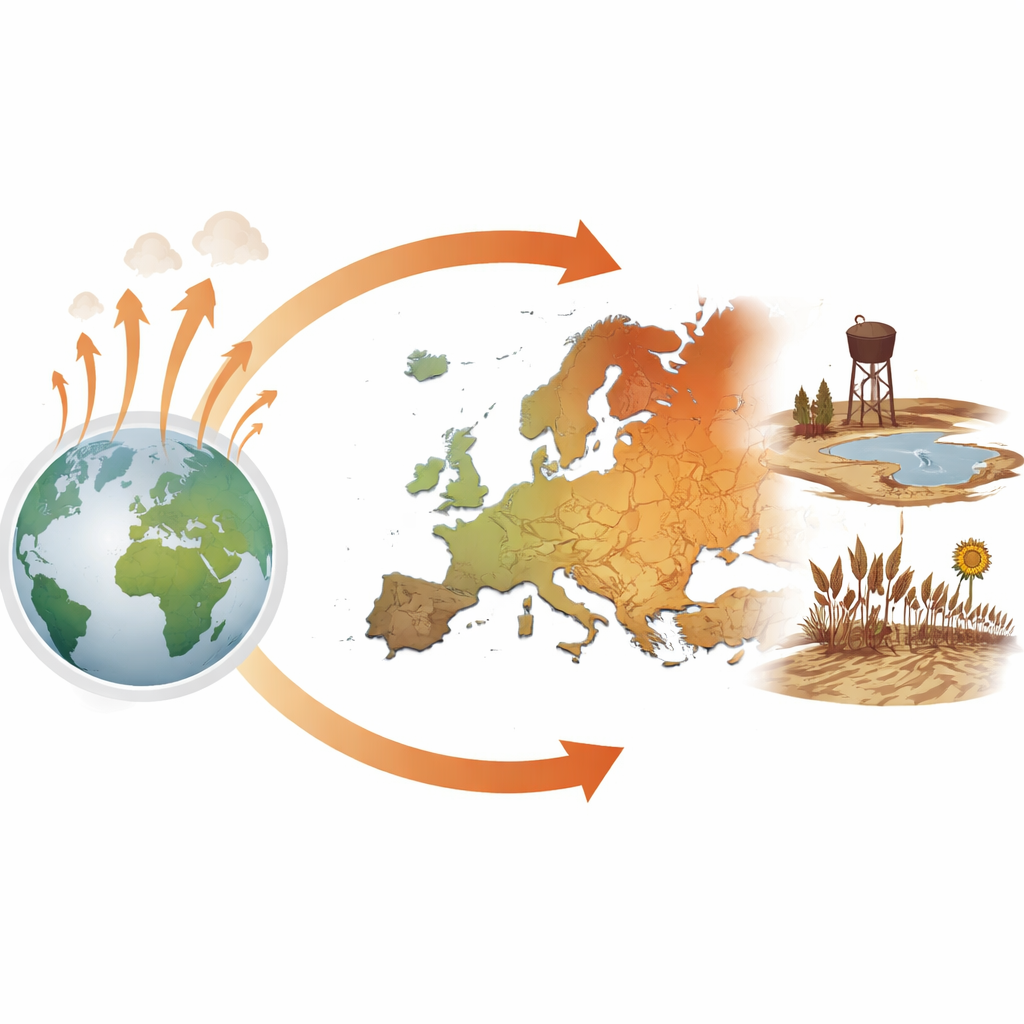
For people living in Europe, summer heatwaves, dry lawns, and low rivers are becoming more familiar. This study asks a simple but crucial question: when will these changes clearly stand out from the natural ups and downs of the weather? Using climate model experiments, the authors explore how quickly rising carbon dioxide levels reshape European summer temperatures, rainfall, and soil moisture—and what that means for future droughts and agriculture.
Watching the Planet Warm in Fast Forward
The researchers used a powerful climate model to run 100 parallel simulations of Earth’s climate, all starting from slightly different initial conditions. In each simulation, atmospheric carbon dioxide rose by 1% every year, doubling after about 70 years and quadrupling after 140 years—similar to a very high real-world emissions path. This setup allowed them to separate the steady push from greenhouse gases from the noisy year-to-year swings in weather. They focused on European land areas and on the summer season, tracking air temperature near the ground, rainfall, evaporation, runoff, and how much water is stored in the soil after summer.
When a New Climate Clearly Stands Out
To see when climate change becomes unmistakable, the authors used a concept called the “time of emergence.” It marks the point when long-term trends driven by rising carbon dioxide consistently rise above normal natural variability. They found that summer air temperatures over Europe are the quickest to stand out: in the Mediterranean region, the warming signal becomes clear in just 20 to 40 years, and in northern Europe within about 40 to 70 years. By contrast, changes in summer rainfall are much harder to distinguish from natural swings, and in many parts of Europe the trend in precipitation does not clearly emerge even after 140 years, despite a strong underlying drying tendency in western and central Europe and around the Mediterranean.
Hidden Shifts in Water and Soil
Soil moisture tells another important part of the story. Even though summer rainfall trends often stay buried within the usual ups and downs, the model projects a marked decline in soil water as carbon dioxide rises. In parts of the Mediterranean, soil moisture trends emerge after about 30 years. In western and central Europe, the soil only clearly dries in the west after roughly 70 years, when carbon dioxide has doubled. Evaporation also changes, increasing in some regions and decreasing in others. Together these shifts signal summers that are hotter and, in many regions, effectively drier at the land surface, even if the average rainfall change looks modest or uncertain.
Extremes Reveal a New Summer Reality
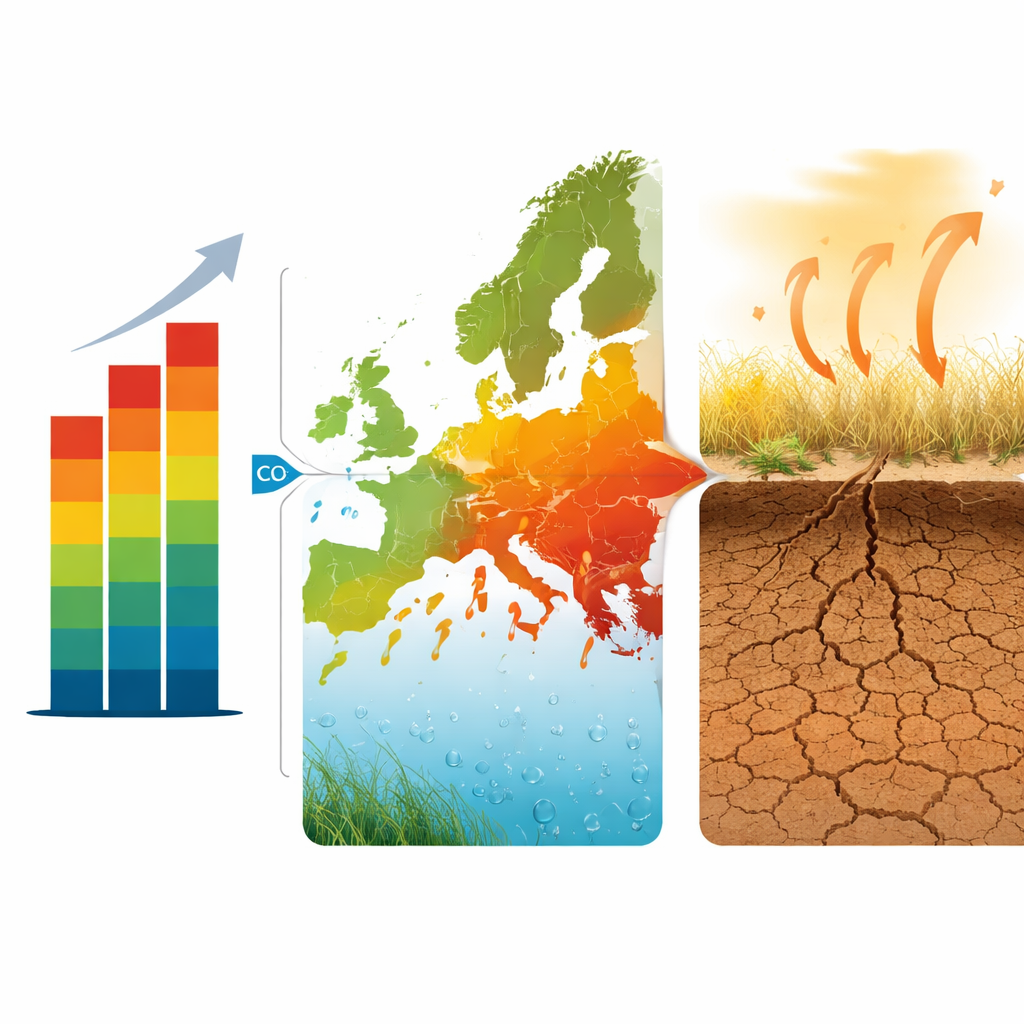
The authors then compared a huge collection of simulated summers from a pre‑industrial climate with those from a world where carbon dioxide is four times higher. Even in places where trends do not formally “emerge,” the overall pattern of summers is strikingly different. Temperature, rainfall, evaporation, runoff, and soil moisture all show altered distributions, often with wider spreads that point to more frequent extremes. In western and central Europe, a summer that would have counted as extremely hot in the pre‑industrial world would feel unusually cool in the future climate. For water-related variables, the driest 1% of summers become much more severe, with stronger heat and more intense drying that shifts and strengthens especially over northeastern parts of the region.
What This Means for People and Planning
In everyday terms, the study suggests that European summers will feel very different in a high‑emissions future, even if average rainfall numbers still appear to sit within past natural ranges. Air temperatures emerge clearly from natural variability within a few decades, soil moisture follows more slowly, and the rarest dry summers become harsher and more widespread. For farmers, water managers, and policymakers, this means that planning based only on past experience can be misleading: future “once in a century” hot, dry summers are likely to be hotter and drier than anything in the historical record. Cutting greenhouse gas emissions can delay these shifts, but without such action, Europe faces a new and more extreme summer climate that will challenge food production, water supplies, and resilience across the continent.
Citation: St-Pierre, M., Kjellsson, J., Park, W. et al. Emergence time of CO2-forced European summer climate trends. Sci Rep 16, 9707 (2026). https://doi.org/10.1038/s41598-026-44761-5
Keywords: European summer climate, time of emergence, soil moisture drought, CO2 warming, hydrological extremes