Clear Sky Science · en
Concurrent validation of OpenCap for identifying ACL re-injury risk factors during a drop jump test in a healthy cohort
Why jumping science matters for your knees
Many athletes who tear the anterior cruciate ligament (ACL) in their knee face a second injury even after careful surgery and rehab. Doctors know that subtle changes in how a person lands from a jump can reveal this hidden risk, but the best tools to measure those movements are expensive lab systems covered in reflective markers and cameras. This study asked whether a new, low-cost, smartphone-based approach called OpenCap can deliver similar insights, potentially bringing elite motion analysis out of the lab and into everyday clinics and training rooms. 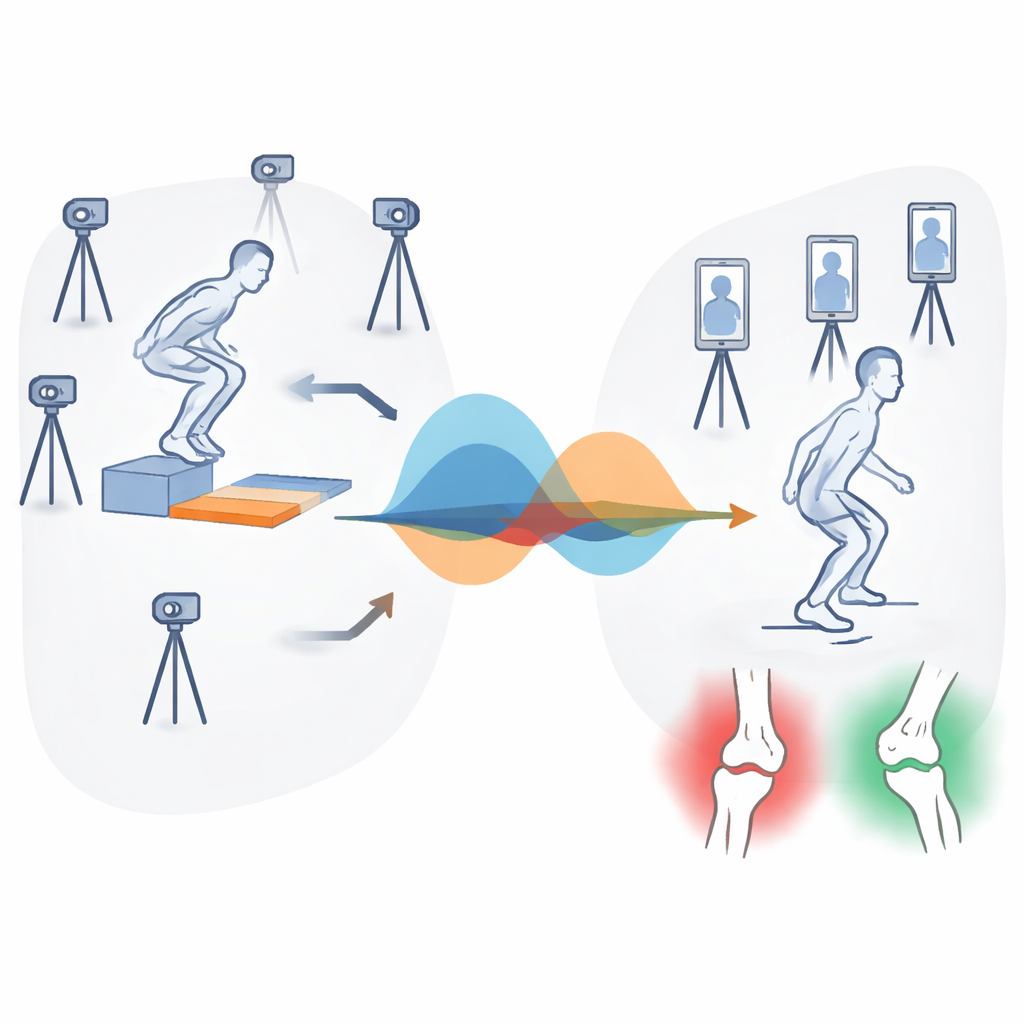
From high-tech labs to phones on tripods
Traditional three-dimensional motion analysis uses many infrared cameras and force plates in the floor to record how the body moves and how hard it hits the ground. It is highly accurate, but it demands time, money, and technical expertise, so only a few specialized centers can offer it. Markerless systems try to remove these hurdles by using regular video cameras and artificial-intelligence algorithms to track body positions without sticking markers on the skin. OpenCap goes one step further by using ordinary smartphones plus cloud computing, offering a potentially affordable way to analyze movement almost anywhere.
Putting OpenCap to the test
The researchers recruited 24 healthy, physically active adults to perform a demanding landing task: stepping off a 30-centimeter box and jumping upward again as quickly and powerfully as possible. During 240 such drop jumps, every movement was captured at the same time by both the gold-standard marker-based lab system and the smartphone-based OpenCap setup. The team focused on measures known to be linked with ACL re-injury risk: how the knee moves inward or outward during landing, how strongly the knee and hip muscles work to control the motion, and how much vertical force travels through each leg when the feet hit the ground.
How close did the phones come?
For overall movement patterns, OpenCap did a surprisingly good job. The shapes of the curves over time—showing how joints moved and forces rose and fell—lined up closely with the lab system for many variables. However, when the team looked at the size of the differences, important gaps emerged. The angle of the knee moving side-to-side differed on average by more than six degrees, larger than the small changes that have been shown to separate athletes who suffer a second ACL tear from those who do not. Forces at the knee and ground reaction forces under the feet also showed errors beyond commonly accepted limits for clinical decision-making, and important differences appeared during much of the landing phase. In about one in five trials, OpenCap’s internal simulations could not even produce usable force estimates. 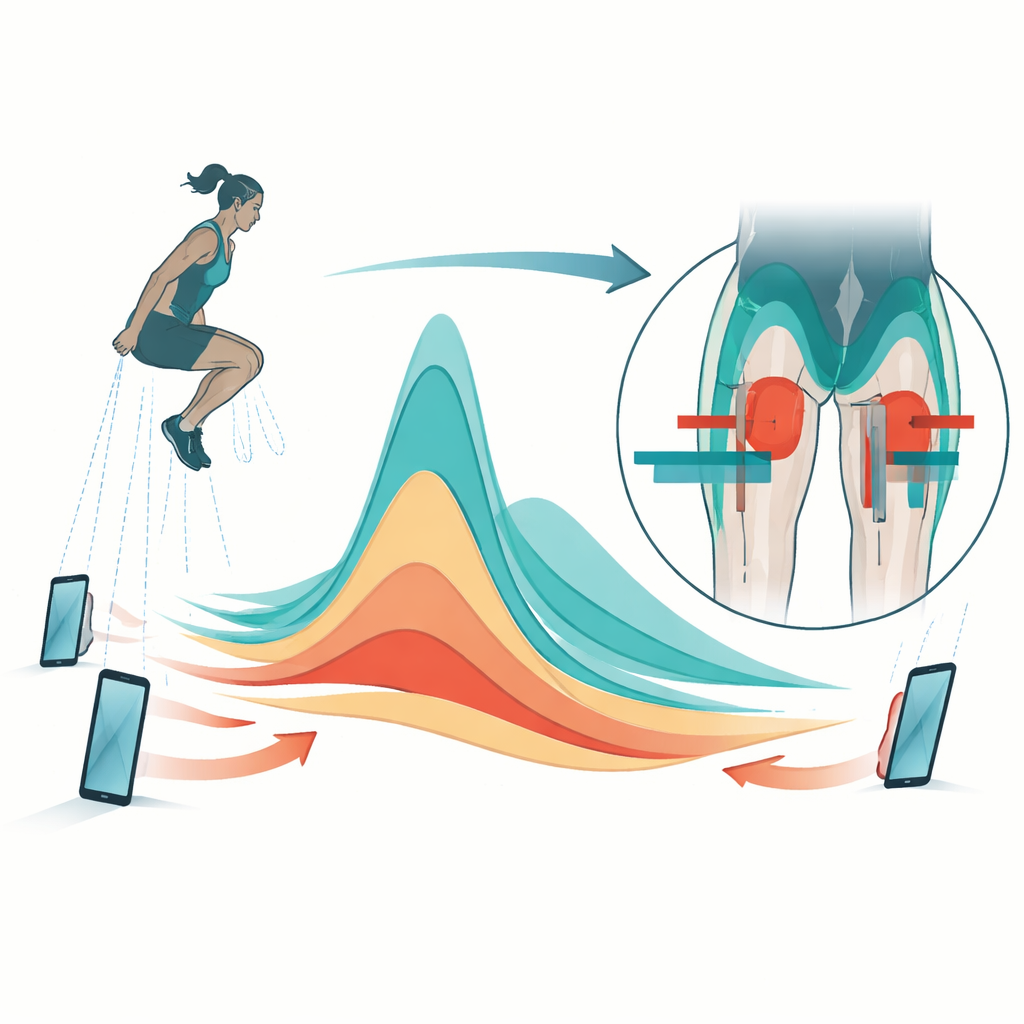
What this means for athletes and clinicians
Because ACL re-injury risk depends on small but meaningful differences between limbs and across time, tools used to guide return-to-sport decisions must be both accurate and consistent. In this study, OpenCap reliably captured the general shape of how people moved and landed, but it was not precise enough in key knee angles, muscle loading, and limb-to-limb differences to safely replace a full laboratory system for individual risk screening. The authors conclude that, for now, OpenCap should not be used on its own to judge whether an athlete is ready to return to sport after ACL surgery.
Promise on the horizon
Even though OpenCap fell short of current clinical standards, the results are encouraging in another way. The strong agreement in overall movement patterns suggests that, with better pose-estimation algorithms and refined internal models, smartphone-based systems could eventually narrow the gap. If those improvements succeed, motion analysis that once required a specialized lab might one day be done in a regular clinic, training facility, or even on the sideline—helping more athletes protect their knees without the barrier of high-end equipment.
Citation: Färber, B., Horsak, B. & Paternoster, F.K. Concurrent validation of OpenCap for identifying ACL re-injury risk factors during a drop jump test in a healthy cohort. Sci Rep 16, 9843 (2026). https://doi.org/10.1038/s41598-026-44758-0
Keywords: ACL re-injury risk, markerless motion capture, sports injury prevention, jump landing mechanics, smartphone movement analysis