Clear Sky Science · en
Duckworth–Lewis–Stern modeling with fuzzy logic and contextual indices for target revision in cricket
Why rain and dew can change a cricket match
Fans often grumble that rain rules and late-evening dew can unfairly tilt a limited-overs cricket match. When play is cut short, the Duckworth–Lewis–Stern (DLS) method is used to reset the target for the chasing team, but it looks only at overs left and wickets lost. This paper asks a question that many spectators and players already feel in their gut: should target calculations also account for how strong the teams are, how the pitch is behaving, and whether the outfield is slick with dew? The authors propose a new, more flexible way to do exactly that.
How the current rain rule sees a match
The standard DLS method assumes that a team’s scoring power depends on two numbers: how many overs remain and how many wickets have fallen. From these, it builds a smooth curve that describes the fraction of “batting resources” still available. Targets and par scores in rain-hit games are then computed simply by comparing the resources used by each side. This approach has worked well enough to become the world standard, but it has a blind spot: it treats two innings with the same overs and wickets as identical, even if one side has world-class batters on a flat pitch and the other faces a swinging ball under lights.
Bringing context into the picture
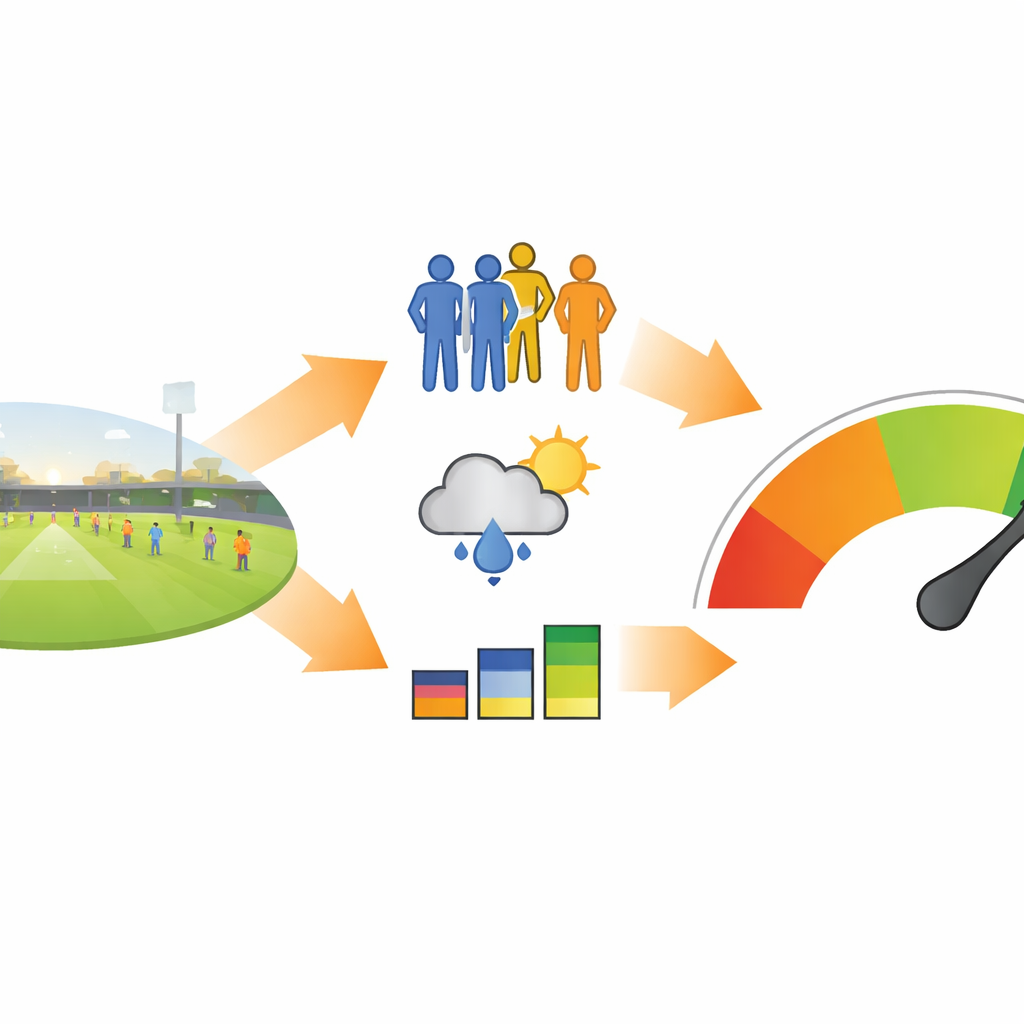
To close this gap, the authors construct numerical indices that capture team strength and match conditions in a simple, interpretable way. A Batting Quality Index blends batting averages, strike rates, and rankings into a single value between zero and one, where 0.5 means roughly “average.” A Bowling Threat Index does the same for the bowling side, using economy rate, wickets per ball, averages, and rankings, with stronger attacks receiving higher scores. They also account for how many Powerplay overs are left, how favorable the pitch is to bat or bowl, and whether the weather suggests dry air, drizzle, or heavy dew. Pitch and weather are summarized using fuzzy logic: instead of a rigid “good” or “bad,” they are described in overlapping shades such as “hard,” “moist,” or “worn,” which are then blended into a single pitch or weather score.
A flexible curve that bends with conditions
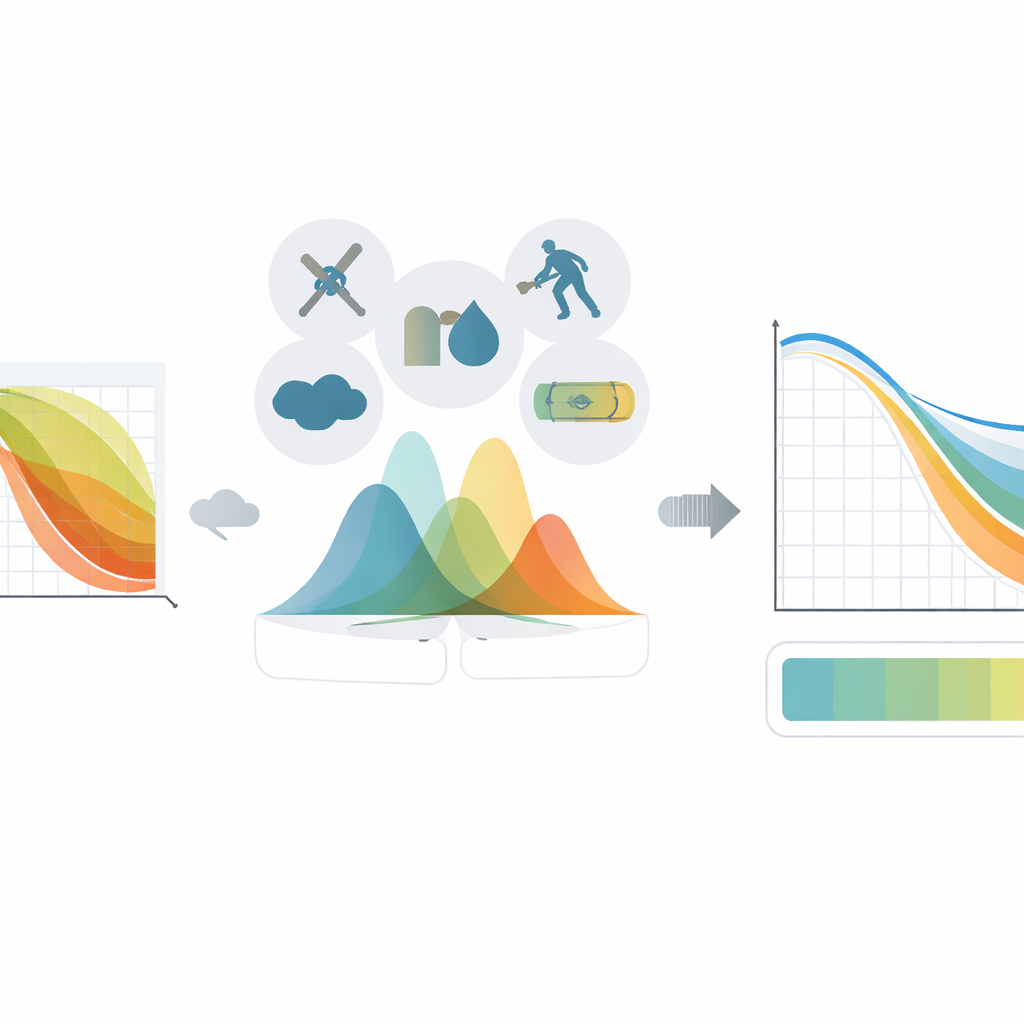
Building on these inputs, the authors design two related mathematical tools. First, they present a generalized logistic–exponential curve that closely mimics the familiar DLS resource curve when conditions are average, but bends slightly upward or downward when batting is stronger, bowling is fiercer, the pitch flattens out, or dew arrives. Second, they embed this idea inside a full fuzzy-logic system, which takes linguistic rules that sound like real cricket talk—such as “if batting is strong and the pitch is flat and dew is present, then resources are very high”—and translates them into precise numerical adjustments. In worked examples, the model gently nudges par scores up under bowler-friendly settings and down when the chase is helped by conditions, while always snapping back to the classic DLS shape when everything is neutral.
Does dew really help the chase?
Beyond the modeling, the paper examines 100 one-day internationals played in India to test a widely held belief: that winter dew makes chasing easier. Dividing the matches into winter and non-winter months, the authors find that teams batting second won 56.5 percent of winter games but only 37.0 percent of non-winter games. The odds of winning while chasing are a little more than double in winter, although the sample is just small enough that the result falls short of strict statistical significance. Still, this pattern fits well with the fuzzy inputs the model is designed to use: slippery balls, faster outfields, and gentler conditions for batters in the second innings.
What this means for fairer targets
Overall, the Fuzzy-DLS model behaves like an enhanced, context-aware version of the standard rain rule. In a set of 30 illustrative cases, its resource estimates differ from the official DLS values by only about 1.5 percentage points on average, and the par scores change by just over two runs—small, smooth shifts rather than drastic overhauls. Yet those shifts are grounded in information that players, commentators, and fans already talk about: the strength of the lineups, the state of the pitch, and the presence of dew or rain. For a lay reader, the key takeaway is that it is possible to keep the familiar DLS framework while making it more sensitive to the real feel of a match, potentially leading to target revisions that seem not only mathematically tidy but also intuitively fair.
Citation: Samanta, S., Allahviranloo, T., Mrsic, L. et al. Duckworth–Lewis–Stern modeling with fuzzy logic and contextual indices for target revision in cricket. Sci Rep 16, 10630 (2026). https://doi.org/10.1038/s41598-026-44750-8
Keywords: cricket analytics, rain-affected matches, target revision, fuzzy logic, Duckworth-Lewis-Stern