Clear Sky Science · en
Frequent coral disease interventions reduces tissue loss
Why coral disease care matters
Colorful coral reefs are more than pretty underwater scenes; they are living cities that shelter fish, protect coastlines, and support local economies. In Florida and across the Caribbean, a fast moving coral disease has been turning these vibrant structures into bare rock. This study asks a practical question that matters for anyone who cares about reefs: if we regularly check on the biggest coral “old growth” colonies and treat their infections by hand, can we actually keep them alive long enough to help rebuild damaged reefs?
A quiet killer on the reef
Over the past decade, a severe condition called stony coral tissue loss disease has swept through Florida’s reefs. It strips away living tissue from coral skeletons at a startling pace, leaving behind bare surfaces that are quickly taken over by algae. Many different coral species are vulnerable, and once this disease takes hold, whole colonies can die. Because the exact cause is still uncertain and the disease is now common in the region, managers cannot simply wait for it to disappear. Instead, they must decide where limited time, money, and diving effort will do the most good.
Focusing on the reef’s big builders
To test whether targeted care can help, researchers followed unusually large colonies of a key reef building coral off southeast Florida for seven years. These massive boulder like colonies of Orbicella faveolata are important because they produce many of the eggs and larvae that seed future generations. Starting from an earlier survey of 115 big colonies, the team chose 42 of the largest and healthiest as “priority” corals and visited them every month. Divers checked each colony for fresh disease spots and applied underwater treatments directly to the wounded edges. The remaining 36 colonies of the same species were left as “non priority” corals that were only revisited every few years for comparison. 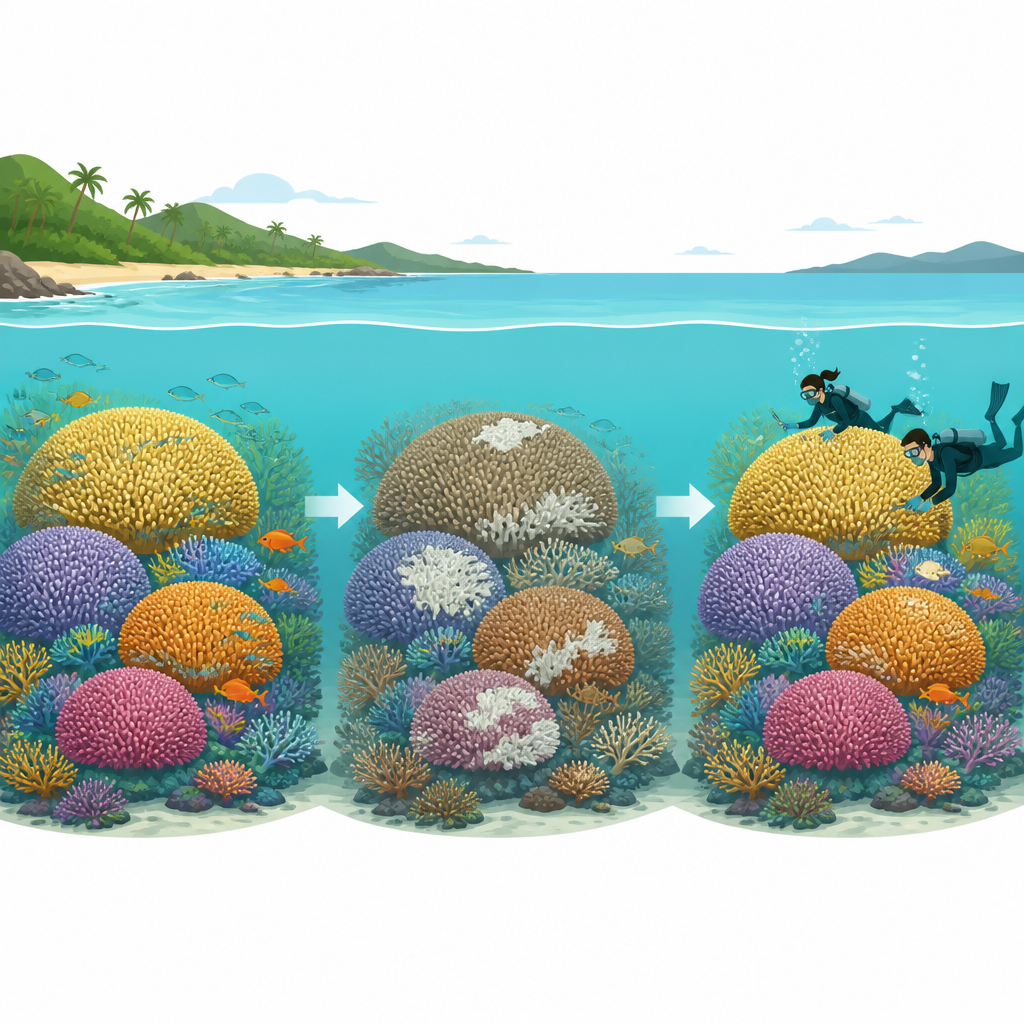
Hands on care slows the damage
Before regular visits and treatments began, both priority and non priority corals were already losing living tissue. Once monthly care started, however, the paths of the two groups diverged. The treated priority colonies still developed new disease spots and needed attention almost every month, but the total amount of living tissue they lost dropped sharply. On average, tissue loss in these corals was cut by about half, and not a single priority colony died during the study. In contrast, the non priority corals continued to lose tissue year after year, and about two thirds of them died. Statistical models confirmed that the change in tissue over time differed strongly between the treated and untreated groups.
Many small fixes add up
The team also looked at how much living coral surface was effectively “saved” by treatment. By comparing what happened before and after interventions, they estimated that repeated care preserved more than 13 square meters of coral tissue on the priority colonies. To replace the same amount of habitat with small lab grown fragments would require on the order of hundreds of thousands of pieces, at great cost. Although some treatments failed and a few colonies still lost noticeable tissue, most applications successfully halted the advance of individual disease spots. Long term forecasts suggest that with continued regular care under present conditions, these large colonies could survive and keep reproducing for at least another 30 years. 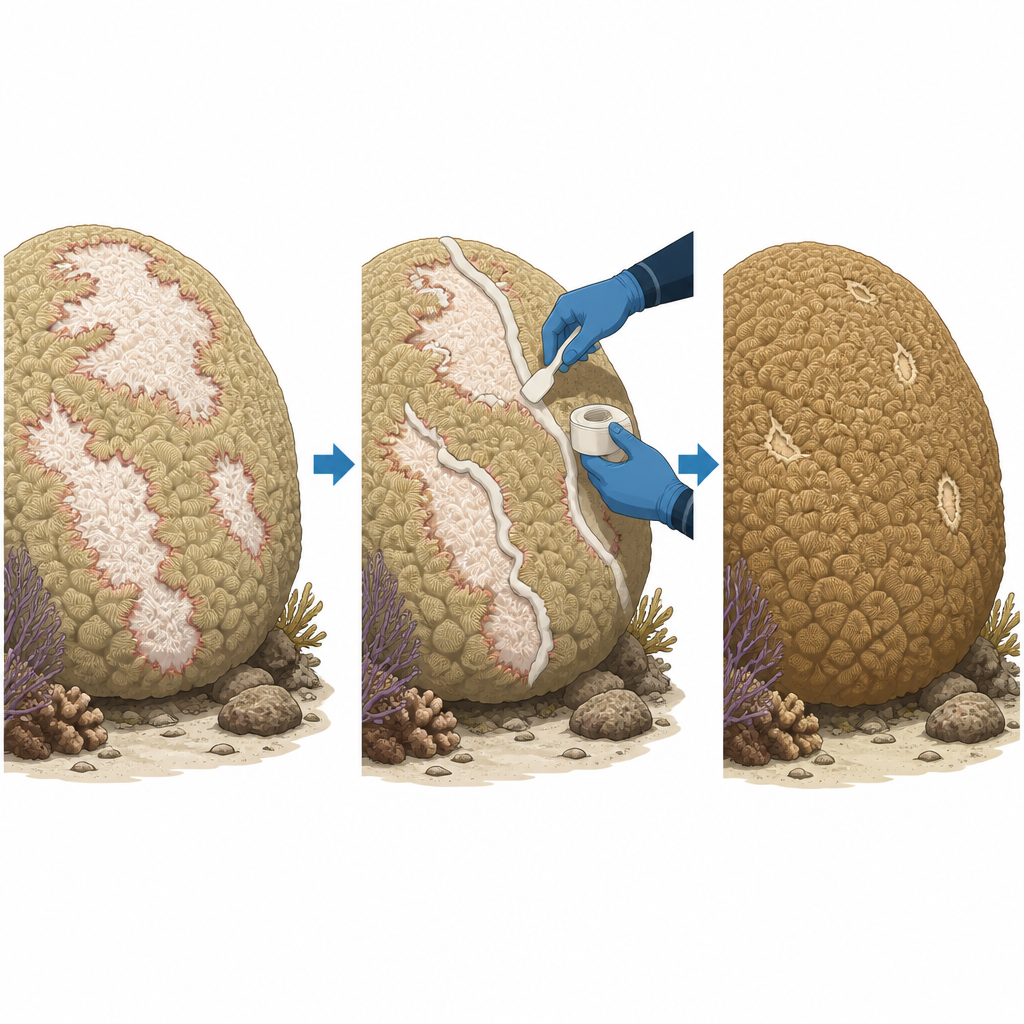
What this means for reef futures
For managers facing fast moving coral disease outbreaks, this study shows that frequent, targeted care of the largest and most important colonies can keep them alive far longer than they would survive on their own. These “old growth” corals act as seed sources for future reefs, buying time while broader efforts tackle climate change and water quality problems. Hand treating disease does not cure the reef or prevent new infections, and it must be repeated again and again. But as part of a wider strategy, regular interventions on priority corals offer a practical way to hold on to vital reef builders and their genetic diversity instead of relying solely on expensive rebuilding efforts after they are gone.
Citation: Kozachuk, A., Jones, N.P., Williams, G.J. et al. Frequent coral disease interventions reduces tissue loss. Sci Rep 16, 14987 (2026). https://doi.org/10.1038/s41598-026-44748-2
Keywords: coral disease, reef conservation, Florida coral reef, stony coral tissue loss, coral restoration