Clear Sky Science · en
OTFS channel estimation method based on IBO-dynamic gated Bi-GRU
Smarter signals for fast-moving vehicles
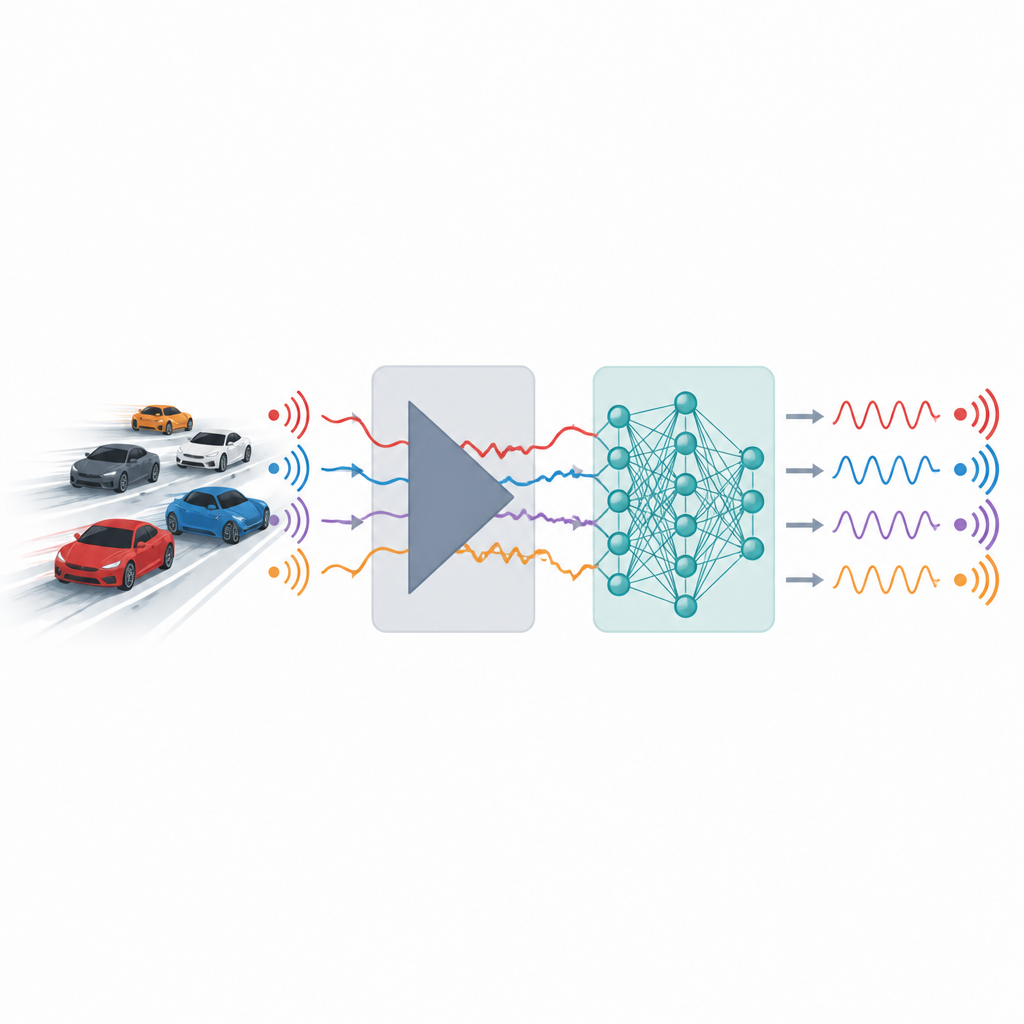
As cars, trains, and drones move faster and carry more connected devices, their wireless links must juggle high data rates, crowded airwaves, and constantly changing signal paths. This paper explores a new way to keep those links clear and reliable even when the power amplifier in the radio distorts the signal, a problem that quietly limits how well many modern systems can perform.
Why today's wireless tricks fall short
Most current mobile networks rely on a scheme called OFDM, which works well when users move slowly. At highway or train speeds, however, signals bounce off buildings, cars, and terrain, arriving at slightly different times and frequencies. This makes channels change quickly and can cause nearby signal slices to interfere with each other, raising error rates. A newer scheme called OTFS tackles this by arranging data in a different grid that separates delay and motion effects, making the channel appear more stable and easier to handle for fast users such as vehicles.
Power amplifiers quietly bend signals
Even with OTFS, another bottleneck lurks in the hardware. To push radio waves over long distances, transmitters use high-power amplifiers that work best in a narrow, linear range. To save energy and cost, these amplifiers are often driven close to their limits, where they begin to bend both the strength and phase of the signal in a nonlinear way. A setting called Input Back-Off (IBO) measures how far the operating point sits from this nonlinear region. Existing channel estimation methods largely ignore how this setting changes over time, missing a key clue about when and how distortion corrupts the link.
A learning model that listens to power settings
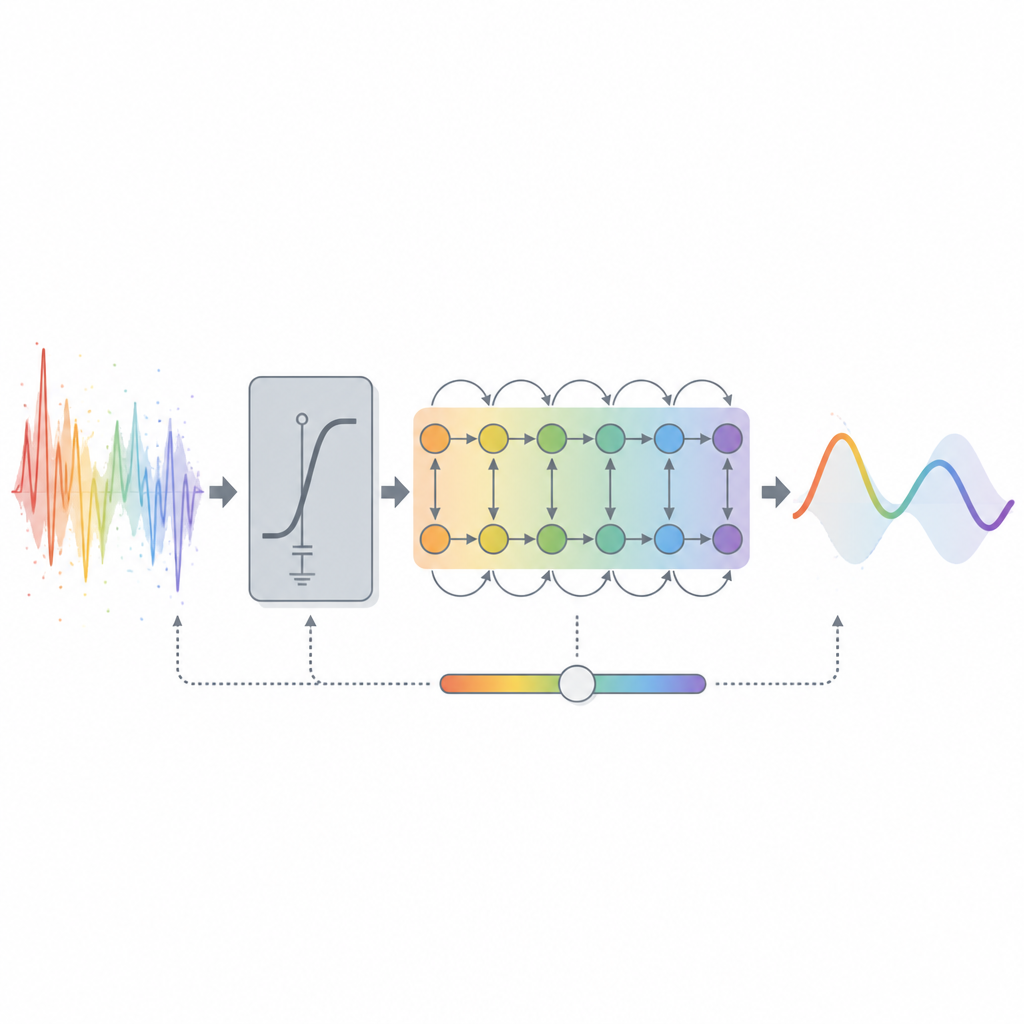
The authors propose a deep learning based channel estimator built around a bidirectional gated recurrent network that processes the time–frequency channel response in both forward and backward directions. The twist is a dynamic gating mechanism that feeds the real-time IBO value into the network’s internal gates. When the IBO is low and distortion is severe, the model automatically leans more on fresh observations and less on past history; when the IBO is high and the amplifier behaves more linearly, it can safely reuse more stored information. On top of this, a multi-head attention block learns long-range patterns in the channel, allowing the system to pick out the most informative features across time and frequency.
Lower power spikes, fewer errors, less computing
The team also redesigns how pilot tones and data are arranged, using a special low-peak preamble and keeping pilot power at the same level as data symbols. This reduces sharp power spikes that would otherwise push the amplifier further into its nonlinear region. In computer simulations of fast vehicular channels, the new estimator cuts the error between the true and estimated channel by up to about 22.6 dB compared with classic threshold and cross-correlation methods, and by several decibels relative to other deep learning baselines. At a typical high signal-to-noise point, it drives the bit error rate more than an order of magnitude lower while also trimming more than 7 dB off the peak-to-average power ratio of the transmitted signal. Crucially, the dynamic gating strategy lets the model skip many internal computations when possible, reducing its complexity by roughly one-fifth to nearly one-half compared with a similar recurrent network without gating.
Robust performance across speeds and conditions
The authors test their approach under a range of vehicle speeds from city traffic to very high-speed motion, and across several standard channel models. Using the same set of network parameters in all cases, the estimator maintains low bit error rates and stable throughput without retuning, even when the IBO value used by the receiver is somewhat misaligned with the true hardware setting. While a conventional method using very strong pilots can appear to deliver higher raw throughput in perfectly linear conditions, that approach becomes fragile once amplifier distortion is taken into account, whereas the proposed model is designed to thrive in these realistic regimes.
What this means for future wireless systems
In simple terms, the study shows that treating the power amplifier’s operating point as a live piece of information, rather than a nuisance, can help a learning-based receiver undo distortion more effectively. By combining OTFS modulation with an IBO-aware neural network that focuses its effort where the hardware is most strained, the method improves reliability and energy use in demanding, high-speed scenarios. This suggests a path toward vehicle and infrastructure radios that adapt gracefully to both changing channels and changing hardware conditions, without constant manual tuning.
Citation: Hou, J., Wei, Z., Ji, Y. et al. OTFS channel estimation method based on IBO-dynamic gated Bi-GRU. Sci Rep 16, 15157 (2026). https://doi.org/10.1038/s41598-026-44747-3
Keywords: OTFS, wireless channels, power amplifier distortion, deep learning, vehicular communication