Clear Sky Science · en
Electron and spin dynamics in a single quantum emitter
Why tiny light sources matter
Quantum dots—nanoscopic specks of semiconductor—are among the most promising building blocks for future quantum technologies. They can emit single particles of light on demand and can store information in the spin of a single electron, a leading candidate for a quantum bit. But inside these tiny structures, electrons constantly jostle, scatter, and sometimes lose their carefully prepared states. This study looks inside one such quantum dot and asks: how do magnetic fields reshape the ways electrons move, flip their spins, and disappear through an energy-draining process called Auger–Meitner recombination?
Watching a single nano-lamp
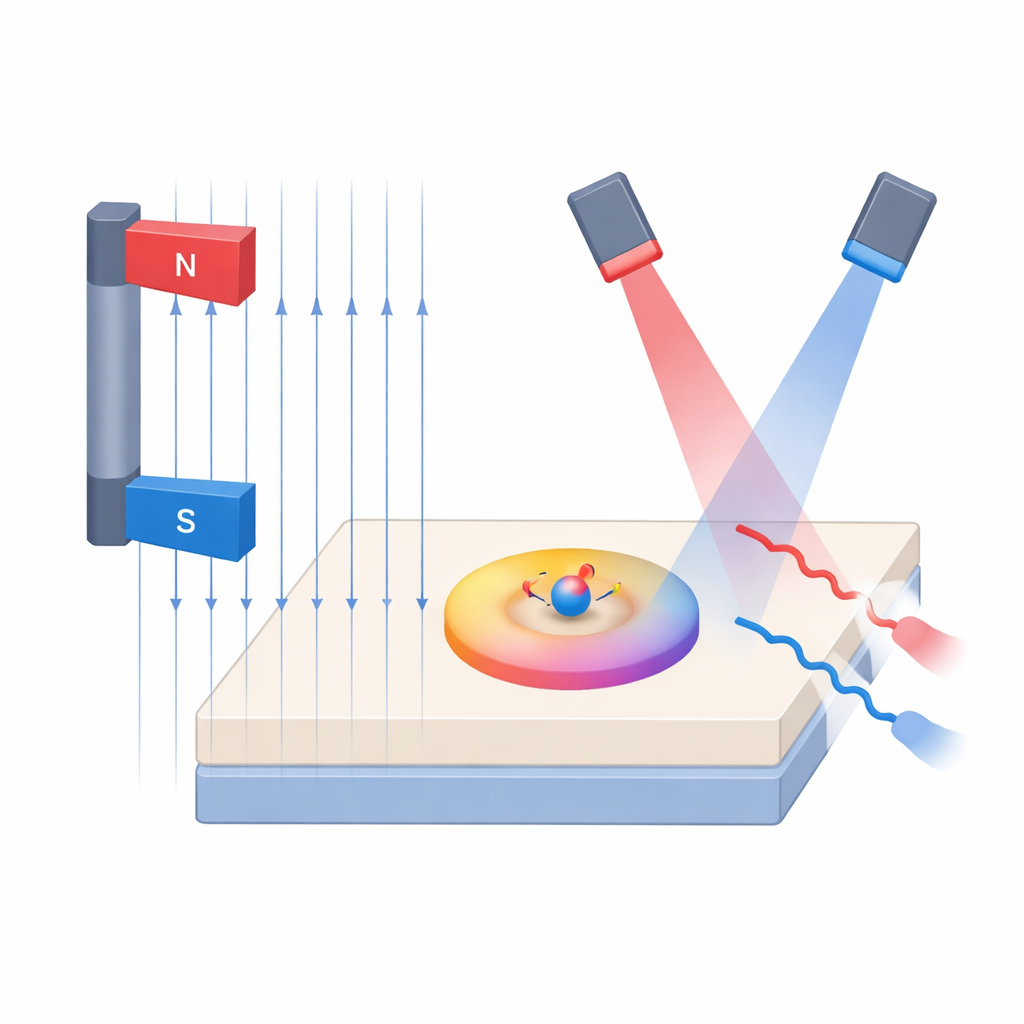
The researchers examine an individual indium arsenide quantum dot embedded in a gallium arsenide device, cooled to just a few degrees above absolute zero. By applying a voltage, they can choose whether the dot is empty or holds a single electron. They then shine two ultra-precise lasers on it: one that excites the neutral dot (creating an “exciton,” an electron–hole pair) and another that excites the dot when it already contains an extra electron (a “trion”). Each laser color corresponds to a different transition, and the emitted photons are separated by a tiny diffraction grating and detected on different single-photon detectors. This clever arrangement lets the team watch, in real time, how the dot switches between being empty, singly charged, and optically excited.
Timing the inner traffic of electrons
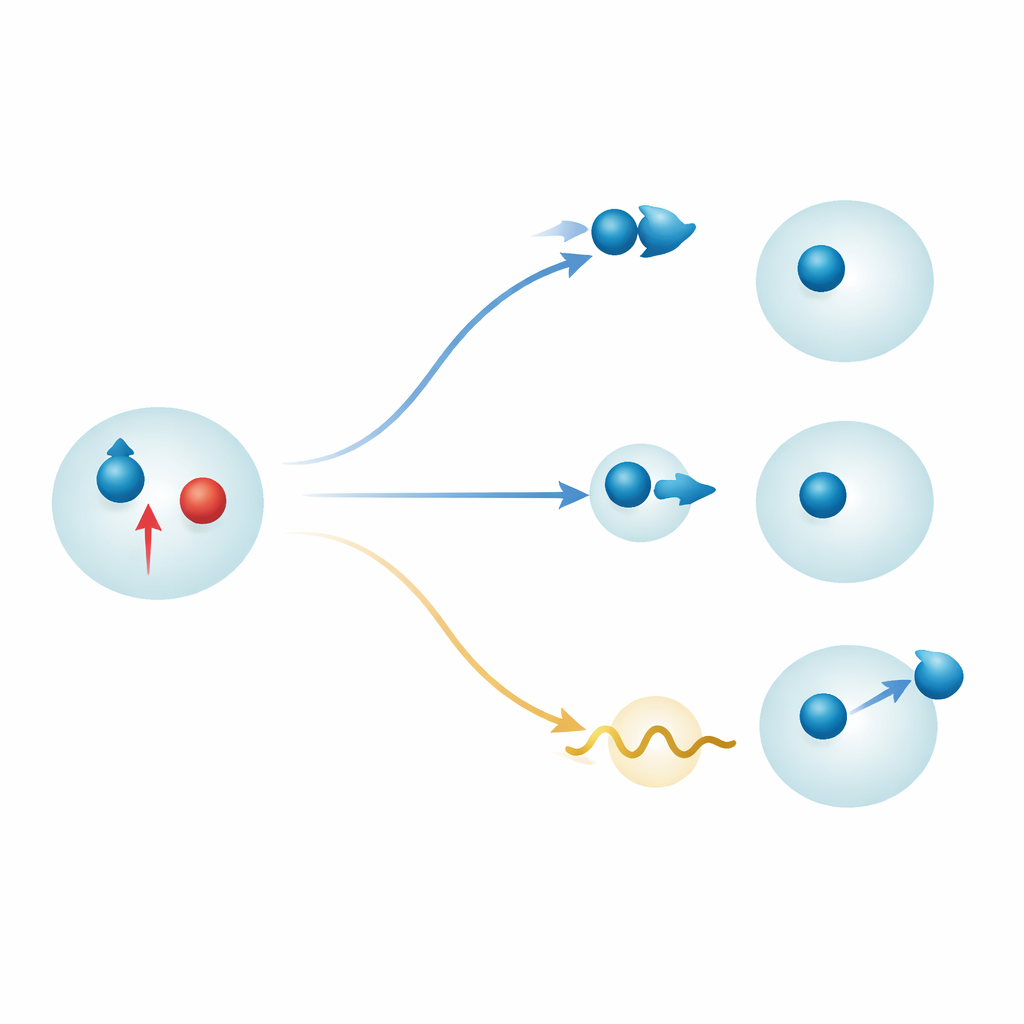
To unravel the microscopic processes, the team uses a pulsed “prepare–probe–background” sequence. First, with the lasers off and voltage set appropriately, an electron slowly tunnels from a nearby reservoir into the dot, ending up in either of two spin orientations. Next, during the probe window, both lasers are switched on. The trion laser repeatedly excites the charged dot, while the exciton laser can only interact when the dot has been emptied. That emptying happens when an excited electron transfers its energy to a second electron, which is kicked out of the dot—a non-radiative process known as Auger–Meitner recombination. At the same time, the electron’s spin can flip through two routes: via interactions with vibrations of the crystal (spin relaxation) or by a light-assisted path in which an emitted photon accompanies a spin flip (spin-flip Raman scattering. By recording how the two photon signals rise and fall over microseconds to milliseconds, and fitting them with a rate-equation model, the authors extract separate numerical values for all of these transition rates.
How magnetic fields reshape the game
By sweeping the magnetic field from zero up to eight tesla—stronger than typical hospital MRI scanners—the team maps how each key process responds. The Auger–Meitner recombination rate stays roughly constant at low and moderate fields, around three events per microsecond, but above about 5.5 tesla it drops by roughly a factor of six. This suppression hints that the magnetic field rearranges the available final states for the expelled electron, likely through the formation of discrete magnetic energy levels, though a full microscopic theory is still lacking. In contrast, the rate of ordinary spin relaxation shows a striking non‑monotonic behavior. At low fields below about three tesla it decreases, reaching a minimum, and then climbs rapidly with field strength, following a power law consistent with spin–orbit coupling assisted by lattice vibrations. Throughout, the light-assisted spin-flip Raman rate remains nearly constant, indicating that it is mainly set by the internal structure of the excited state rather than by the external magnetic field.
Building better quantum building blocks
The upshot of these measurements is a detailed map of the competing processes that govern how long an electron spin can remain usable inside a quantum dot while it is being driven optically. Even when suppressed at high magnetic fields, Auger–Meitner recombination is still at least a hundred times faster than ordinary spin relaxation, making it a major bottleneck for spin-based devices. By showing how to disentangle this loss channel from spin-flip mechanisms in a single, well-controlled emitter, the work provides a powerful diagnostic tool for designing improved quantum-dot structures. In practical terms, it tells engineers which knobs—such as heterostructure design and magnetic field strength—must be tuned to tame destructive electron–electron scattering and to turn quantum dots into reliable sources and interfaces for future quantum networks.
Citation: Rimek, F., Schwarz, N., Mannel, H. et al. Electron and spin dynamics in a single quantum emitter. Sci Rep 16, 10498 (2026). https://doi.org/10.1038/s41598-026-44746-4
Keywords: quantum dots, spin dynamics, Auger recombination, magnetic field effects, single-photon sources