Clear Sky Science · en
Applying Liebig’s law of the minimum for variable rate soybean seeding based on CEC-nutrient fertility index
Smarter Planting for Bigger Harvests
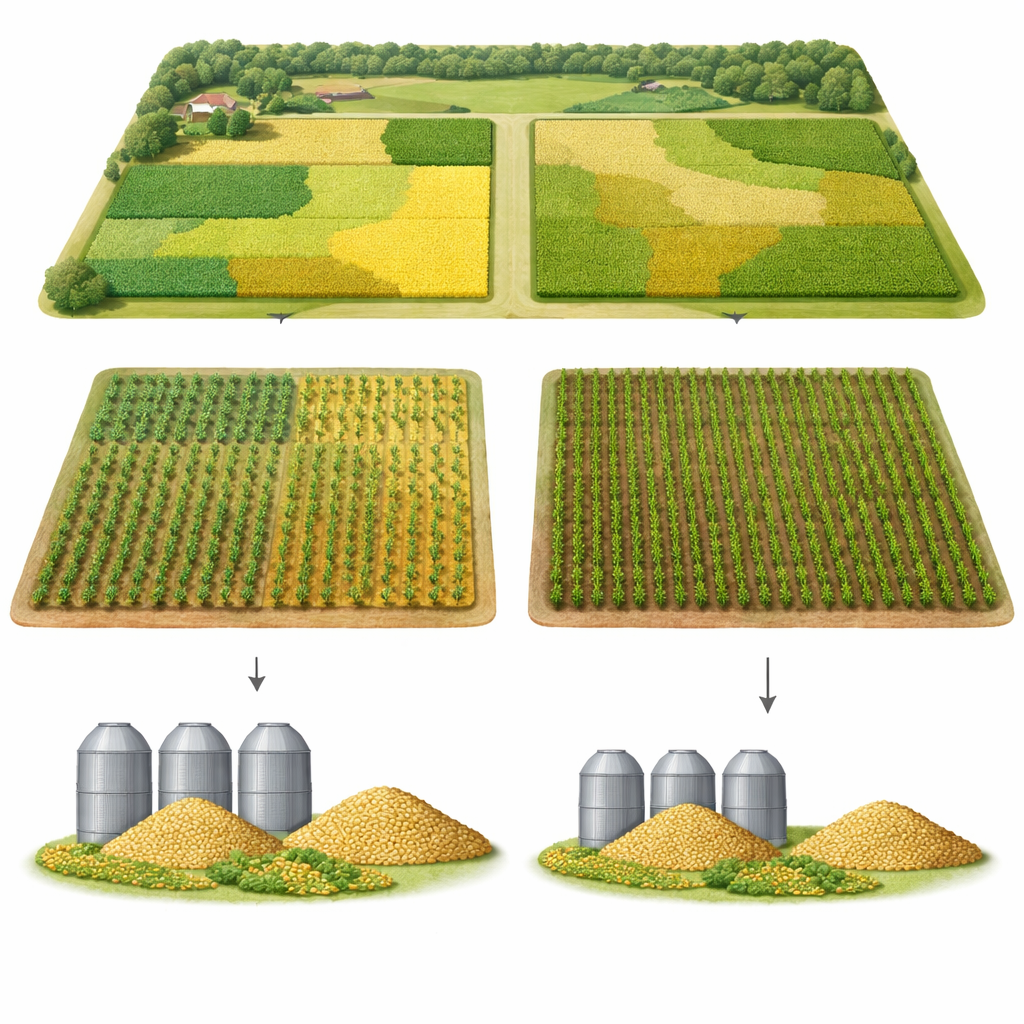
Farmers know that no two spots in a field are exactly alike. Some areas are rich and deep, others are sandy and stingy. Yet soybeans are often planted at a single, fixed rate across entire fields. This study shows how tailoring the number of seeds to the hidden pattern of soil fertility can boost harvests and profits—without more fertilizer or land—by applying a classic idea from plant nutrition in a modern, high-tech way.
Why Soil Differences Matter
The researchers focused on a key soil trait called cation exchange capacity, which reflects how well soil can hold essential nutrients such as calcium, magnesium, and potassium. They worked in two large commercial soybean fields in Brazil, each with its own weak point: in one field, magnesium was slightly low and easily pushed aside by high levels of other nutrients; in the other, calcium was clearly deficient. Because these nutrients limit plant growth when scarce, even if everything else is abundant, they act like the narrow stave in a wooden barrel that sets its maximum water level. Recognizing this, the team set out to map where, and how strongly, these limits appeared across each field.
Turning Soil Maps into Planting Plans
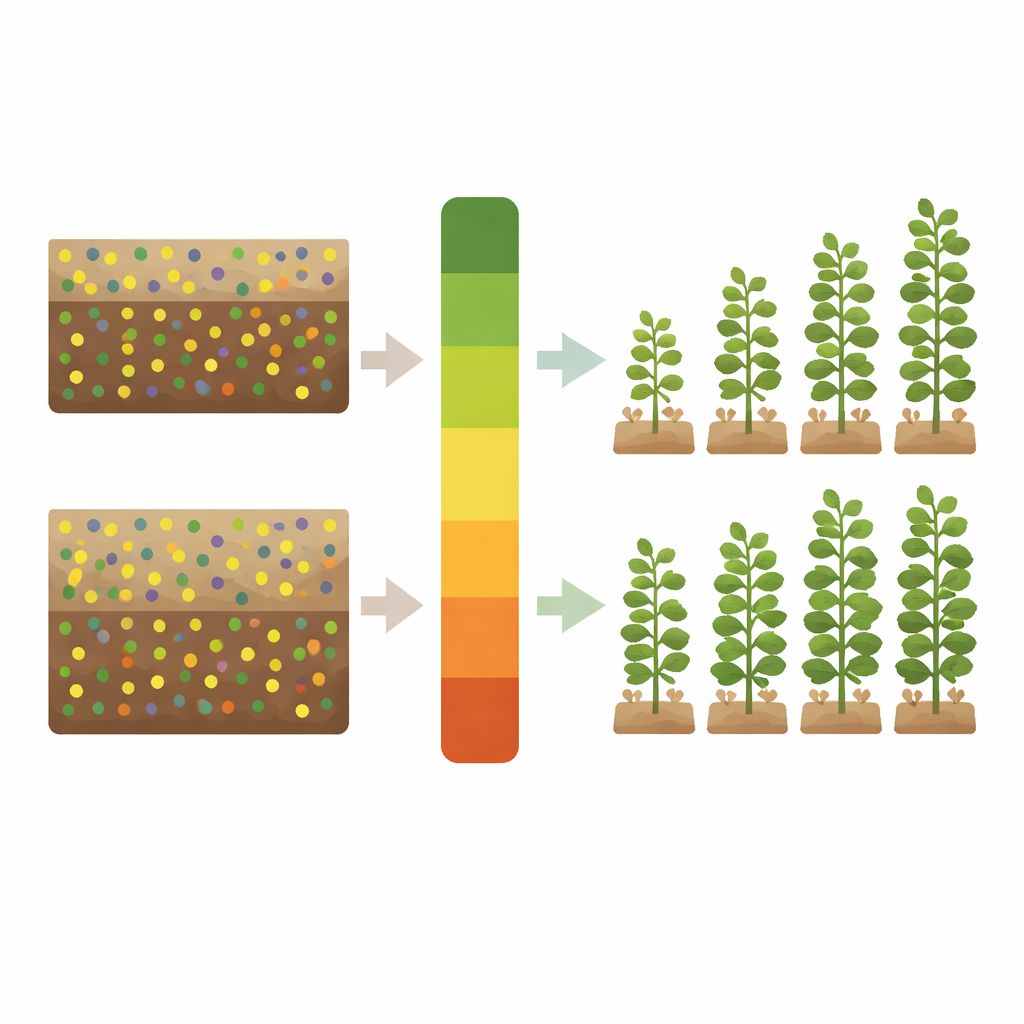
Using regularly spaced soil samples and mapping software, the team created detailed maps of cation exchange capacity and either magnesium or calcium. Instead of relying on traditional percentage-based measures, they multiplied each soil’s nutrient level by its capacity to hold nutrients, forming a “fertility index” that better reflected the actual nutrient reservoir available to roots. These index values were then grouped into five classes, or management zones, ranging from low to high fertility. A seed prescription map was built on top of this: in zones with low fertility, more soybean seeds were sown; in zones with higher fertility, fewer seeds were used. In other words, they deliberately avoided planting the same number of seeds everywhere and instead matched plant density to local soil support.
What Happened to Plants and Yields
Satellite images were used mid-season to estimate plant biomass, and ground measurements captured pod numbers, plant mass, and final grain yield. As expected, denser plantings produced more leafy growth and higher vegetation index values. But these lush canopies did not always give the best harvests. In both fields, the highest yields came from zones with low to medium-low plant populations, not from the most crowded areas. Individual plants in thinner stands produced more branches and many more pods, making up for having fewer neighbors. In the most densely planted zones, plants competed more intensely for light, water, and nutrients, which led to taller, leafier plants but fewer pods per plant and ultimately lower grain output.
Profits from Planting Less, but Better
The variable rate seeding strategy outperformed the traditional fixed seeding rate in both fields. In the first field, yields rose by about 10 percent and net income increased by over 11 percent, even with a small rise in seed costs. In the second field, yields rose by about 2 percent, but net income improved nearly 7 percent thanks to a noticeable reduction in seed use. Across both sites, carefully adjusting plant numbers to the fertility index turned out to be more profitable than simply sowing more seeds everywhere. The study also showed that satellite indicators of “greenness” can be misleading when canopies are very dense, because they may saturate and no longer reflect true differences in productivity.
What This Means for Farmers
In practical terms, the work demonstrates that packing in as many soybean plants as possible is not the path to maximum yield or profit. By using soil tests and simple mapping tools to locate where nutrients truly limit growth, farmers can vary their seeding rate across a field and let plants in better spots grow larger and more fruitful. The fertility index that combines nutrient level with soil storage capacity gave a clear, workable guide for drawing management zones and choosing seeding rates. Although these results come from one growing season, they suggest that smarter, site-specific planting can help farmers harvest more grain and earn more income while using seed and soil resources more efficiently.
Citation: Baio, F.H.R., Teodoro, L.P.R., Campos, C.N.S. et al. Applying Liebig’s law of the minimum for variable rate soybean seeding based on CEC-nutrient fertility index. Sci Rep 16, 13795 (2026). https://doi.org/10.1038/s41598-026-44739-3
Keywords: soybean, precision agriculture, variable rate seeding, soil fertility, Liebig law of the minimum