Clear Sky Science · en
Temperature control performance change of EPS foam box with ice packing in aircraft cargo hold
Why keeping food cold on planes matters
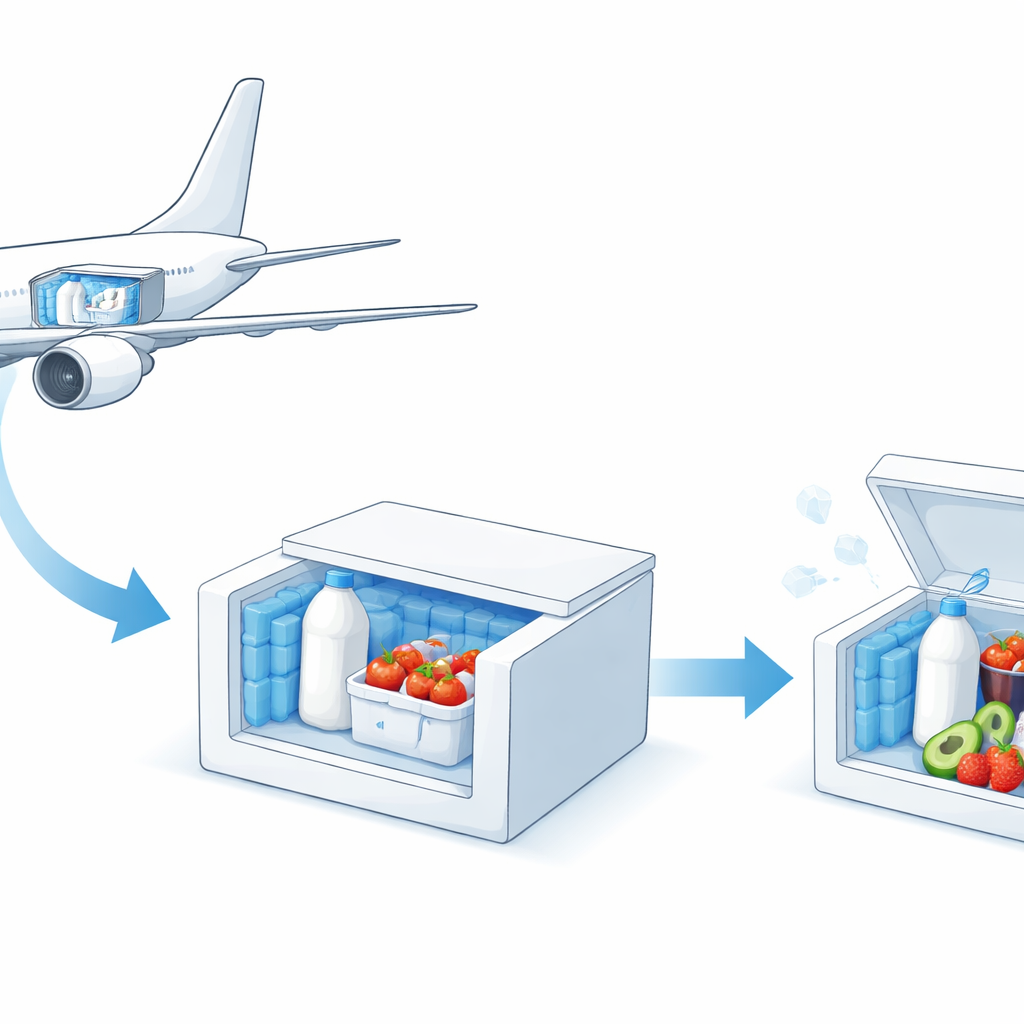
When you order fresh seafood or medicine that has flown across the country, its safe arrival depends on more than just the plane’s schedule. Many of these delicate goods travel in simple foam boxes packed with ice. This study asks a practical but overlooked question: do those boxes keep things just as cold in an airplane’s thin, fast‑moving cargo air as they do in everyday ground transport?
How a simple box became a research subject
The researcher focused on a common white box made of expanded polystyrene (EPS), a lightweight foam widely used in cold‑chain deliveries. Inside this box were only air and five flat ice packs arranged on the inner top surface, with no food added so that the cooling process itself could be studied cleanly. Nine virtual “thermometers” were placed in a grid across the middle of the box interior. The aim was to understand how the air moved and how the temperature changed in different parts of the box during a flight‑like situation.
Simulating a box flying through the sky
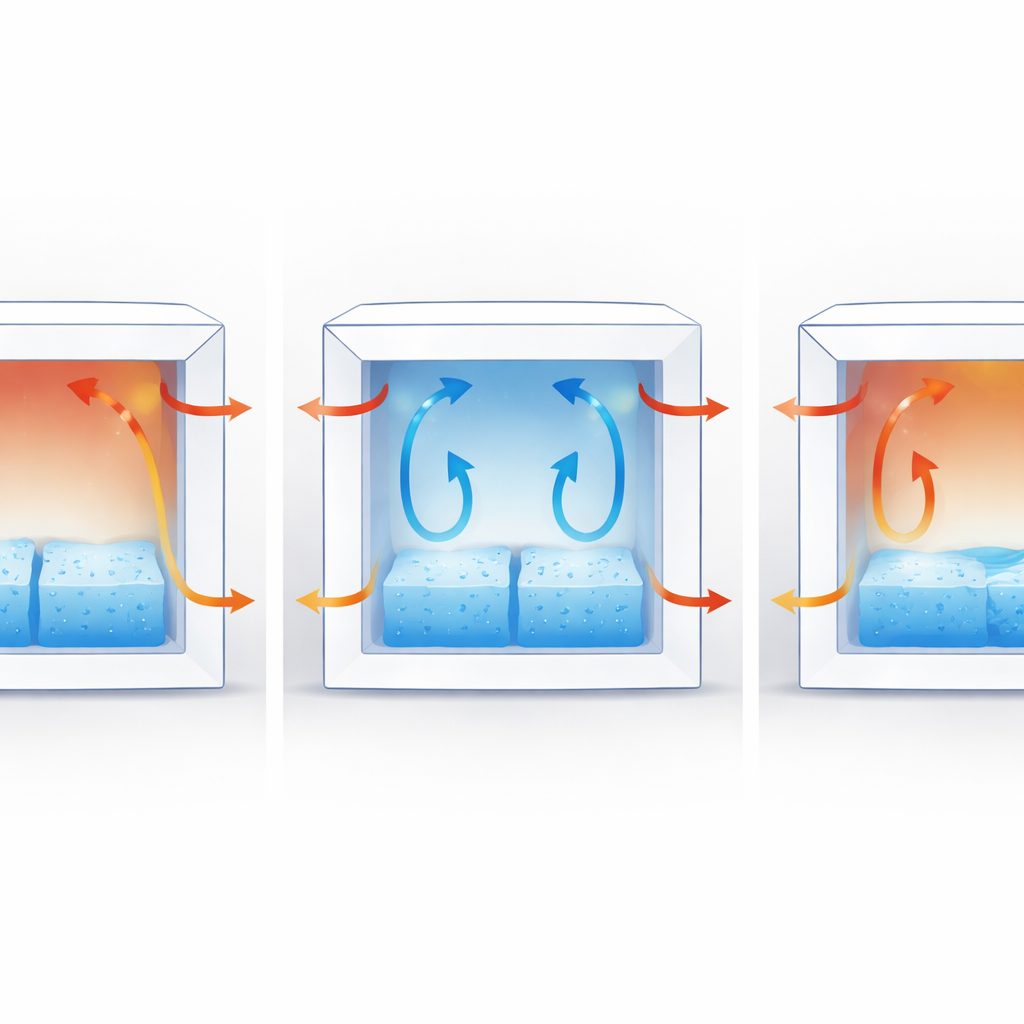
Instead of placing foam boxes in an actual airplane, the study built a detailed computer model using finite element simulation. The model treated the air inside the sealed box as moving slowly in natural swirls driven by the temperature difference between the cold ice and the warmer walls. It also represented how heat seeps through the foam and ice layers and how air flowing around the outside of the box in the cargo hold strips away cold. Conditions typical of an aircraft cargo hold were used: reduced air pressure (about four‑fifths of normal) and air temperature around 25 °C, with forced airflow that increases heat transfer at the box surface.
What happens inside the box during a flight
The simulations showed that the temperature inside the foam box is far from uniform. Air closest to the ice packs stayed coldest, while regions near the inner walls and farther from the ice warmed up noticeably, forming layers of different temperatures. Compared with ground‑level conditions, the low pressure in the cargo hold slightly improves insulation by making air within the foam walls a poorer conductor of heat. However, this benefit is offset by strong air movement outside the box, which speeds up the loss of cold. Over time, the average temperature inside the box first dropped quickly, then climbed slowly, and finally settled into a nearly steady state as the ice passed through its melting phase.
Testing the model against reality
To check that the virtual results were trustworthy, the author carried out laboratory experiments under controlled conditions similar to those in the simulations. Temperatures at the nine points inside a real box were recorded as the ice packs warmed. The computer predictions and measured values matched closely, with differences generally below seven percent. This agreement suggests that the model can reliably capture how the temperature field inside EPS boxes behaves and can therefore be used to explore different cargo hold settings that would be difficult or expensive to test in real flights.
How cargo conditions change cooling power
The study then varied two key environmental factors: the average air temperature in the cargo hold and the strength of outside airflow, expressed as the convective heat transfer coefficient. When the surrounding air moved more vigorously, the average temperature inside the box rose, showing that stronger forced convection is bad news for keeping goods cold. At cooler cargo temperatures, differences in airflow strength mattered less. But as the cargo hold warmed, higher airflow increasingly hurt the box’s temperature control, causing the interior to warm more quickly despite the ice packs.
What it means for shippers and travelers
Putting these findings together, the study concludes that foam boxes with ice do not behave exactly the same in aircraft cargo holds as they do in trucks or warehouses at ground pressure. The thinner air helps the foam insulate, but the rapid airflow around the box works against it. For short flights, this tug‑of‑war may not matter much. For longer journeys, however, the work suggests that shippers should slightly increase the amount of ice or otherwise adjust their packing strategy to ensure that food, medicines, and other temperature‑sensitive products stay safely cold from takeoff to landing.
Citation: Feng, S. Temperature control performance change of EPS foam box with ice packing in aircraft cargo hold. Sci Rep 16, 13744 (2026). https://doi.org/10.1038/s41598-026-44737-5
Keywords: air cargo cold chain, foam box packaging, ice pack cooling, aircraft cargo hold, temperature control