Clear Sky Science · en
Antibacterial and biocompatibility potentials of zinc oxide quantum dots via Nd: YAG laser ablation
Why tiny particles matter for fighting germs
Antibiotic resistant bacteria are a growing concern, and scientists are searching for new ways to stop harmful microbes without harming healthy cells. This study explores how extremely small particles of zinc oxide, made using a laser in water, can act as a type of nanoscopic cleaner that weakens dangerous bacteria and their protective slime layers while remaining gentle to normal cells.
Making tiny zinc specks with light
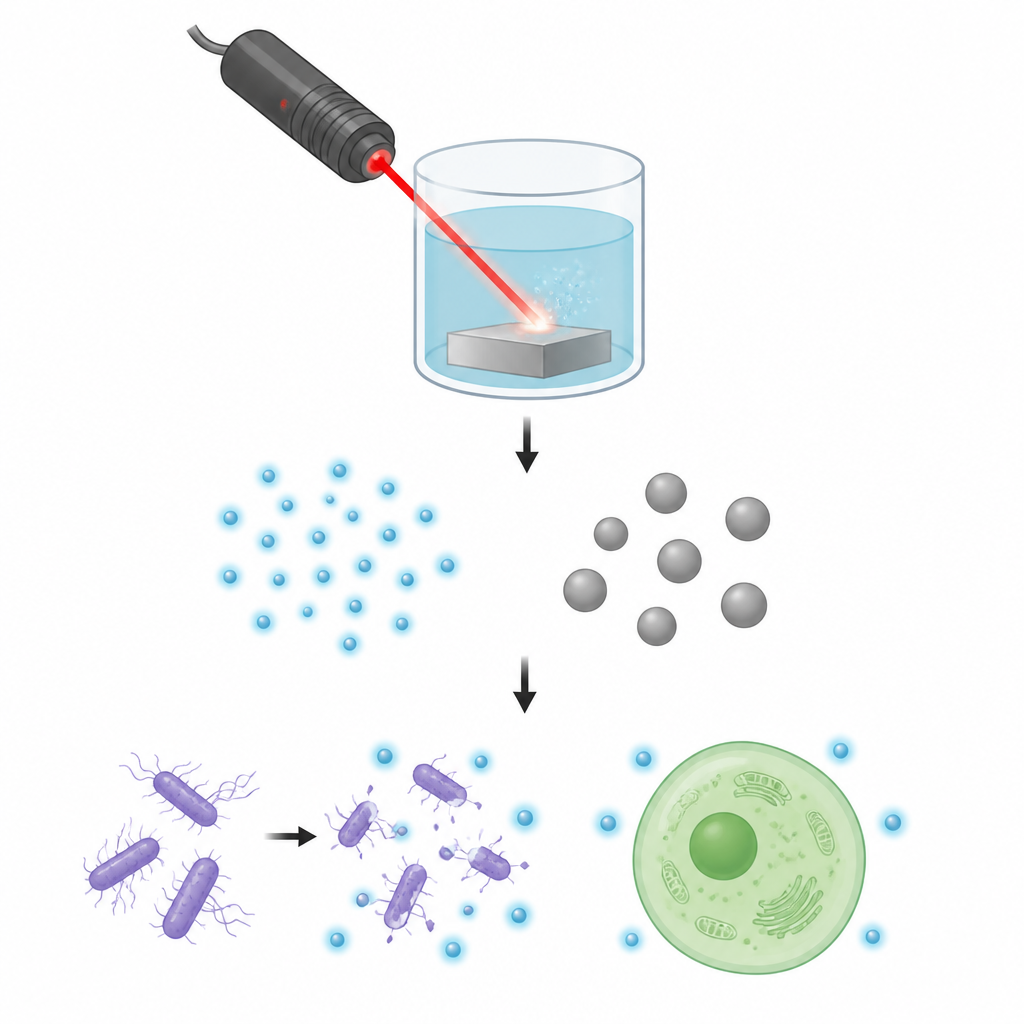
The researchers created zinc oxide particles by focusing a powerful pulsed laser onto a small zinc metal piece sitting in pure water. Each brief flash of light instantly heated and vaporized a bit of the metal, forming a hot cloud that quickly cooled in the water and solidified into zinc oxide particles. By tuning the laser energy, they could shift the average particle size: lower energy yielded ultra small “quantum dots” just a few billionths of a meter across, while higher energy produced larger nanoparticles more than three times bigger.
Seeing shape, structure, and light behavior
To understand what they had made, the team used several standard tools of materials science. X ray measurements showed that all samples shared the same orderly crystal structure, even though the particle sizes differed. Electron microscope images confirmed that the quantum dots formed nearly round clusters only 3 to 6 nanometers wide, whereas the higher energy process produced 12 to 22 nanometer particles. When the scientists shined ultraviolet and visible light through the suspensions, they found that the tiniest particles absorbed light differently, revealing a wider energy gap linked to their extremely small size.
Putting bacteria to the test
The key question was whether these particles could actually slow or stop harmful microbes. The team exposed two common disease causing bacteria, Escherichia coli and Streptococcus pyogenes, to suspensions containing either the small quantum dots or the larger nanoparticles. Surprisingly, the smaller particles were more effective even though they were used at a much lower mass. At just 110 micrograms per milliliter, the quantum dots reduced bacterial growth more strongly than the larger particles did at nearly four times that amount. Tests on solid plates and in liquid cultures both showed clearer zones of inhibition and lower survival for bacteria facing the tiny dots.
Breaking up bacterial slime and sparing healthy cells
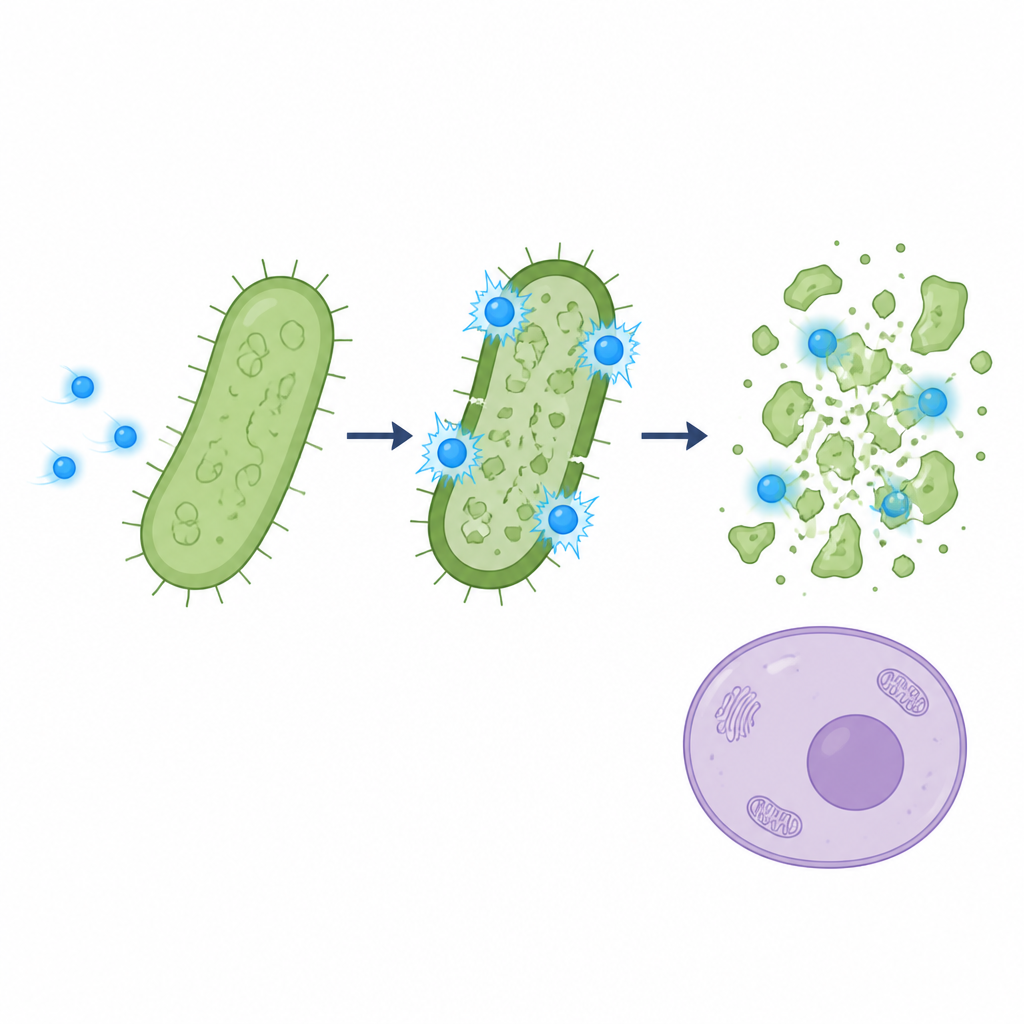
Bacteria often protect themselves by forming sticky communities called biofilms on surfaces. In this study, both types of zinc oxide particles reduced biofilm formation, but again the quantum dots stood out as more potent at the lower dose. At the same time, the team checked how these materials affected normal rat fibroblast cells. The cells showed only modest loss of viability under the same exposure conditions, suggesting that the quantum dots can stress bacterial cells more than healthy mammalian cells, an important sign of biocompatibility.
What this means for future germ control
Overall, the work shows that shrinking zinc oxide down to quantum dot size, using a simple laser in water method, makes the particles better at disrupting bacteria and their biofilms while keeping their impact on normal cells relatively low. For a non specialist, the takeaway is that not just the material, but its size and how it is made, strongly influence how well it can act as a microscopic cleaner against germs. Fine tuning laser energy offers a practical way to design zinc based particles that may one day help keep surfaces and medical tools safer from infection.
Citation: Hameed, R., Abdulrahman, T.E., Yaseen, G.S. et al. Antibacterial and biocompatibility potentials of zinc oxide quantum dots via Nd: YAG laser ablation. Sci Rep 16, 14871 (2026). https://doi.org/10.1038/s41598-026-44736-6
Keywords: zinc oxide quantum dots, nanoparticles, antibacterial activity, biofilm inhibition, laser ablation in liquids