Clear Sky Science · en
A novel fractional-order coupled model integrating a damped oscillator equation with a non-Fickian heat conduction equation
Why this matters for future materials
Modern aerospace parts, batteries, and protective coatings are often built from nanohybrid materials—composites where tiny particles are mixed into a host substance to boost strength, damping, or heat management. Yet these materials behave in ways that standard equations of motion and heat flow cannot fully capture, especially when past history and complex internal structure strongly influence how they vibrate and conduct heat. This paper introduces a new mathematical framework designed specifically to describe those long-memory, coupled thermo-mechanical behaviors, with an eye toward making advanced materials safer and more reliable.
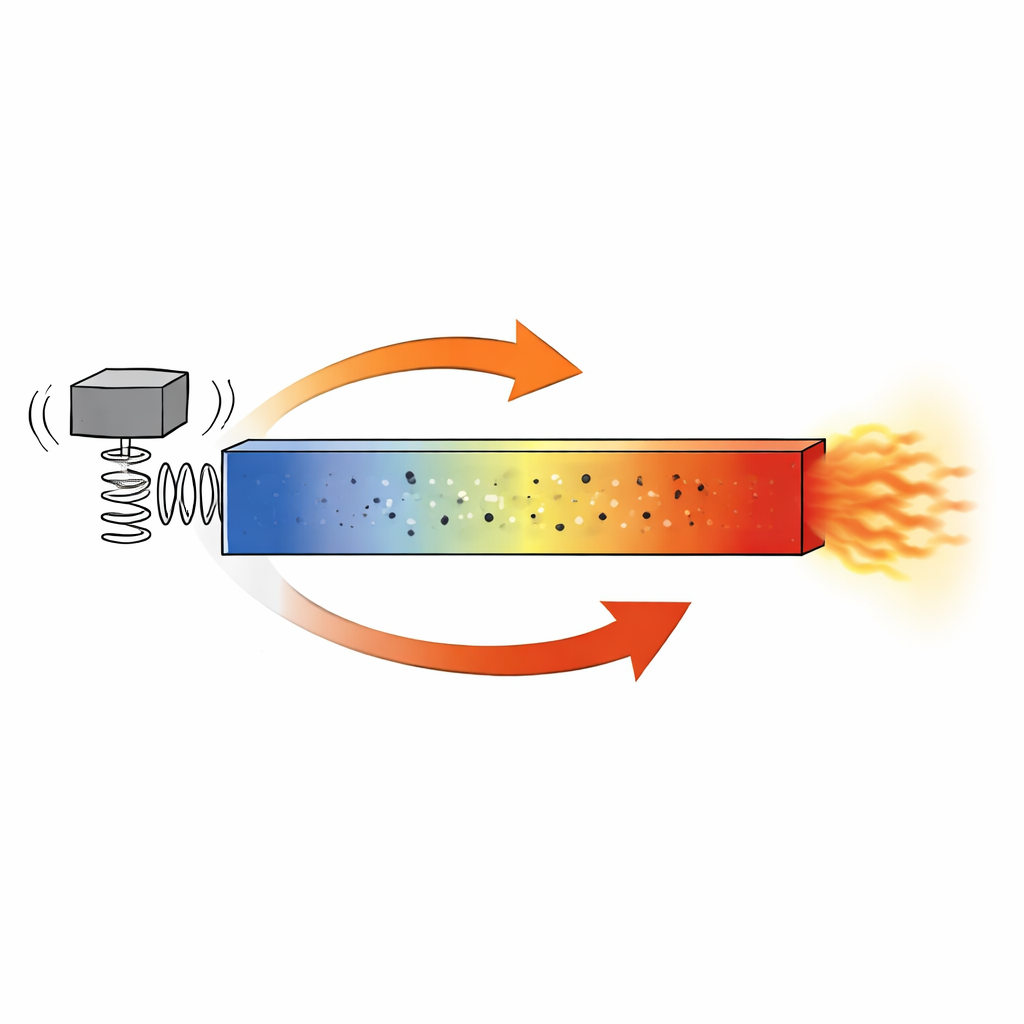
A new way to link shaking and heating
The authors build a unified model that ties together two familiar physical ideas: a damped mechanical oscillator (think of a mass on a spring with a dashpot) and heat conduction through a solid. Instead of using standard derivatives, which assume that systems respond instantly and locally, they employ so‑called fractional derivatives. In time, these capture how a material “remembers” past deformations and vibrations; in space, they describe how heat and other quantities spread in a way that can be either slower or faster than classical diffusion. By coupling these two ingredients, the model can represent how mechanical vibrations and heat transport influence one another inside a nanohybrid solid.
Capturing memory and nonstandard heat flow
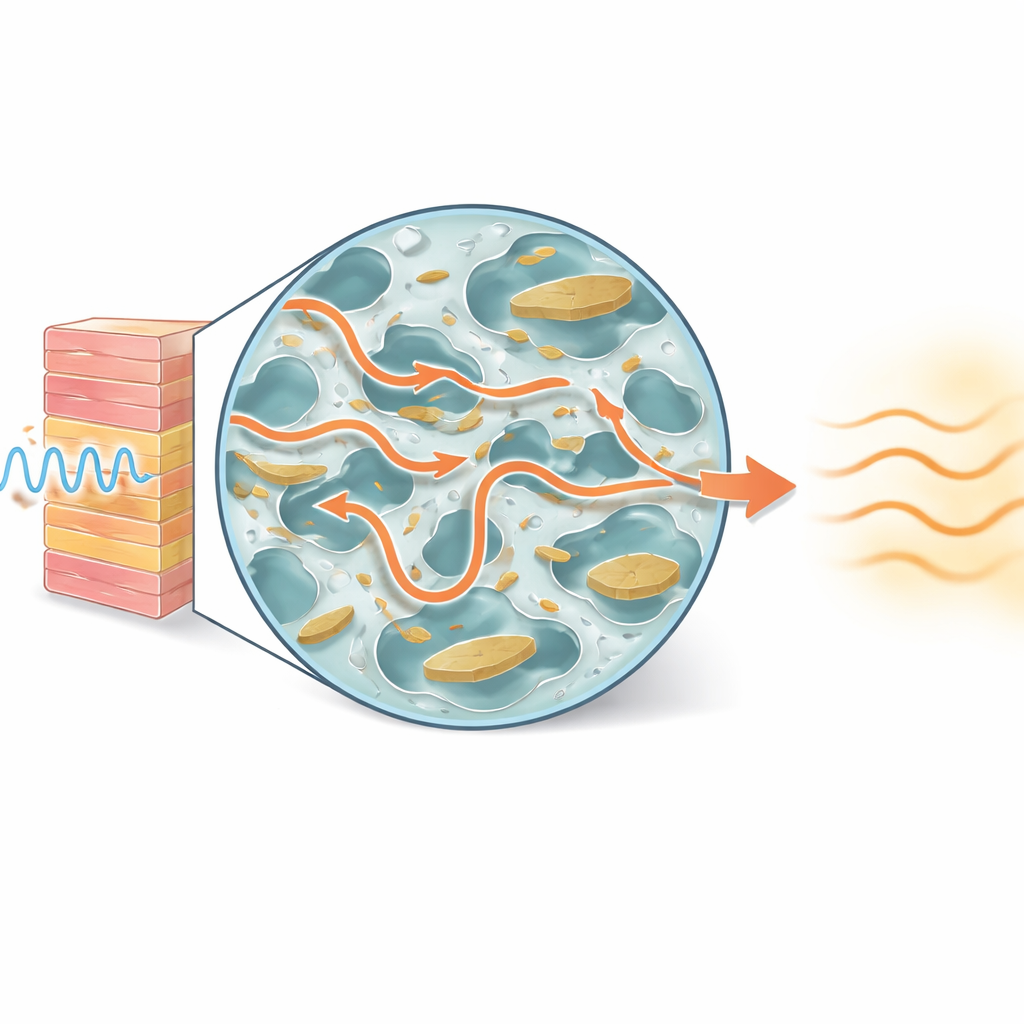
In nanohybrid materials, the presence of nanoparticles and a highly irregular internal structure causes two striking effects. First, mechanical damping does not follow a simple exponential decay; instead, the material can dissipate energy according to a power law, keeping a long tail of memory. Second, heat or mass does not spread according to the familiar Fickian law where diffusion is governed by a smooth second‑order equation. Instead, transport may be hindered or redirected by tortuous pores and interfaces, leading to non‑Fickian behavior. The fractional time derivative in the new model represents this viscoelastic memory, while the fractional space derivative encodes anomalous diffusion through the complex microstructure, making the equations better aligned with real experimental observations.
Guaranteeing predictable and stable behavior
Because the model is more sophisticated than classical equations, the authors devote substantial effort to proving that its solutions behave in a controlled, physically meaningful way. Using tools from functional analysis, they show that for appropriate conditions there is one and only one solution that fits the initial data, and that this solution remains uniformly stable: its energy stays bounded and responds smoothly to external forcing. They then extend the model to include an explicit time delay, representing lags in thermal relaxation and feedback between mechanical motion and temperature. Analyzing this delayed system, they derive conditions under which a Hopf bifurcation occurs—when a steady state loses stability and gives rise to sustained oscillations—and determine whether these emerging oscillations are stable or unstable.
What simulations reveal about long‑term response
To connect theory with practice, the researchers simulate their fractional model and compare it to a traditional integer‑order counterpart. Using established numerical schemes tailored to fractional derivatives, they study how a representative field—such as temperature or concentration—evolves in time and space. The fractional model shows a markedly slower decay and stronger memory than the classical one, mirroring the long‑lived responses observed in real nanocomposites. They also carry out a careful error and convergence analysis, confirming that the numerical methods reliably approximate the underlying equations and that refining the computational grid systematically reduces the residual error.
Implications for designing smarter materials
For a non‑specialist, the key message is that the new framework offers a more realistic way to predict how advanced nanohybrid materials will vibrate and conduct heat over long periods, especially when their past history matters and their internal structure is highly irregular. By unifying mechanical damping, unconventional heat flow, and delayed feedback into a single, mathematically sound model, the work lays the groundwork for better stability control and performance tuning in applications ranging from aerospace components to vibration‑heat coupling systems. In practical terms, engineers gain a tool that can be calibrated against experiments and then used to anticipate and manage complex dynamic behaviors before they show up in real hardware.
Citation: Li, T., Zhao, X., Zhang, Y. et al. A novel fractional-order coupled model integrating a damped oscillator equation with a non-Fickian heat conduction equation. Sci Rep 16, 14237 (2026). https://doi.org/10.1038/s41598-026-44718-8
Keywords: nanohybrid materials, fractional calculus, non-Fickian diffusion, viscoelastic damping, thermo-mechanical coupling