Clear Sky Science · en
Black hole information turbulence and the Hubble tension
Why the Universe’s Expansion Problem Matters
Our universe is expanding, but two of our best measurement methods disagree on exactly how fast. This puzzle, known as the “Hubble tension,” may signal that something important is missing from our picture of space, time, and matter. This paper explores a daring idea: that the way information behaves inside a black hole—specifically how it grows and becomes turbulent—could naturally produce two different cosmic expansion rates, mirroring the values that are currently in conflict.
Patterns That Repeat Across the Cosmos
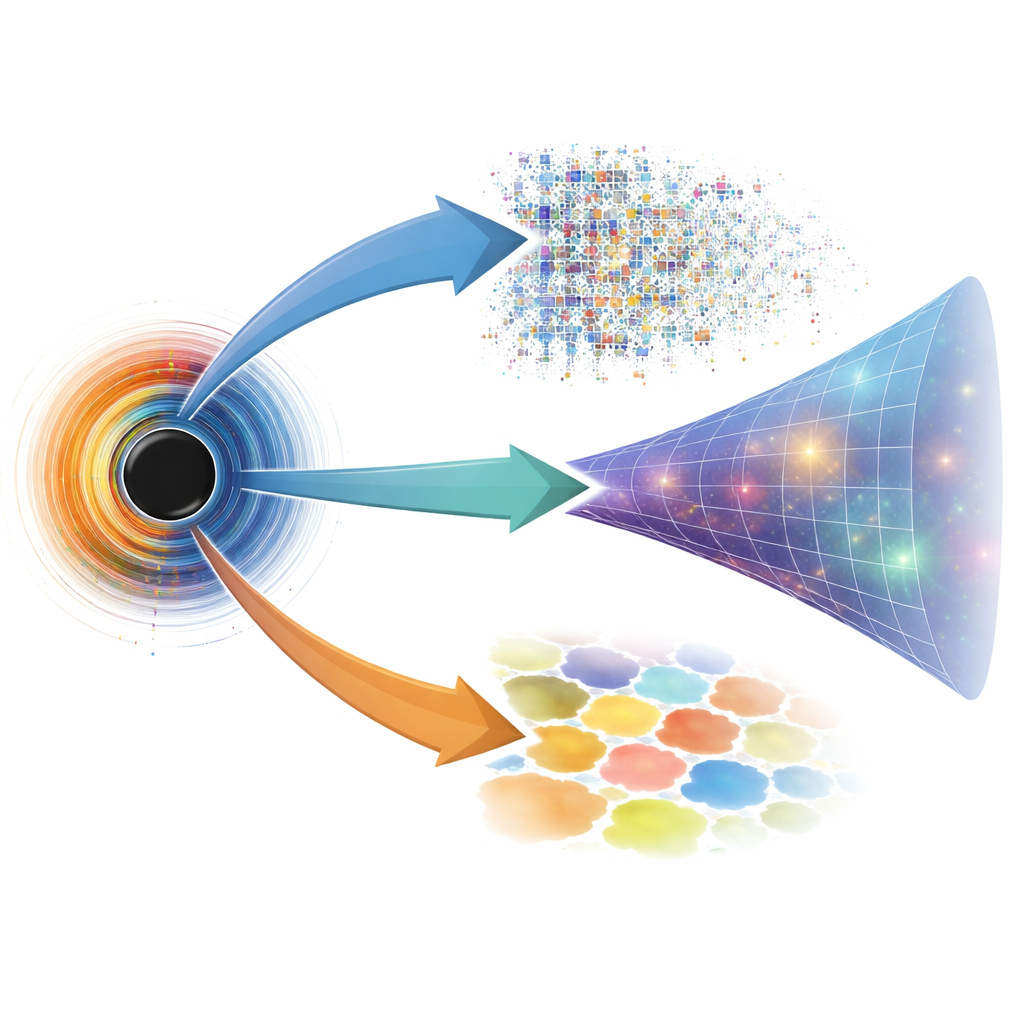
Fractals are shapes whose patterns repeat at many scales, like the branching of a tree or the jagged outline of a coastline. In cosmology, similar fractal-like behavior shows up in the cosmic microwave background and the large-scale web of galaxies. The author proposes that to understand the Hubble tension, we should look at how such repeating patterns might arise from deep physics, not just from visible matter, but from the very information that underlies spacetime. Building on modern ideas that spacetime could emerge from quantum entanglement, and that black holes behave like the most powerful possible information processors, the work treats a black hole interior as a kind of quantum circuit where information spreads and mixes.
From Quantum Circuits to Turbulent Information
Inside this quantum circuit picture, bits of quantum information—qubits—interact and “infect” each other step by step, much like individuals in a growing population. Previous work described this with a smooth, continuous equation. Here, the author keeps the dynamics in discrete steps and shows that the evolution follows a classic nonlinear rule known for producing chaos and complex behavior. When the finite resources inside the black hole are taken into account, the system enters a state the author calls information turbulence: a complicated, ever-branching pattern where coefficients that describe the system’s behavior form a fractal cascade, similar in spirit to how energy moves across scales in ordinary fluid turbulence.
A Fractal Mirror of Cosmic History
As this fractal cascade progresses, it fills a growing abstract “space” with both active elements and empty gaps. When the cascade runs out of resources, it stops and effectively runs in reverse as seen by an outside observer. The author tracks how the fractions of active and empty parts change during this backward evolution and discovers that their behavior closely resembles how the fractions of matter and dark energy change over cosmic time in standard cosmological models. By treating each step in the fractal as roughly analogous to a cosmic epoch, and by fitting the fractal data to familiar expansion models, the study links the geometry of this information cascade to the history of the universe’s expansion.
Two Ways Space Can Seem to Grow
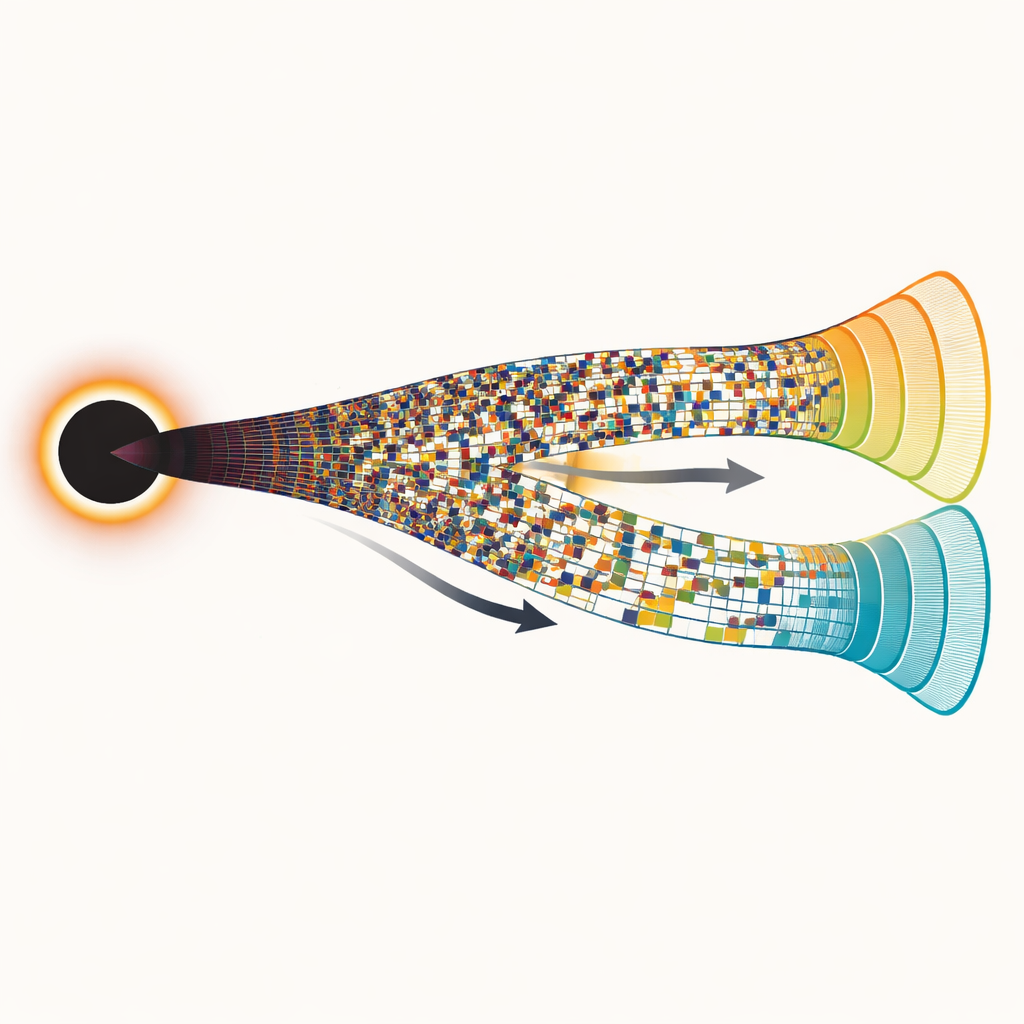
To make this link more concrete, the paper introduces two measures of how the fractal “fills” space. One measure focuses on the fine-grained dust of tiny elements, and another on larger repeating motifs or clusters. Both evolve as the cascade develops and recedes. When the rates of change of these measures are translated into effective expansion rates—using standard cosmological formulas—they naturally produce two different values for the Hubble constant. One aligns with the lower expansion rate inferred from the early universe (such as from the cosmic microwave background), which is sensitive to small-scale detail. The other agrees with the higher expansion rate measured from nearby galaxies and supernovae, which respond more to large-scale structure.
What This Means for the Hubble Tension
In everyday terms, the study suggests that the Hubble tension may not require mysterious new particles or large experimental mistakes. Instead, it could arise from the fractal, turbulent way information once evolved inside a black hole, shaping spacetime in such a way that different methods “see” different levels of structural detail. The work does not claim to be a full cosmological model, but it shows that a single underlying information process can mimic two distinct cosmic expansion rates. For a lay reader, the key message is that the universe’s conflicting expansion measurements might be a trace of deep, fractal information patterns written into the fabric of space itself.
Citation: Cabrera Fernández, J.L. Black hole information turbulence and the Hubble tension. Sci Rep 16, 14602 (2026). https://doi.org/10.1038/s41598-026-44713-z
Keywords: Hubble tension, black holes, fractal cosmology, information turbulence, cosmic expansion