Clear Sky Science · en
Carbon peaking pathways for topographic-constrained megacities: multi-scenario simulations and regional comparisons based on Chongqing
Why mountain megacities matter for climate
As the world races to cut greenhouse gases, most climate plans are drawn with flat, coastal cities in mind. But many of the fastest-growing urban centers sit in steep, crowded valleys where space, energy networks, and industry are shaped by rugged terrain. This study focuses on Chongqing, a vast inland city in southwest China, to ask a deceptively simple question: how can a mountainous megacity, locked into heavy industry and coal, find a realistic path to peak its carbon emissions?
How hills, rivers, and factories push emissions up
Chongqing’s landscape is dominated by four mountain ranges and deep river valleys, with more than 70% of its land covered by hills and mountains. That dramatic setting funnels development into narrow flatlands along rivers, creating tight clusters of factories, power facilities, and dense neighborhoods. These "valley industries"—especially steel, chemicals, and other heavy manufacturing—generate just a quarter of the city’s economic output but more than half of its carbon emissions. At the same time, the rugged terrain makes it harder and more expensive to build and run energy infrastructure, driving up energy losses and reinforcing dependence on coal. With over 30 million residents and rapid urbanization, these constraints translate into powerful upward pressure on carbon pollution.
Building a model tuned to local realities
Most tools used to forecast carbon emissions treat cities as if they were laid out on a flat map, and often rely on a few broad drivers such as population, income, and technology. The authors argue that this approach misses what really matters in a place like Chongqing: the tight coupling between industrial layout, energy use, and terrain. They adapt a widely used statistical framework known as STIRPAT to better fit mountainous cities by expanding it from three to six key factors. In addition to population, income per person, and urbanization, the model explicitly tracks the share of heavy industry, how much energy is needed to produce a unit of economic output, and how strongly the energy system leans on coal. To avoid misleading results caused by strong overlap among these factors, they apply a method called ridge regression, which stabilizes the estimates while keeping all six variables in play.
Testing future paths from now to mid‑century
With this tailored model in hand, the team first checked how well it could reproduce Chongqing’s recent emissions and found that its average error was under 5%, a strong performance for this kind of analysis. They then designed seven future storylines from 2023 to 2050, each combining different speeds of population growth, economic expansion, urbanization, industrial restructuring, and clean‑energy rollout. Some scenarios extend current trends; others imagine rapid growth with weak climate policies, or more modest growth paired with aggressive energy saving and a swift shift away from coal. For each storyline, the model traces how emissions rise, peak, and eventually fall. The results show that heavy industry, coal use, and overall population are the strongest drivers, while improvements in energy efficiency and a cleaner energy mix are the most effective brakes.
What an earlier and lower peak looks like
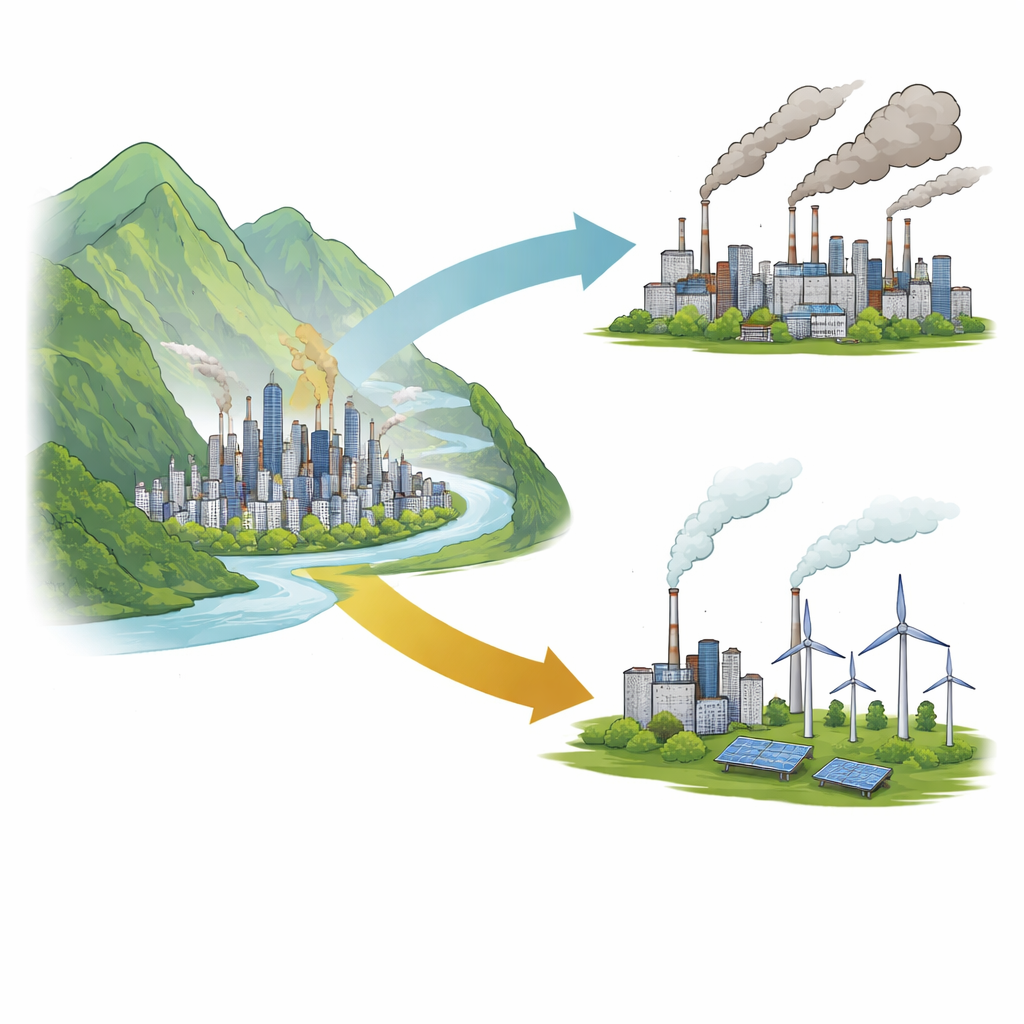
Across all scenarios, Chongqing does reach a turning point—but not always on the same schedule. If the city more or less continues on its current path, emissions peak around 2037. Under a high‑growth, high‑carbon route, the peak is pushed back to about 2043 and reaches the highest level. By contrast, a "slow‑growth plus high‑efficiency decarbonization" pathway—where economic expansion is steadier and policies strongly favor cleaner energy and leaner industry—brings the peak forward to 2035 and keeps it lower. In this more climate‑friendly case, emissions level off at just over 200 million tons of carbon dioxide before declining. However, even this earlier peak still lags behind China’s national goal of peaking emissions by 2030, underscoring the added difficulty for inland, terrain‑limited megacities.
Lessons for Chongqing and other mountain cities
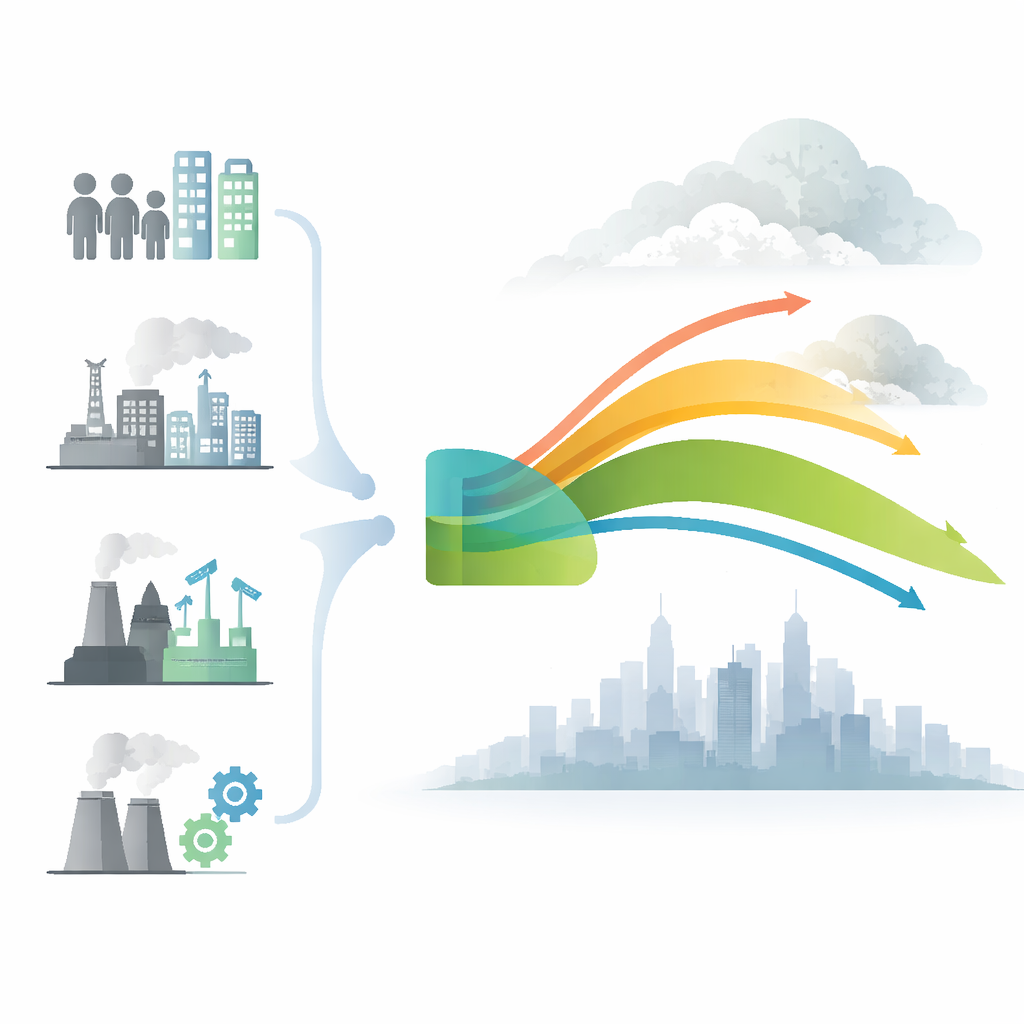
To see whether their insights travel beyond one city, the authors compare Chongqing with Yunnan Province, another mountainous region in southwest China. Both share steep terrain, but their economic foundations differ. In Chongqing, tightly packed heavy industries dominate emissions, so changes to industrial structure and coal use rank far above income growth as levers for cutting carbon. In Yunnan, where cleaner power resources such as hydropower are more abundant, rising income plays a bigger role in driving emissions. This contrast suggests that terrain matters less as a direct factor and more as something that shapes where factories sit and how energy flows. For Chongqing and similar "valley industrial" cities, the study argues that the most realistic route to an earlier and lower carbon peak is to focus on what local governments can actually steer: phasing down coal, upgrading or shifting heavy industry, improving energy efficiency, and deepening power links with cleaner neighboring regions so that seasonal gaps in local hydropower can be filled without defaulting to coal.
A big‑picture message for a warming world
Viewed from space, a ton of carbon dioxide from a valley factory in Chongqing looks no different from a ton emitted in a coastal metropolis. But on the ground, the forces shaping those emissions can be very different. This study shows that climate strategies built for flat, coastal cities cannot simply be copied into mountainous megacities and expected to work. Instead, emission pathways must respect terrain, industrial history, and energy networks. For Chongqing, that means pairing realistic growth with determined structural change in industry and energy. More broadly, it reminds planners that a fair and effective path to global carbon peaking will depend on understanding the physical and economic constraints of each region, and designing policies that work with, rather than against, the landscapes in which cities are built.
Citation: Liang, L., Ma, M. & Feng, J. Carbon peaking pathways for topographic-constrained megacities: multi-scenario simulations and regional comparisons based on Chongqing. Sci Rep 16, 14111 (2026). https://doi.org/10.1038/s41598-026-44711-1
Keywords: carbon peaking, mountainous cities, industrial structure, energy transition, Chongqing