Clear Sky Science · en
Research on short-term prediction method of photovoltaic power based on HPO-VMD-BiLSTM
Why better solar forecasts matter
As more homes, businesses, and cities turn to solar panels for clean electricity, a new challenge appears: the sun is not steady. Passing clouds, shifting seasons, and sudden storms make solar output rise and fall from minute to minute. Power grid operators must balance supply and demand in real time; if they cannot predict these swings, they risk wasting energy, overloading equipment, or turning to backup fossil-fuel plants. This paper presents a smarter way to forecast the short-term power output of a solar farm, aiming to make solar energy more reliable and easier to integrate into everyday power systems.
Seeing the full picture of changing weather
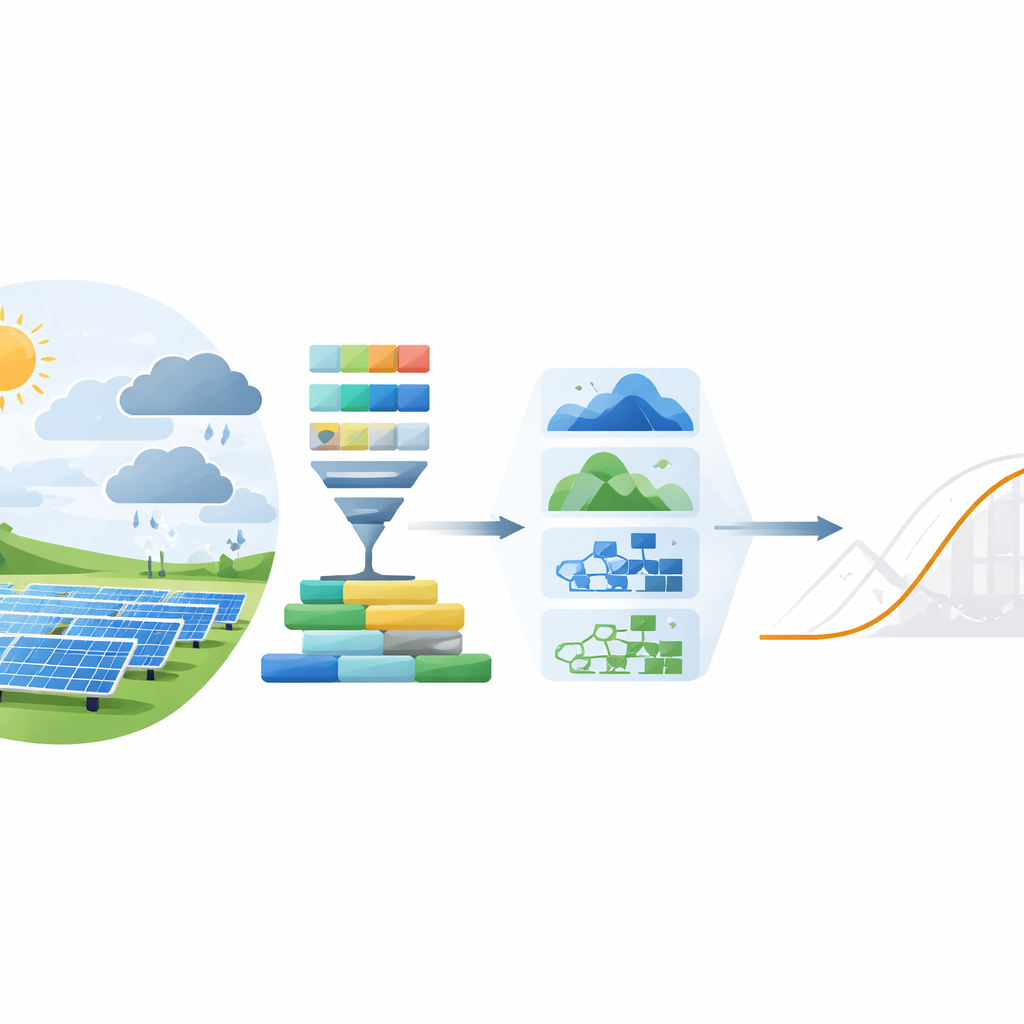
Solar power depends not just on sunshine, but on a mix of weather conditions such as cloud cover, humidity, and temperature. Many existing forecasting tools use only one of these signals, often total sunlight, which misses important details. The authors begin by building a rich weather portrait for each day at a solar farm in Alice Springs, Australia. For every day, they compute simple statistics—such as how often the sunlight peaks, how much it varies, and how skewed the pattern is—for several weather variables. They then group days into types, like sunny, cloudy, or rainy, using an improved form of a standard clustering method. Instead of treating every weather feature as equally important, their method adjusts how heavily each feature counts, based on how random or orderly it is over time. This leads to more realistic weather groupings and ensures the forecasting model trains on truly comparable days.
Taming noisy solar signals
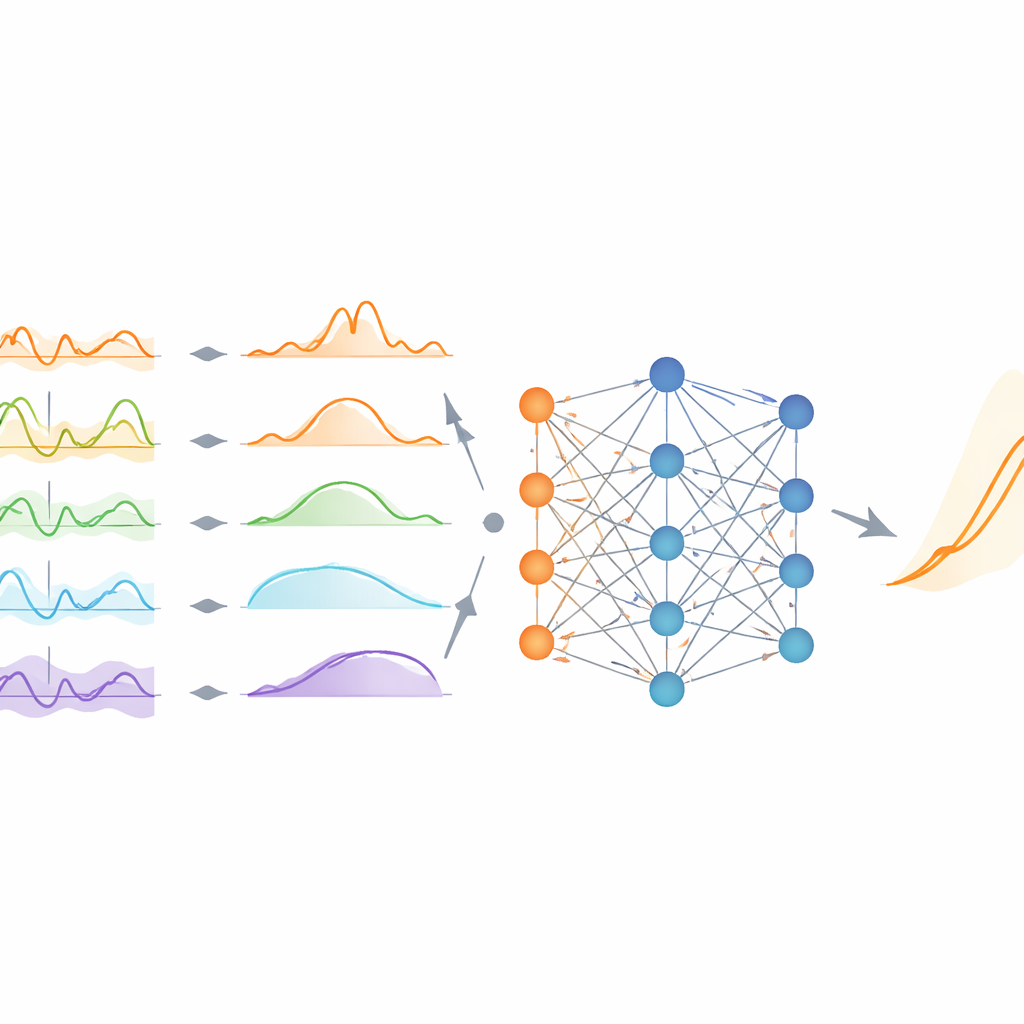
Even within one weather type, solar power data are bumpy and irregular. Small cloud patches or gusts of wind introduce sharp jumps that make it hard for a forecasting algorithm to learn stable patterns. To address this, the study applies a signal-processing step that breaks the raw power data into several simpler pieces. Each piece represents a different kind of fluctuation, from fast wiggles to slower trends. A key innovation is that the algorithm which performs this splitting no longer relies on hand-tuned settings; instead, a search process inspired by hunter–prey behavior automatically selects the best way to divide the signal. By letting the computer adapt these inner settings to the actual data, the authors reduce guesswork and obtain cleaner, more stable components for the forecasting stage.
Letting the model learn from past and future
Once the data have been grouped by weather and smoothed into components, the forecasting engine steps in. The authors use a type of neural network that is especially suited for time series, and that reads data in both directions along the timeline. In simple terms, this model learns how today’s solar power output depends not only on what happened just before a given moment, but also on patterns that become clear later in the day. Each decomposed component of the power signal, plus its key weather inputs, is fed into this model. Again, the hunter–prey search method is used to tune the model’s inner settings—such as how many neurons it has and how fast it learns—so that it can capture complex relationships without getting stuck in a poor solution or overfitting to noise. The forecasts for all components are then recombined into a final prediction for total solar output.
Putting the method to the test
The team tested their approach using real data from a 5.8 kilowatt solar array in Alice Springs over two years, sampling power and weather conditions every five minutes. They chose three representative days—sunny, cloudy, and rainy—and trained their model using several days with highly similar weather patterns. The new method was compared against a range of common tools, including traditional neural networks, simpler time-series models, and other mixed approaches that used either weather grouping or signal splitting alone. For each method, they measured how far its predictions deviated from the actual solar power values. Across all three weather types, the new hybrid method cut average errors by roughly one-third to nearly one-half compared with standard models, while also training faster than most of the more complex alternatives.
What this means for everyday power use
In plain terms, the study shows that combining smarter weather grouping, careful signal cleaning, and an automatically tuned learning model can make short-term solar power forecasts both more accurate and more robust. For grid operators, better forecasts mean they can plan ahead with greater confidence, switching other power plants on and off more efficiently and reducing waste. For communities investing in solar, this kind of forecasting helps make the technology a more dependable part of the energy mix. Although the authors note that more varied weather types and lower-quality data will need to be explored in future work, their results point toward forecasting tools that can keep pace as solar power grows from a promising option into a central pillar of the world’s electricity supply.
Citation: Li, J., Li, L., Du, Q. et al. Research on short-term prediction method of photovoltaic power based on HPO-VMD-BiLSTM. Sci Rep 16, 13541 (2026). https://doi.org/10.1038/s41598-026-44708-w
Keywords: solar power forecasting, photovoltaic grid integration, weather-based energy prediction, machine learning for energy, renewable energy stability