Clear Sky Science · en
Hyper-dimensional computing for enhanced label-free particle analysis in a flow-based optical detection system
Seeing Tiny Particles in a New Light
Many tests in medicine and environmental science depend on spotting and sorting tiny particles, from cells to plastic beads. Today this often requires chemical labels or bulky microscopes, which can be slow, costly, and sometimes stressful for living cells. This study shows how a clever mix of fast optical sensing and brain-inspired computing can sort particles by size without any labels, using compact hardware that could one day fit into portable diagnostic tools.
Why Label-Free Testing Matters
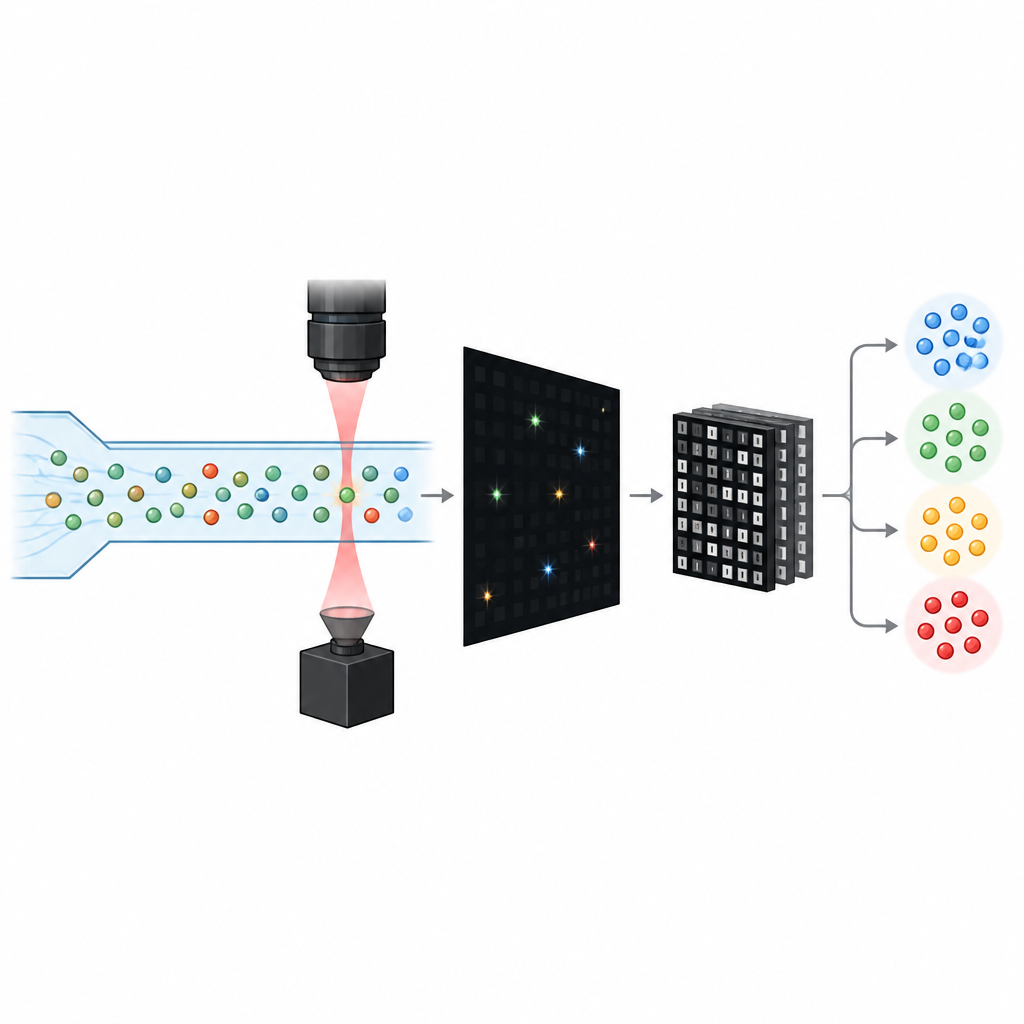
In standard flow-based optical systems, particles drift through a narrow channel while light shines on them, and cameras or detectors record how they scatter that light. If the particles are tagged with glowing dyes, they are easier to tell apart, but preparing these samples takes time and may alter the very cells scientists hope to study. Label-free methods skip the dyes and instead read out the natural optical fingerprints of each particle, such as how they bend or scatter light. The challenge is that these raw patterns are complex and arrive very quickly, so turning them into reliable decisions in real time is not straightforward.
A Camera That Listens for Change
The researchers replaced a normal video camera with an event-based sensor, a device that responds only when the brightness at a pixel changes. As polystyrene beads of four different sizes flowed through a thin plastic channel and crossed a focused laser beam, the sensor recorded bursts of light and dark events that traced the evolving interference patterns around each bead. Because it ignores static background, the camera generates far less data and captures motion with very fine timing, which is ideal when thousands of particles rush past every second. The team also carefully designed their measurements so that each bead type was recorded under varied conditions, reducing hidden biases that might otherwise inflate accuracy.
Brain-Inspired Codes for Fast Decisions
Instead of training a heavy neural network, the team used hyper-dimensional computing, which represents each pattern as a very long binary code called a hypervector. Positive and negative events from the sensor are turned into separate binary maps and then combined, preserving subtle differences in how the light brightens and darkens. During training, many hypervectors from the same bead size are merged into a single prototype code for that class. During testing, a new pattern is encoded and compared against these prototypes, and the bead is assigned to the class whose code is most similar. This approach needs only simple operations on bits, yet still reached over 93 percent accuracy without any extra optical tricks.
Shaping Light to See More Clearly
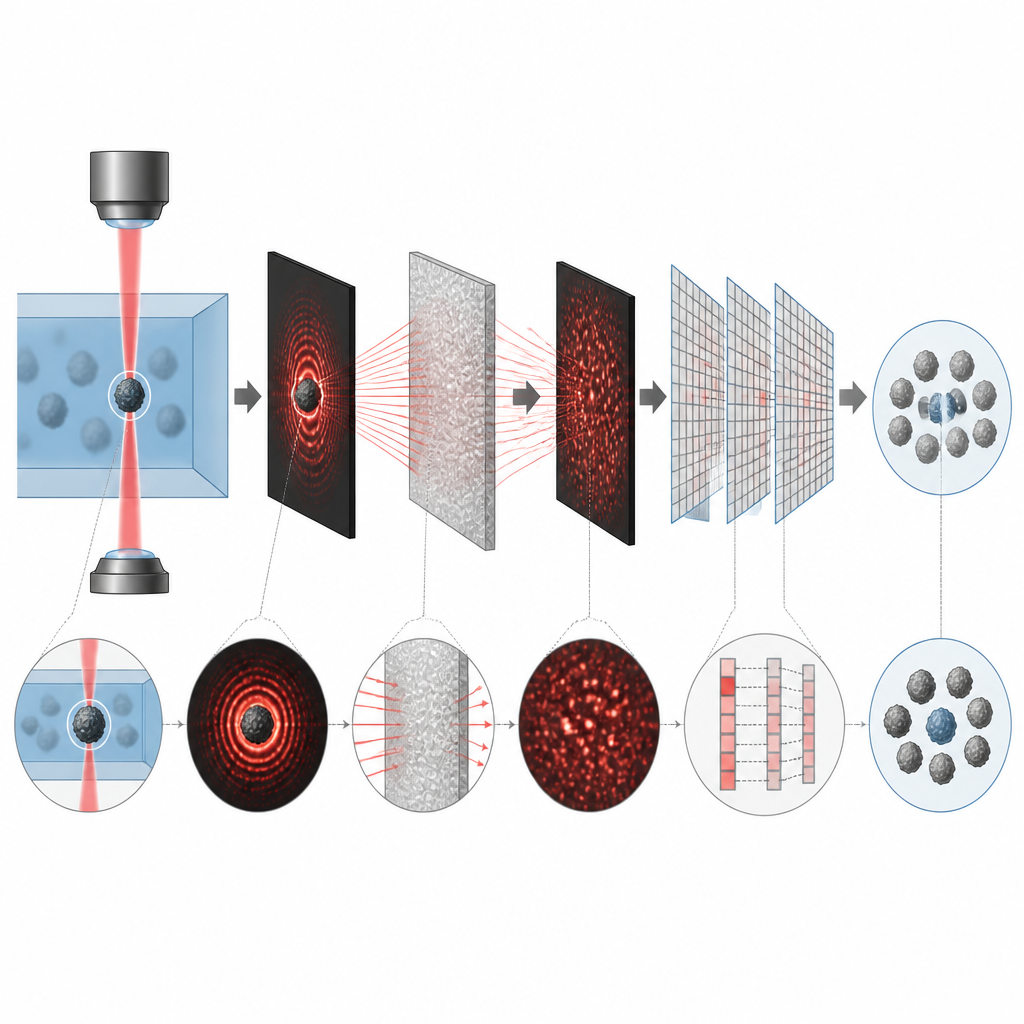
To push performance further, the researchers placed a sheet of ground glass between the channel and the camera. This scattering layer spreads the light into richer speckle patterns that carry more distinctive signatures for each bead size. By testing diffusers with different surface roughness, they found that a coarser piece of glass produced broader and more informative patterns, boosting average accuracy up to 98.67 percent. They also showed that they do not need to keep every pixel: down-sampling the images to moderate resolutions preserved most of the accuracy while cutting computational cost, reinforcing the method’s suitability for small, energy-efficient devices.
From Plastic Beads to Real-World Samples
The work uses simple plastic beads as a clean test case, proving that the combination of event-based vision, smart optical scattering, and hyper-dimensional computing can classify flowing particles quickly and with high reliability. Moving to real cells and more varied particles will add complexity, because shape, internal structure, and material differences all influence how light is scattered. Still, the results suggest a path toward compact, label-free systems that not only detect but may eventually help sort particles in real time, supporting future tools for diagnostics, environmental monitoring, and industrial quality control.
Citation: Yue, Y., Gouda, M., Sunada, S. et al. Hyper-dimensional computing for enhanced label-free particle analysis in a flow-based optical detection system. Sci Rep 16, 14900 (2026). https://doi.org/10.1038/s41598-026-44705-z
Keywords: label-free flow cytometry, event-based imaging, hyper-dimensional computing, microparticle classification, microfluidics