Clear Sky Science · en
Environmental enrichment as an immunostimulant for rainbow trout aquaculture
Why fish tanks need more than clean water
Most of the fish we eat today are raised in farms rather than caught in the wild. These farms usually use bare tanks that are easy to clean but offer fish little to do or explore. This study asked a simple but powerful question: could adding a few simple structures to trout tanks not only improve fish welfare, but also make the animals naturally more resistant to disease—without drugs, vaccines, or special feeds?
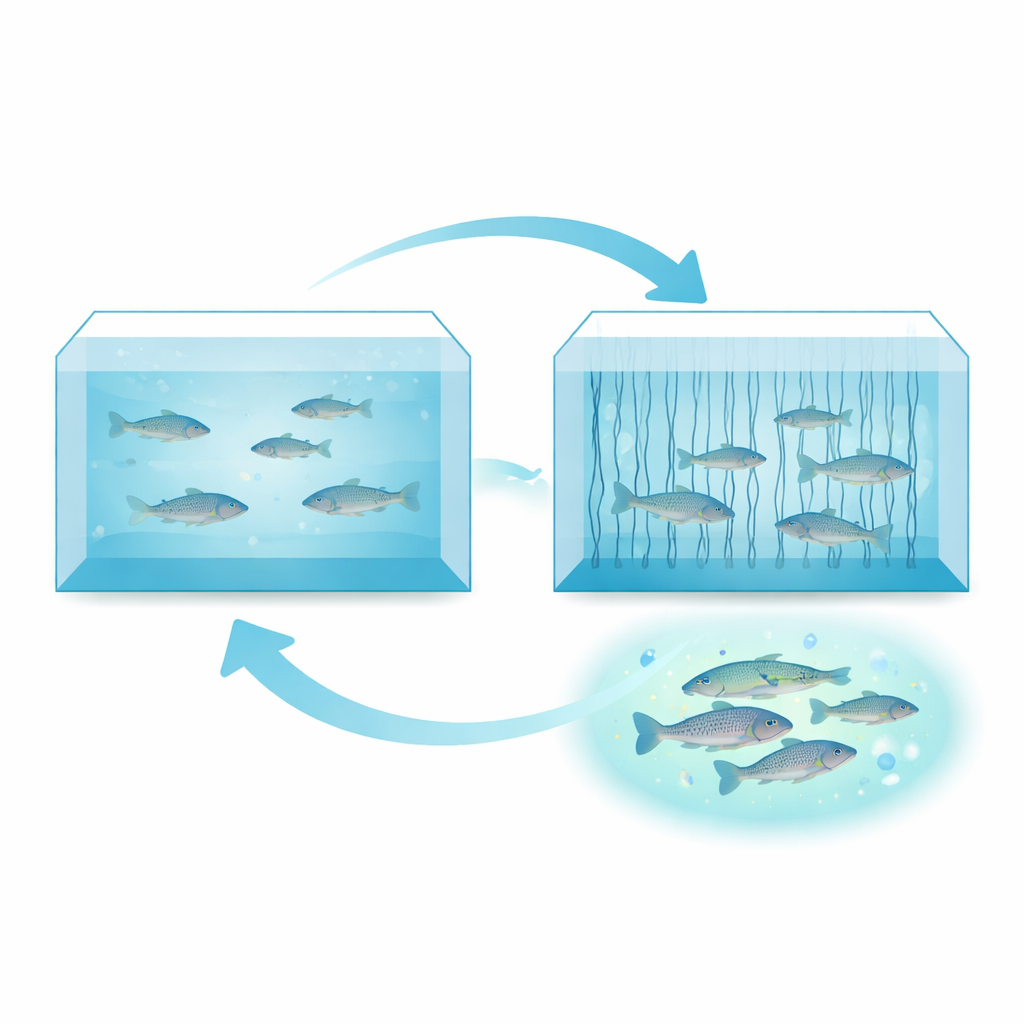
Making tanks feel a bit more like rivers
The researchers worked with young rainbow trout, one of the world’s most important farmed fish. They compared bare glass tanks with two types of added structure meant to mimic elements of a natural stream. In one setup, a layer of gravel covered the bottom, like a riverbed. In another, thin rubber cords hung down through the water, loosely resembling underwater plants. A control group of tanks remained completely bare. The team then watched the fish for two months, recording their behavior, levels of the stress hormone cortisol, and a range of immune-system measures drawn from blood and a key immune organ called the head kidney.
How fish behaved and coped with stress
Trout are social but can also be quarrelsome, forming pecking orders through chasing and nipping. The scientists counted chasing events to see whether added structures calmed or inflamed tensions. Over time, aggression generally declined in all tanks, but patterns suggested that enrichment helped fish sort themselves into more stable social groups and use space differently. Vertical cords, in particular, seemed to create sheltered areas and pathways that fish could claim or avoid. Surprisingly, average cortisol levels—the standard chemical readout of stress—did not differ clearly between setups. However, the spread of cortisol values was wider in enriched tanks, and smaller fish tended to have higher cortisol than larger ones. This points to social hierarchies forming and affecting individuals differently, even when the group average looks unchanged.
Inside the trout’s internal defenses
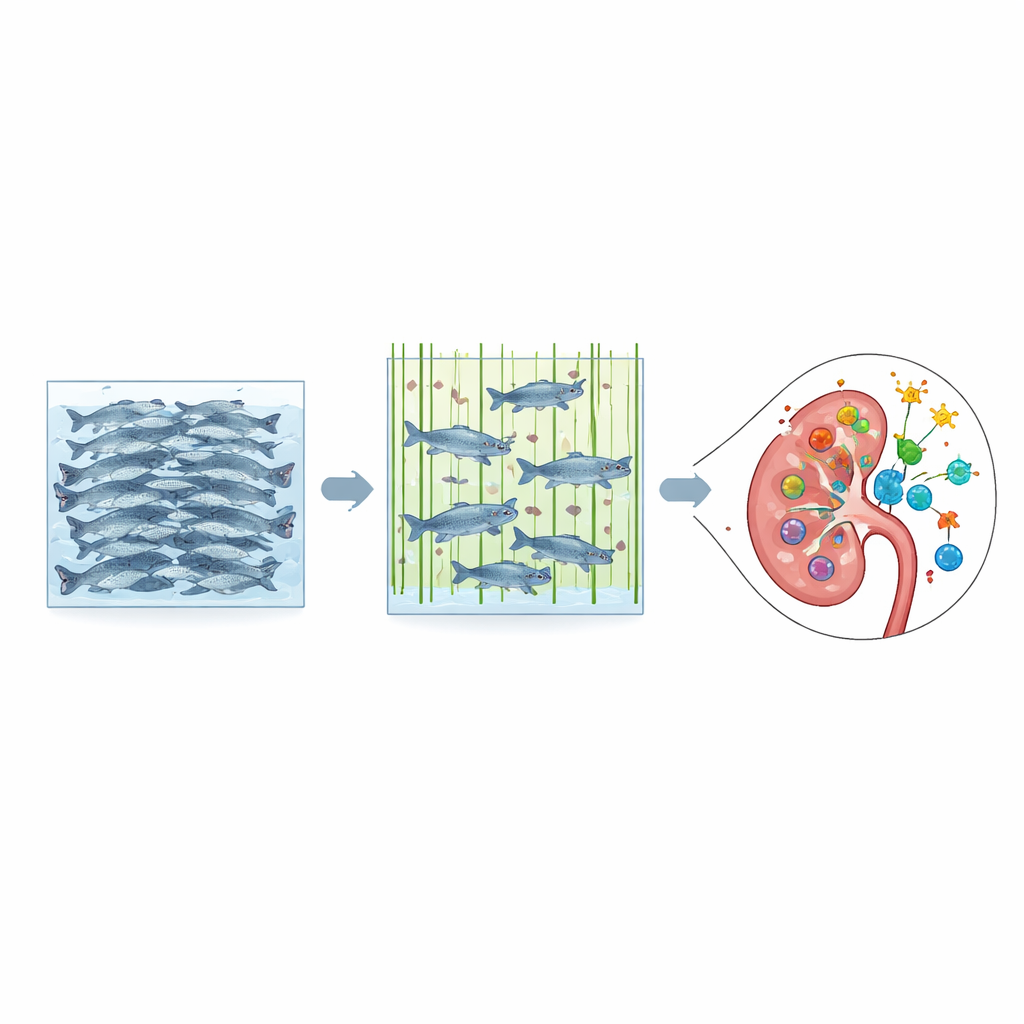
Beyond behavior, the heart of the study lay in carefully measuring how the immune system responded to different tank designs. Rather than looking only at how many immune cells the fish had, the team probed how well these cells functioned. In both experiments, trout kept with vertical cords generally showed fewer circulating immune cells of several types. On its own this might sound worrying, but functional tests told a different story. Under more crowded conditions—twice as many fish per tank—the trout with vertical cords showed stronger signs of immune readiness: their defensive cells produced more reactive oxygen molecules that help kill invaders, contained more of a key protective enzyme, and their blood had higher activity of lysozyme, a natural antibacterial substance. Taken together, these changes indicate a more efficient, better primed immune system rather than simple over-activation.
Good complexity versus harmful overdrive
The gravel-bottom tanks told a cautionary tale. Fish living over gravel sometimes showed signs of heightened inflammation, such as shifts in the balance of different white blood cell types and hints of increased oxidative activity. While this can mean the body is on alert, long-term overdrive of these responses risks damage to the fish’s own tissues. In contrast, the vertical-cord setup appeared to strike a healthier balance: it boosted key defensive functions, especially when the fish were crowded, without the same signs of chronic inflammatory strain. Importantly, growth, body condition, and organ size were similar across all treatments, so the immune benefits came without any obvious cost in performance.
What this means for future fish farms
To a non-specialist, the message is straightforward: a few simple hanging structures in a fish tank can work like a natural “vitamin” for the animals’ immune system. By modestly enriching the environment, farms may help trout handle crowding better and become more resilient to infections, potentially reducing the need for chemical treatments or intensive vaccination programs. Vertical cords are cheap, easy to clean, and practical at large scale, making them a realistic option for commercial aquaculture. While future work must confirm that these immune boosts translate into fewer disease outbreaks, the study shows that designing tanks with the fish’s natural preferences in mind can pay off not only in welfare, but also in health.
Citation: Subramani, P.A., Gennaraki, M.A., Emami, N. et al. Environmental enrichment as an immunostimulant for rainbow trout aquaculture. Sci Rep 16, 12367 (2026). https://doi.org/10.1038/s41598-026-44702-2
Keywords: aquaculture welfare, rainbow trout, environmental enrichment, fish immune system, tank design