Clear Sky Science · en
Mechanical, microstructural, and free-vibration characteristics of concrete reinforced with recycled E-waste PVC fibers
Turning Old Cables into Stronger, Quieter Concrete
Every year, mountains of discarded electrical cables pile up, posing a growing waste problem. This study explores an unexpected way to give some of that trash a second life: chopping up the plastic-coated copper wires and mixing them into concrete. The researchers wanted to know whether these recycled fibers could not only make concrete stronger, but also help buildings and infrastructure vibrate less under traffic, wind, or machinery.
From E-Waste Pile to Building Material
The team started with electrical cables headed for disposal. They stripped off the outer sheathing and cut the insulated copper conductors into short pieces 30 or 50 millimeters long. In the concrete mix, these pieces act like tiny reinforcing threads, with the plastic (PVC) coating touching the cement while the copper core stays buried inside. The researchers prepared a standard high-quality concrete and then made several versions containing different amounts of these fibers, plus a plain “control” mix with no fibers for comparison. They cast cubes for compression tests, beams for bending tests, and longer beams to study how the material behaves when it vibrates freely after being pushed and released. 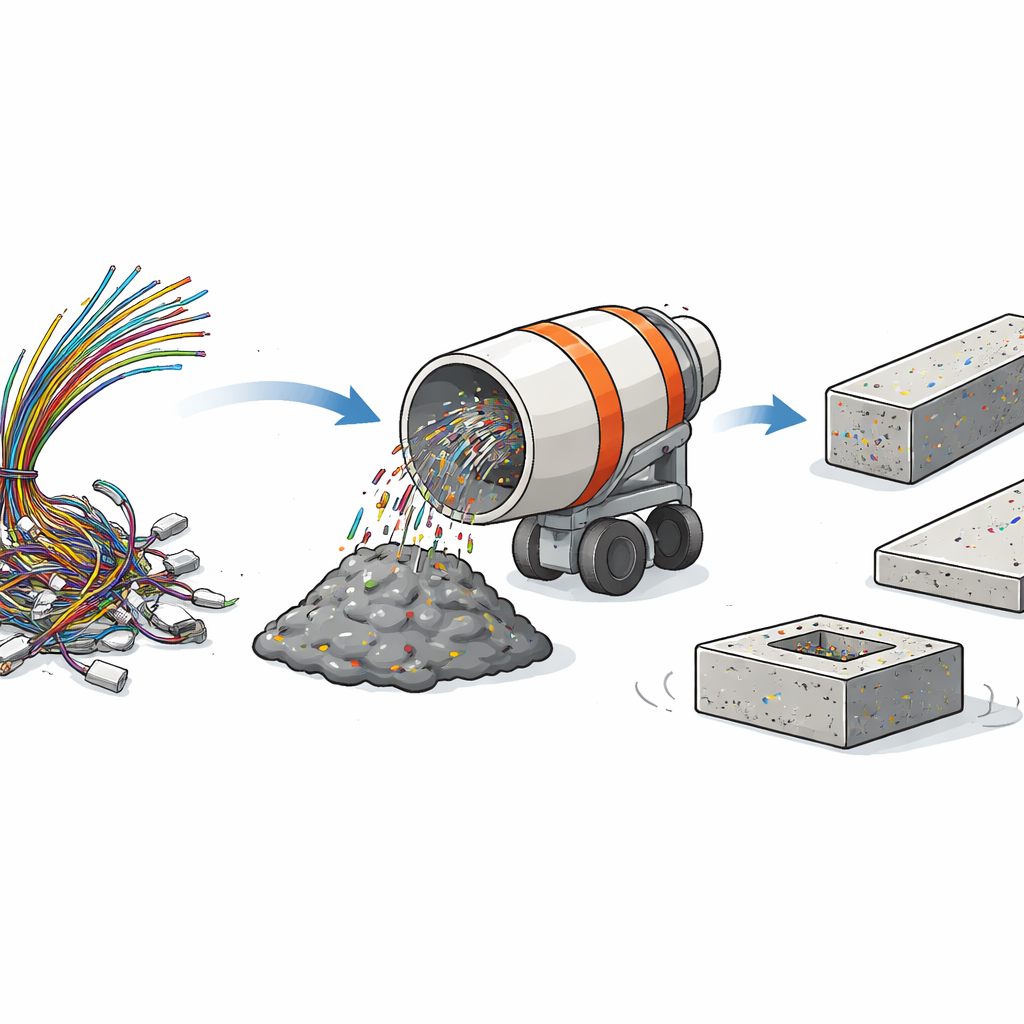
Balancing Strength: Pushing and Bending
When the concrete cubes were squeezed, a moderate fiber content of 0.8 percent by weight gave the highest compressive strength, about 8 percent higher than plain concrete. Adding more fibers beyond that point slightly weakened the material under pure compression, likely because the extra fibers started to clump and create tiny weak spots or extra pores. In bending tests, however, the story reversed. As the fiber content increased up to 1.2 percent, the beams became steadily better at resisting cracks, gaining over 22 percent more flexural strength than the control. Longer fibers (50 millimeters) provided an extra boost in bending performance compared with shorter ones, because their greater “embedment” in the concrete helps them bridge wider cracks and absorb more energy before pulling out.
Quieting Vibrations in Everyday Structures
Many concrete structures—industrial floors, foundations under heavy machines, elevated roadways—are constantly shaken by moving loads. The ability of a material to soak up this motion is captured by its damping ratio: a higher value means vibrations die out faster. The researchers clamped one end of each beam like a diving board, pulled down the free end with a known force, and let it go. Using a small motion sensor linked to an inexpensive microcontroller, they recorded how the vibrating beam gradually came to rest. By fitting the measured motion to a simple “decaying wave” model, they extracted how quickly energy was lost. Beams with the highest fiber content (1.2 percent) showed damping ratios up to about 7.5 percent higher than plain concrete, especially at larger vibration amplitudes. Fiber length helped slightly—longer fibers increased damping by a couple of percent—but the amount of fiber mattered more. 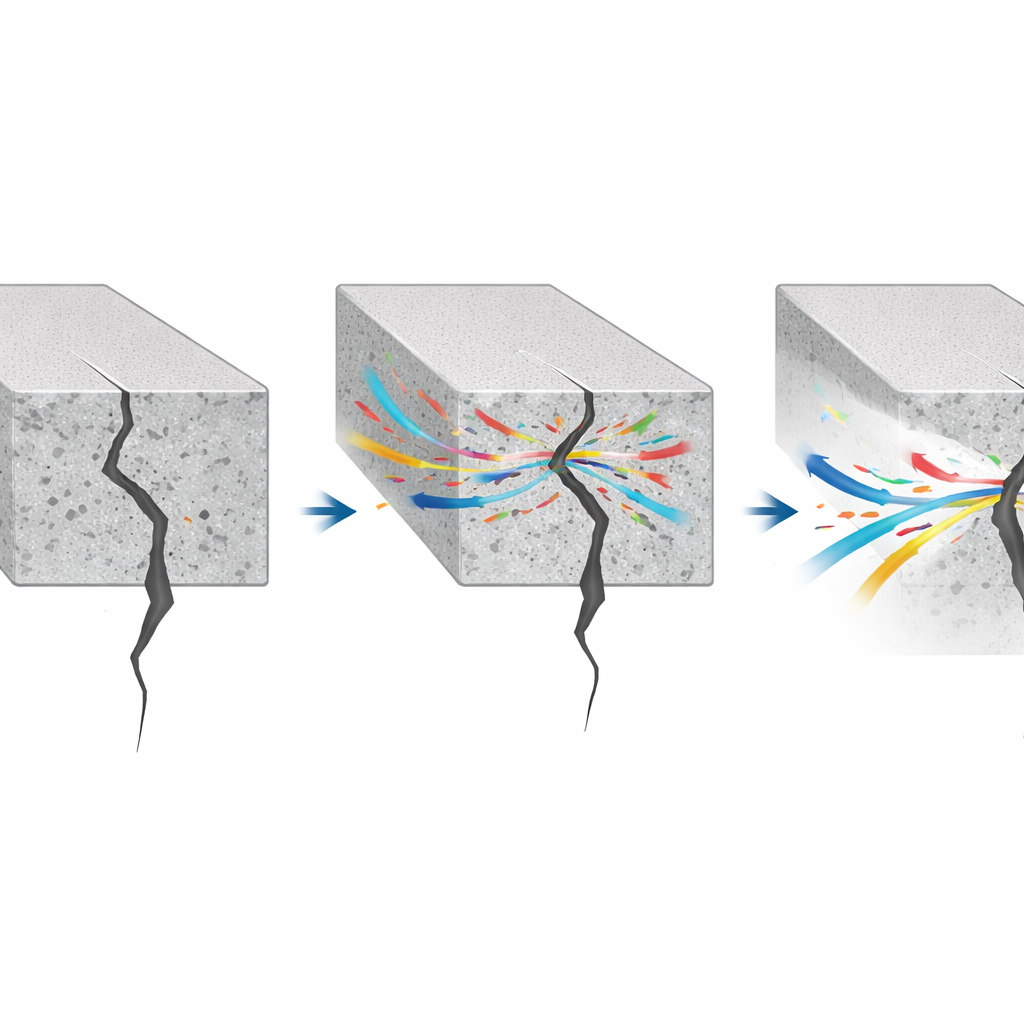
What Happens Inside the Concrete
To see what was going on at the microscopic level, the team examined broken pieces of the test specimens using a scanning electron microscope. They found a dense, well-formed cement paste surrounding the fibers, with typical crystal structures that develop as concrete hardens. At the boundaries where fibers met the cement, they observed hardened paste clinging to the fiber surfaces and signs of controlled separation and pull-out. In some cases, the plastic coating had been partly stripped from the copper core during cracking. These features point to a tough, frictional interface: as cracks try to open, fibers stretch, slide, and gradually pull out, converting mechanical energy into harmless heat and microscopic damage instead of allowing sudden, brittle fracture or long-lasting vibrations.
Why This Matters for Greener, Smarter Construction
In simple terms, this research shows that finely chopped insulated wires from electronic waste can help concrete do two valuable things at once: better resist bending cracks and slightly damp out vibrations, all while making use of a troublesome waste stream. There is a sweet spot in how much fiber to add: around 0.8 percent for preserving compressive strength, and up to about 1.2 percent if vibration control and crack resistance are top priorities. Although more detailed tests are still needed to fully separate material behavior from the test setup, the results suggest that turning old cables into microscopic reinforcements could be a practical step toward sturdier, quieter, and more sustainable concrete structures.
Citation: Admasu, M.B., Gissila, B., Aklilu, A. et al. Mechanical, microstructural, and free-vibration characteristics of concrete reinforced with recycled E-waste PVC fibers. Sci Rep 16, 14325 (2026). https://doi.org/10.1038/s41598-026-44699-8
Keywords: recycled concrete, e-waste fibers, PVC fiber reinforcement, vibration damping, sustainable construction