Clear Sky Science · en
Quasi-elastic neutron scattering studies on bacterial spores and their hydration water
How Sleeping Bacteria Outsmart Extreme Conditions
Bacterial spores are nature’s survival capsules. When food runs out, some bacteria pack themselves into tiny armored shells that can shrug off boiling, drying, radiation, and harsh chemicals for years. This study asks a deceptively simple question with big implications for food safety, sterilization, and even life’s limits: what is water doing inside these sleeping cells, and how does that help them endure such abuse without dying?
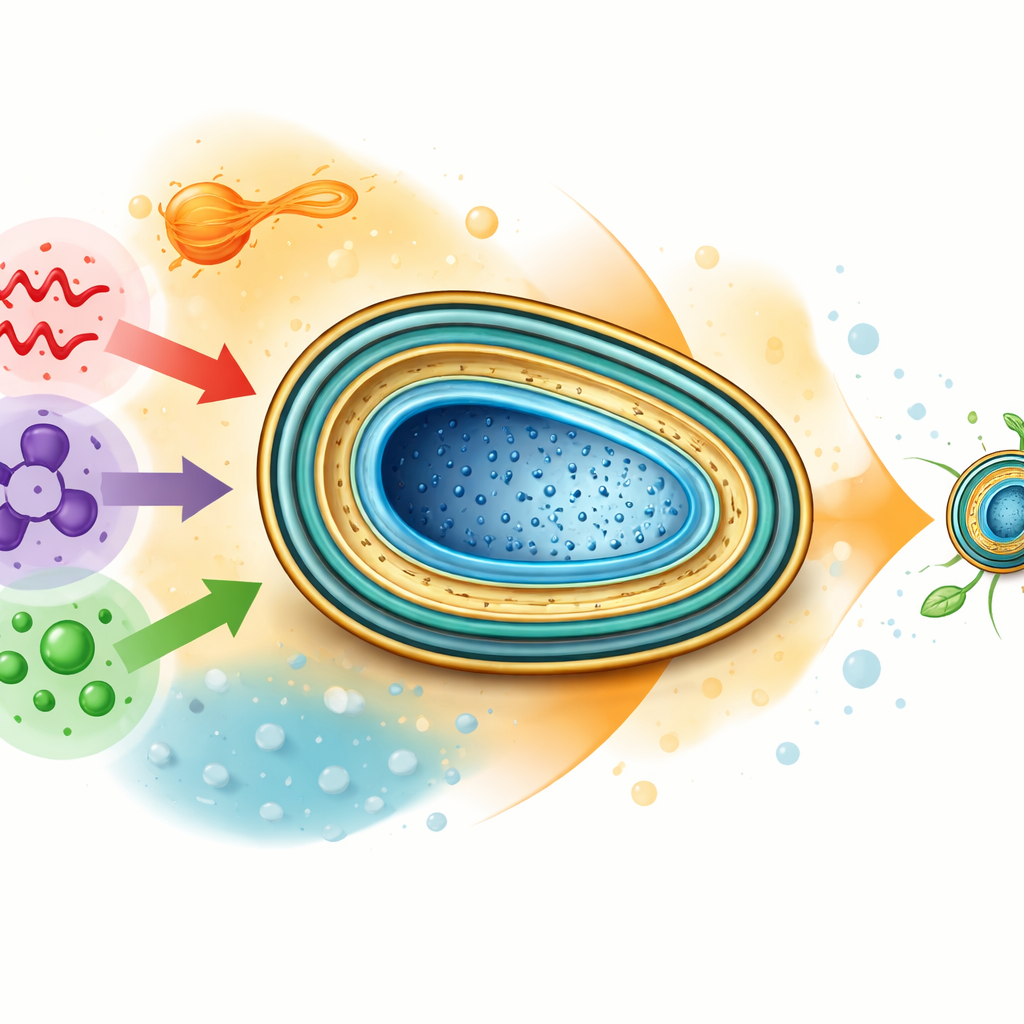
A Tiny Fortress with Many Walls
Bacterial spores, such as those from Bacillus subtilis, are not just shrunken versions of normal cells. They are built like an onion, with multiple protective layers. On the outside sit tough protein coats and a rigid cortex made of a sugar–protein mesh; deeper inside are membranes and, at the center, a core that holds the spore’s DNA and most of its proteins. Unlike growing cells, which are mostly water, the core is relatively dry, with only about one quarter to two fifths of its weight made of water. It is also packed with a special chemical, dipicolinic acid bound to metal ions, which shapes the physical state of this inner compartment.
Following Invisible Motions with Neutrons
Directly watching water and molecules move inside such a tiny, layered particle is extremely hard. The researchers turned to quasi-elastic neutron scattering, a technique that fires neutrons at the sample and infers how fast atoms are jiggling from the tiny changes in the neutrons’ energy and direction. Because hydrogen atoms scatter neutrons very strongly, this method is especially sensitive to water and to hydrogen-rich parts of proteins, lipids, and sugars. The team measured intact spores, spores stripped of their outer coat, and a mutant that largely lacks dipicolinic acid. They studied them in fully hydrated form and at controlled humidity, and on instruments tuned to different time windows, from about a trillionth of a second up to a billionth of a second.
Separating the Dance of Water from the Crowd
The neutron signal is a mix of many overlapping motions: slow reorientation of whole proteins, quicker twitches of side chains, and the darting of water molecules. To isolate the behavior of water inside the spores, the authors modeled how typical proteins, membrane lipids, and simple sugars would scatter neutrons, based on earlier measurements. They then subtracted these contributions from the spectra of whole spores. What remained largely reflected water in and around the core. Across conditions, the data could be described by two main types of motion: slower, confined reorientations, and faster, jump-like movements where molecules rattle in place before hopping to a new position.
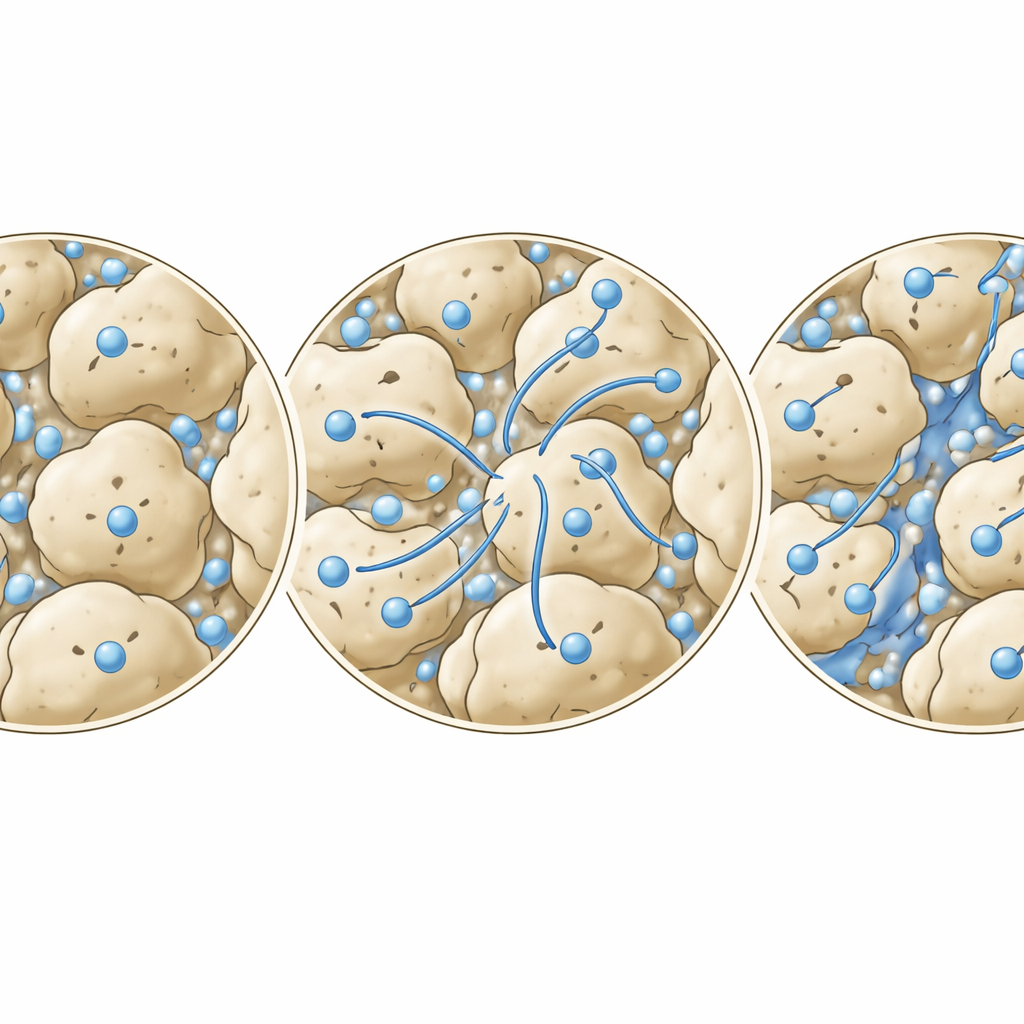
Slow Proteins, Surprisingly Fast Water
The picture that emerged is striking. On relatively long nanosecond time scales, the proteins that make up the bulk of the spore interior move, but very sluggishly, more like those in dense, partially dried protein powders than in a living cell. This slowdown is linked to crowding and confinement in the compact core. Yet the water in and around that core does not behave like stiffly bound “glassy” water. Instead, most water molecules are quite mobile, with diffusion rates similar to or even greater than bulk liquid water, though confined to nanometer-sized cages formed by the surrounding matrix. Only a small fraction appears effectively locked down. The mutant spores lacking dipicolinic acid show somewhat higher mobility of both biomolecules and water, suggesting that this core chemical helps tighten and stabilize the dormant state.
Why This Matters for Survival and Revival
To a non-specialist, the key message is that spore survival is not about freezing everything solid. Inside the spore, large molecules are slowed just enough to prevent damage and unwanted reactions, while small groups and water molecules remain nimble. This combination—sluggish global motion with fast, localized water dynamics—creates a poised state: robust against heat and other stress, yet ready to “wake up” quickly when nutrients return. Understanding this delicate balance helps explain why spores are so hard to kill in food processing and medical settings, and it points to new ways to control them by targeting how water and crowding shape their hidden inner life.
Citation: Colas de la Noue, A., Matsuo, T., Natali, F. et al. Quasi-elastic neutron scattering studies on bacterial spores and their hydration water. Sci Rep 16, 14453 (2026). https://doi.org/10.1038/s41598-026-44676-1
Keywords: bacterial spores, water mobility, neutron scattering, dormancy, Bacillus subtilis