Clear Sky Science · en
Single-channel EEG-based seizure prediction using deep learning
Why predicting seizures matters
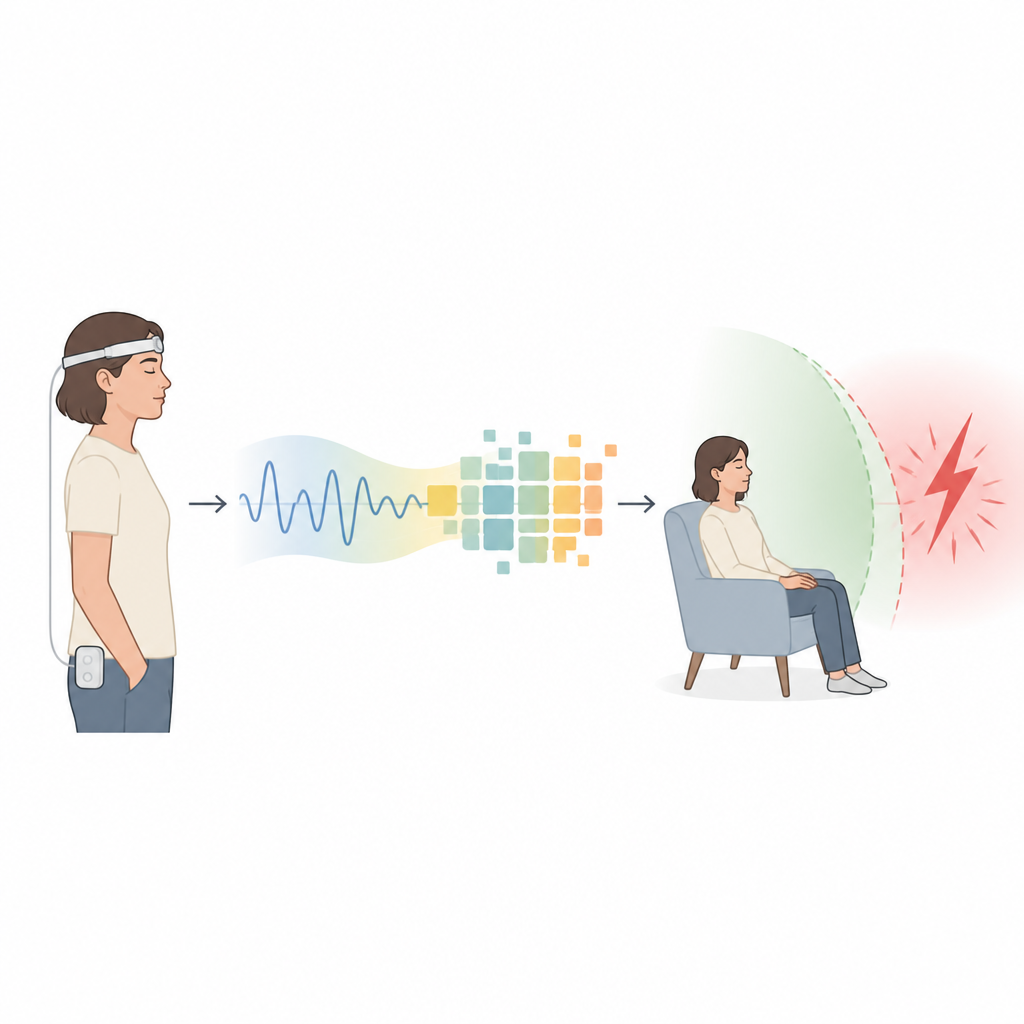
For many people with epilepsy, seizures strike without warning, disrupting work, school, and everyday life. A system that could reliably warn of an oncoming seizure, even just a few minutes in advance, would give patients time to sit or lie down safely, call for help, or pause a risky activity such as driving or cooking. This study explores whether such warnings can be generated from a single small brainwave sensor, instead of a full cap of hospital electrodes, using a compact form of artificial intelligence that could eventually run in a wearable device.
A simpler way to watch brain activity
Most research on seizure prediction has relied on complex recordings with many electrodes placed across the scalp. These systems can work well in the lab but are bulky, power hungry, and hard to wear all day. The researchers instead focused on “single-channel” recordings, which capture brain activity from just one location at a time. They chose six electrode positions on the forehead, temple, and back of the head that would be practical for a lightweight headband or patch. The key question was whether a single, well-placed sensor could still pick up the subtle changes in brain activity that often build up before a seizure.
Training a tiny brainwave reader
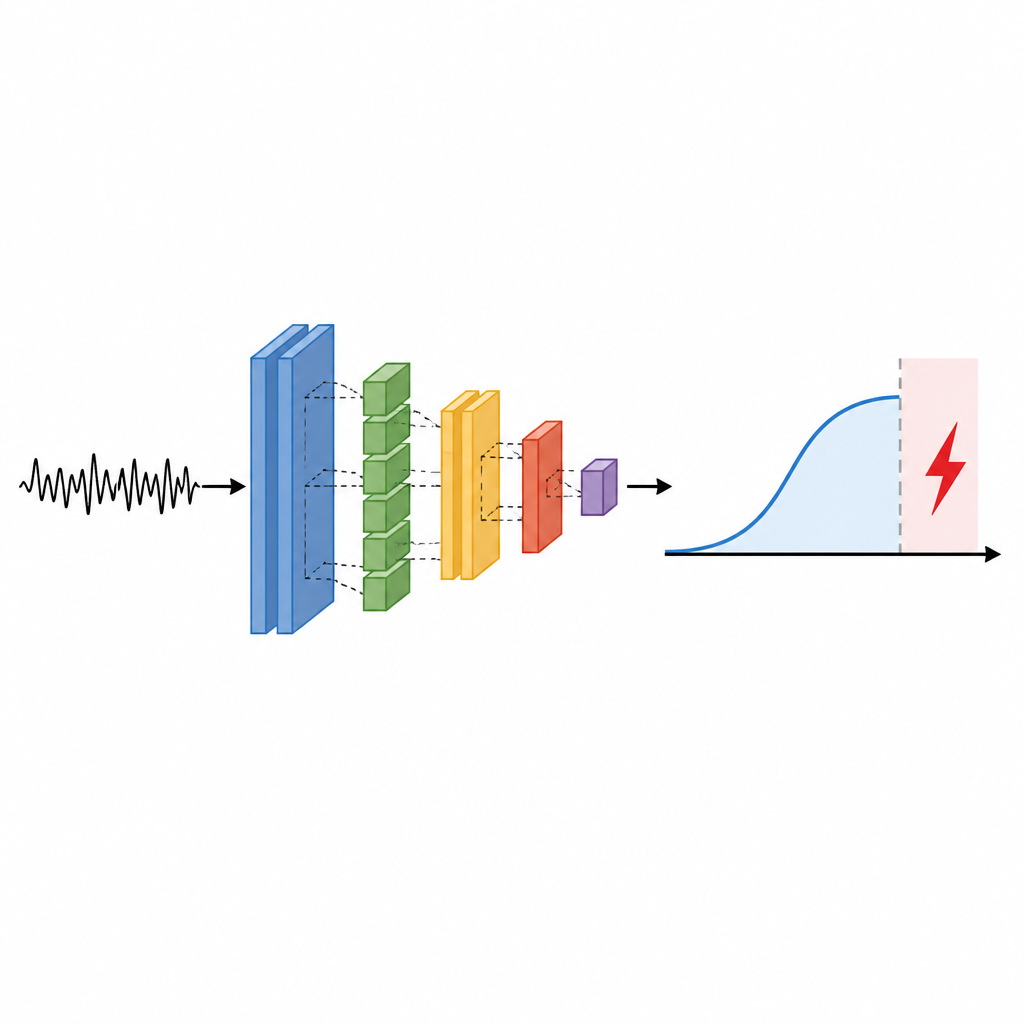
To turn raw brainwaves into something a computer can learn from, the team sliced the data into 10 second segments and converted each slice into a kind of picture that shows how signal strength changes across different frequencies over time. These pictures were then fed into a streamlined deep learning model inspired by MobileNet, a family of neural networks designed to run on phones and other low power devices. By carefully trimming layers and connections, the authors reduced the model to just under 38,000 adjustable parameters, a tiny fraction of the size of many modern image recognition systems, while still allowing it to learn useful patterns linked to seizures.
Defining useful warning time
From a patient’s point of view, not every correct detection is equally helpful. A warning that comes too late offers little protection, while one that comes far too early may cause needless worry. The study therefore adopted clear timing rules that mirror real world needs. For each seizure, the researchers defined a “no warning” zone covering the 2 minutes right before onset, when it would already be hard to react. The 30 minute stretch before that was treated as the true prediction window, where a warning is considered successful if the seizure follows within that span. Only data from this window and from clearly normal periods far from any seizure were used to teach and test the model.
How well the system performed
The model was tested on two groups of patients: adults with drug resistant focal epilepsy treated at Seoul National University Hospital, and children and young adults in a widely used public dataset. For each person, the system was trained and evaluated only on that individual’s data, mirroring how a future device might adapt to its wearer. Across patients, the model correctly classified about 86 to 91 percent of 10 second segments, with relatively low rates of false alarms. When judged at the level of whole seizures and using the strict timing rules, it successfully predicted about 95 percent of seizures in the hospital group and 98 percent in the public dataset. Interestingly, electrodes on the forehead tended to work best, and being closer to the medically identified seizure onset zone did not necessarily improve accuracy.
What this could mean for everyday life
These results suggest that a single small brainwave sensor, paired with a highly efficient learning algorithm, can provide reliable early warnings of many seizures within a practically useful 30 minute window. While more work is needed to test the approach in larger and more varied patient groups, and to refine how channels are chosen for each person, the study points toward seizure prediction systems that could be worn comfortably for long periods and run on limited battery power. Such tools would not prevent seizures, but they could give people with epilepsy more control and confidence in planning their daily activities.
Citation: Jang, D., Jung, KY., Jeon, YG. et al. Single-channel EEG-based seizure prediction using deep learning. Sci Rep 16, 15888 (2026). https://doi.org/10.1038/s41598-026-44670-7
Keywords: epilepsy, seizure prediction, EEG, wearable devices, deep learning