Clear Sky Science · en
A comparative analysis of the effects of green blended activators on the durability and mechanical performance of slag-based geopolymer cement
Building Stronger, Greener Concrete
Cement is everywhere: in our homes, bridges and sidewalks. But making traditional Portland cement releases large amounts of carbon dioxide, adding to climate change. This study explores a promising alternative binder—called slag-based geopolymer cement—that can reuse industrial waste and cut emissions. The researchers ask a practical question for future buildings and infrastructure: can we swap some of the harsh, caustic chemicals normally used to make these binders with gentler, cheaper “green” powders, without sacrificing strength and durability?
From Steel Waste to Next-Generation Binder
The cement studied here is made from ground granulated blast furnace slag, a fine powder left over from steel production. When this slag is mixed with special alkaline powders and water, it hardens into a solid similar to concrete, but with far less climate impact. The team compared three types of activators: a standard dose of sodium silicate (a strong but corrosive chemical), blends of sodium silicate with calcium carbonate (the main ingredient in limestone), and blends of sodium silicate with sodium carbonate (common soda ash). All ingredients were used in dry form so that, like ordinary cement, users would only need to add water at the construction site.
Finding the Right Chemical Recipe
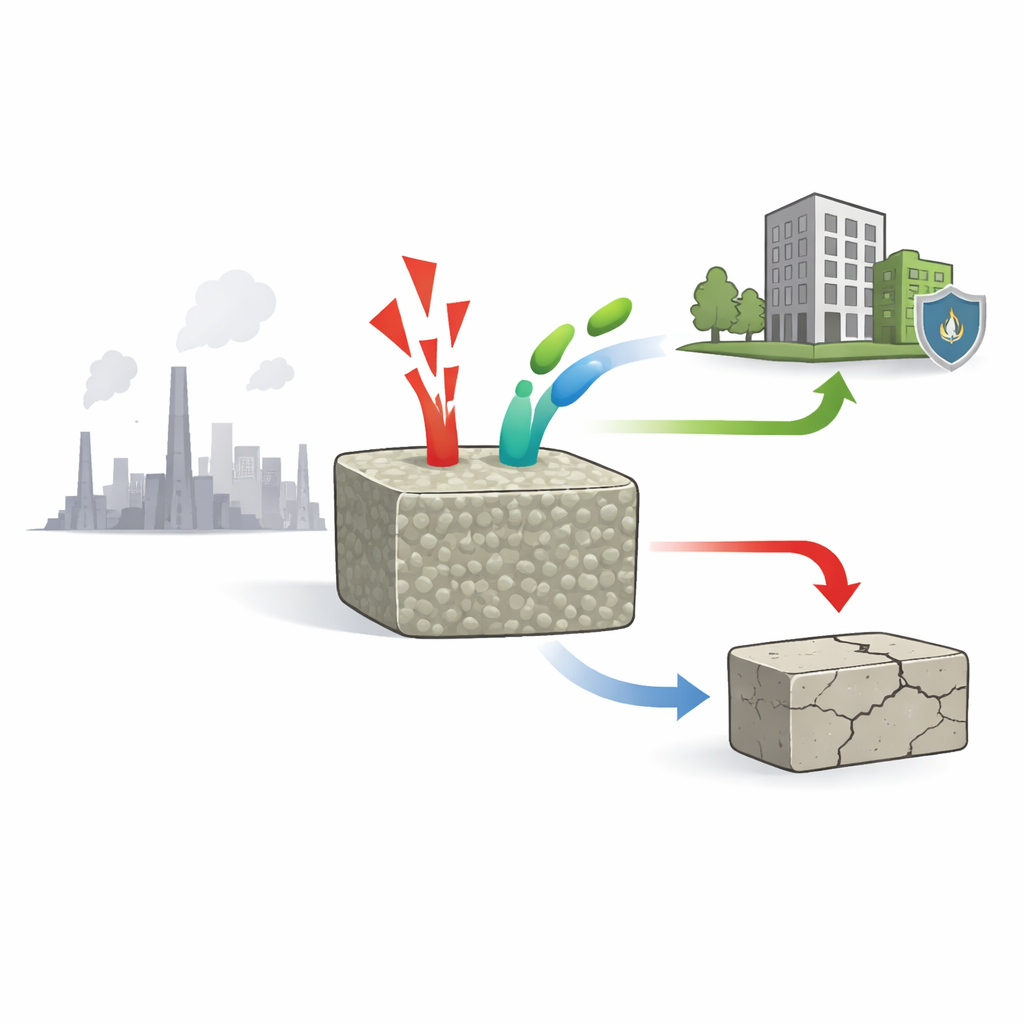
The scientists measured how quickly each mix set, how strong it became over time, and how easily water could move into it. Replacing part of the sodium silicate with calcium carbonate slowed the hardening and caused a major loss of strength—up to 70% lower after 90 days for mixes richest in calcium carbonate. The material also became more porous, with higher water absorption and lower bulk density, signaling a weaker internal structure. In contrast, swapping a small portion of sodium silicate for sodium carbonate actually boosted performance. A mix containing 7% sodium silicate and 3% sodium carbonate developed 10–12% higher compressive strength than the all–sodium-silicate control over 3 to 90 days, while achieving lower porosity and higher density.
Standing Up to Salts and Fire
Durability under harsh conditions is critical if such binders are to replace conventional cement. The team exposed samples to a magnesium sulfate solution for up to six months—an aggressive environment that often damages concrete in soils and groundwater. Mixes rich in calcium carbonate deteriorated badly, with strength falling as low as 3.1 MPa, indicating severe internal cracking and loss of binding gel. By contrast, the sodium carbonate–containing mixes held much of their strength, remaining in the 34–40 MPa range after the same exposure. The researchers also fired specimens at 300, 600 and 800 °C to mimic intense heat and fire. Again, the sodium carbonate blend with 7% sodium silicate and 3% sodium carbonate stood out, retaining about 70%, 51% and 39% of its original 28‑day strength at these temperatures—far better than the calcium-carbonate blends, which suffered strength losses of 32–84%.
Peering Inside the Material
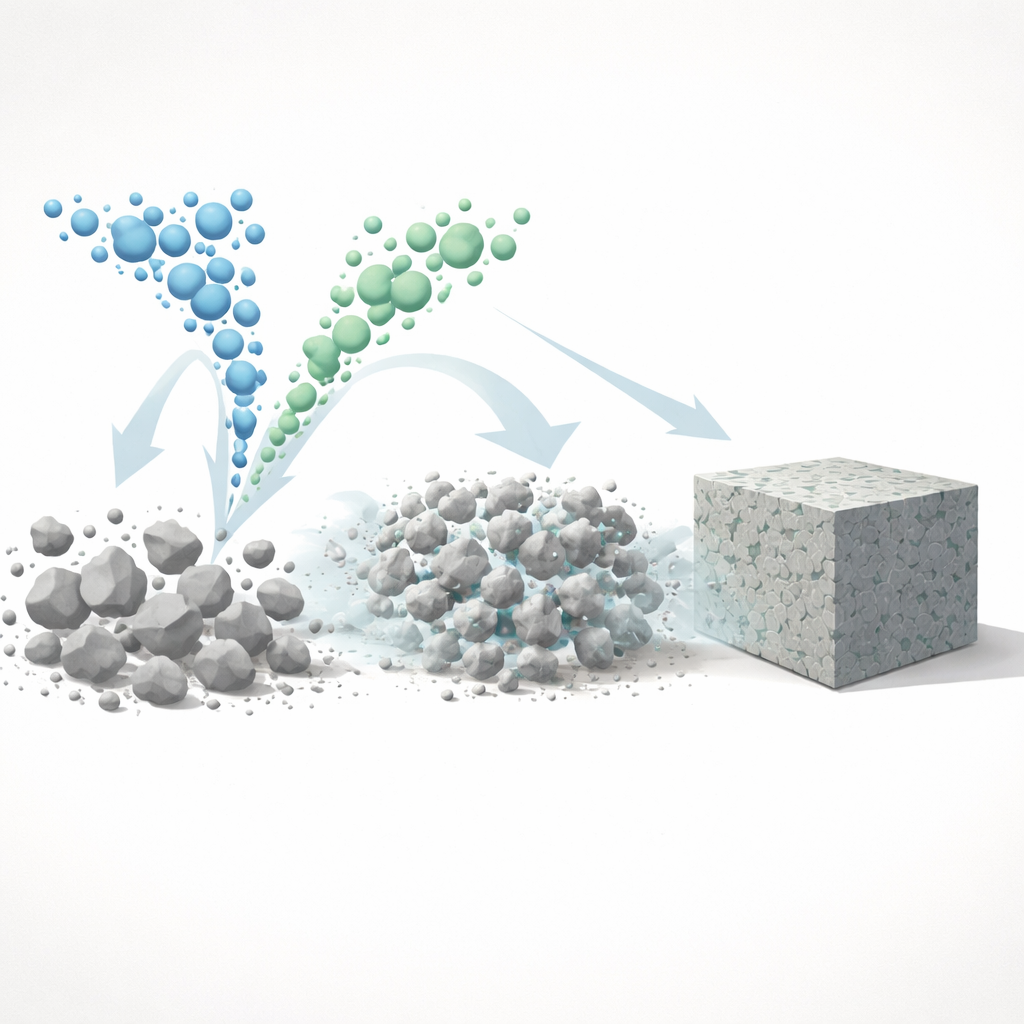
To understand why some mixes performed better, the team used X‑ray diffraction, infrared spectroscopy and electron microscopy to examine their internal structure. These tools showed that mixes with sodium carbonate formed denser, more continuous binding gels that weave slag particles together into a compact network with fewer cracks and pores. The chemistry favored strong aluminosilicate and calcium–aluminosilicate gels that resist heat and sulfate-rich water. In contrast, mixes with high calcium carbonate content had more unreacted powder and calcium-rich phases that were easily attacked by sulfate and destabilized at high temperatures, leaving a weaker, more fractured microstructure.
What This Means for Future Construction
Overall, the study shows that sodium carbonate is a technically sound, safer and more economical partial substitute for sodium silicate in slag-based geopolymer cement. A carefully balanced blend—especially the mix with 7% sodium silicate and 3% sodium carbonate—delivers strong, dense, and more durable binders that withstand both sulfate attack and high heat better than traditional sodium-silicate-only systems, and far better than those relying on calcium carbonate. For a layperson, the takeaway is simple: by tweaking the powder recipe with a common, relatively mild chemical (soda ash), we can turn steel-making waste into a greener cement that is not only kinder to workers and the environment, but also tough enough for long-lasting buildings and infrastructure.
Citation: Hashem, F.S., Fadel, O., Hassan, H.S. et al. A comparative analysis of the effects of green blended activators on the durability and mechanical performance of slag-based geopolymer cement. Sci Rep 16, 12752 (2026). https://doi.org/10.1038/s41598-026-44669-0
Keywords: green cement, geopolymer, slag binder, sodium carbonate activator, durable concrete