Clear Sky Science · en
Exploring the gravito-optic effect for gravity sensing applications
Why Measuring Gravity in New Ways Matters
Gravity quietly shapes everything from ocean tides to the stability of bridges and skyscrapers. Subtle changes in Earth’s pull can reveal underground water, hidden mineral deposits, volcanic activity, and even long-term climate shifts. Today’s most precise gravity meters, however, rely on tiny test masses and delicate moving parts that struggle on ships, aircraft, or submarines. This paper explores a radical alternative: using light itself, rather than a physical weight, to sense changes in gravity, pointing toward rugged, fast, and compact instruments for real-world use.
The Challenge of Weighing the Planet
Earth’s gravity is not perfectly uniform. It varies slightly with mountains and valleys, buried rock structures, ocean currents, and the planet’s rotation. Scientists use gravimeters to track these variations for geophysics, resource exploration, navigation, and natural hazard monitoring. Traditional instruments fall into two broad camps. Absolute gravimeters drop a test mass in a vacuum and use laser interference or cold atoms to time its fall with exquisite precision. Relative gravimeters, in contrast, measure how gravity stretches a spring or supports a levitating sphere, comparing one place to another. While these methods can detect incredibly tiny changes in gravity, they tend to be bulky, sensitive to vibration and motion, and prone to gradual drift over time.
Limits of Today’s Moving-Platform Instruments
When gravimeters are mounted on aircraft or ships, new problems emerge. Because these instruments sense acceleration, they respond not only to gravity but also to every jolt, sway, and turn of the vehicle. Sophisticated processing and mechanical isolation can reduce the noise, but some interference is unavoidable. In addition, separating the steady pull of gravity from the ever-changing accelerations of a moving platform is mathematically and technically demanding. These limits motivate the search for gravity sensors that do not rely on a moving mass at all—devices that might shrug off vibration and work reliably in rough conditions.
Letting Light Feel Gravity
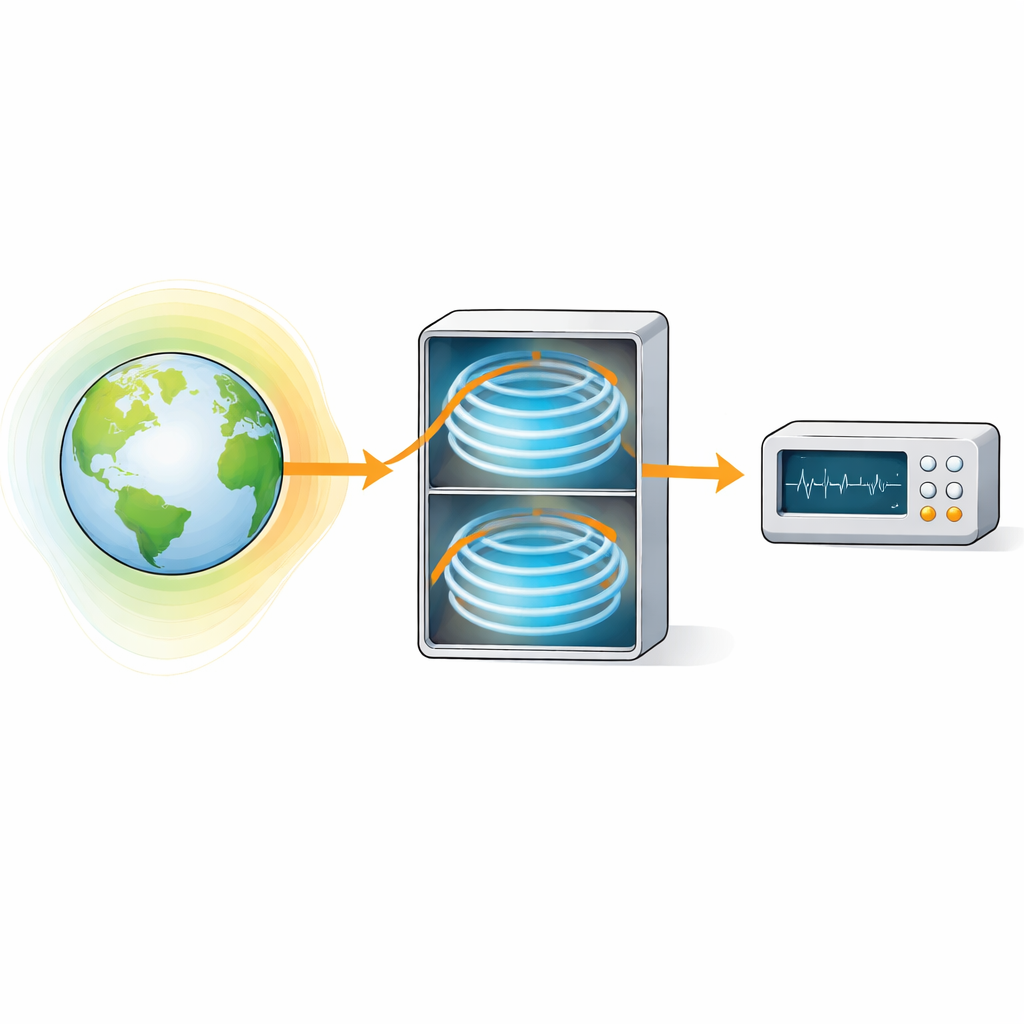
The work reported in this paper builds on earlier experiments suggesting that the speed of light in an optical fiber can be influenced, ever so slightly, by Earth’s gravity. According to general relativity, gravity affects the flow of time, and in turn the way light propagates. The author defines this interaction between gravity and light as the gravito-optic effect. To probe it, the team sends ultrafast laser pulses through long coils of optical fiber and measures how long the pulses take to make a round trip. If two identical fiber coils sit at slightly different gravitational potentials, or experience slightly different gravitational pulls, the pulses should return with a tiny difference in arrival time. Detecting such differences, on the scale of trillionths of a second, demands extremely stable conditions and sensitive electronics.
A New Kind of Gravity Gradiometer
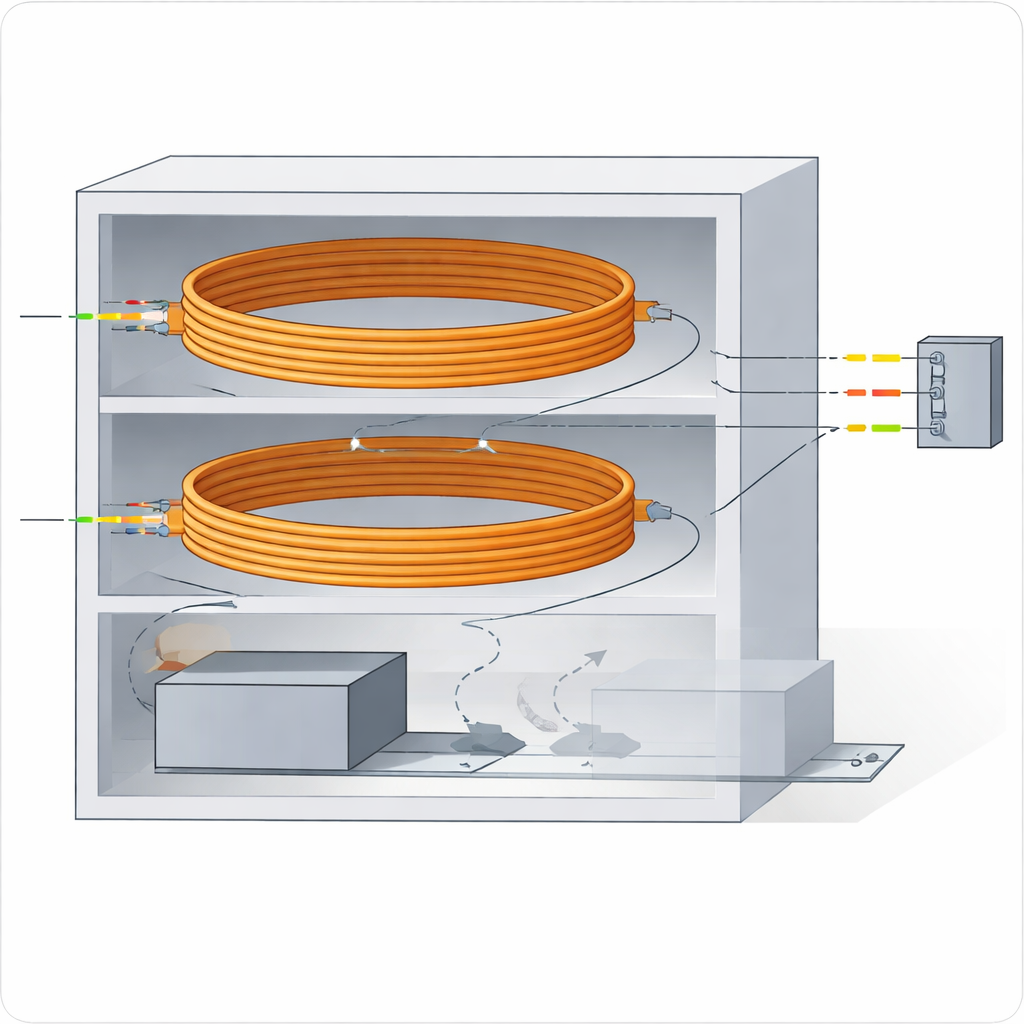
In the new experiment, two 10-kilometer fiber spools are stacked vertically one meter apart inside carefully temperature-controlled copper enclosures. Each laser pulse from a femtosecond fiber laser is split in two, with one copy sent into each coil. The pulses travel down and back, effectively covering 20 kilometers in glass before returning to a detector. The travel times are compressed using dispersion compensation so that the pulses remain sharp enough to time accurately. All optical components are mounted on a rigid frame and shielded from temperature swings, air pressure changes, and electromagnetic interference. The setup is designed as a gravity gradiometer: instead of measuring gravity at a single point, it measures the difference in gravity between the upper and lower coils by tracking the time difference between their returning pulses.
Making Gravity Waves in the Lab
To test whether this light-based system truly responds to changes in gravity, the researchers created a controlled disturbance. A 72-kilogram steel block was placed on a motorized cart running underneath the lower fiber coil. By sliding the block in toward the instrument and then out again over and over, they gently altered the gravitational pull near the lower coil while leaving the upper one almost unchanged. During the tests, the lab’s temperature, humidity, and air pressure were held constant. The laser ran at 80 million pulses per second, and a high-speed detector and oscilloscope recorded the time delays between pulses from the two coils. The raw delay values wandered within a few trillionths of a second, making the effect hard to see directly. But when the team analyzed the data using frequency techniques, a clear peak appeared that matched the block’s motion rate, showing that the instrument was responding to the periodic gravity changes caused by the moving mass.
What This Means for Future Sensors
The study demonstrates that an all-optical, solid-state device—using photons instead of moving test masses—can sense tiny, time-varying changes in gravity. While the signal is extremely weak and further work is needed to understand and reduce background noise, the experiment confirms earlier reports of a gravito-optic effect and shows that it can be harnessed for sensing. Because light pulses can be generated and recorded millions of times per second and the system has no moving mechanical parts, such photonic gravimeters could eventually offer fast, robust gravity measurements from airplanes, ships, or underwater vehicles. In simple terms, the paper points toward gravity sensors that listen to how gravity tugs on light rather than on weights, opening a new route to mapping our planet’s hidden structures and monitoring its changing mass with greater flexibility.
Citation: Li, E. Exploring the gravito-optic effect for gravity sensing applications. Sci Rep 16, 13556 (2026). https://doi.org/10.1038/s41598-026-44668-1
Keywords: gravity sensing, optical fiber, gravimeter, photonics, Earth geophysics