Clear Sky Science · en
Broadband low-frequency sound absorption and high insulation in a clay-cement composite with hydrogel-foaming engineered gradient porosity
Quieter Cities with Smarter Walls
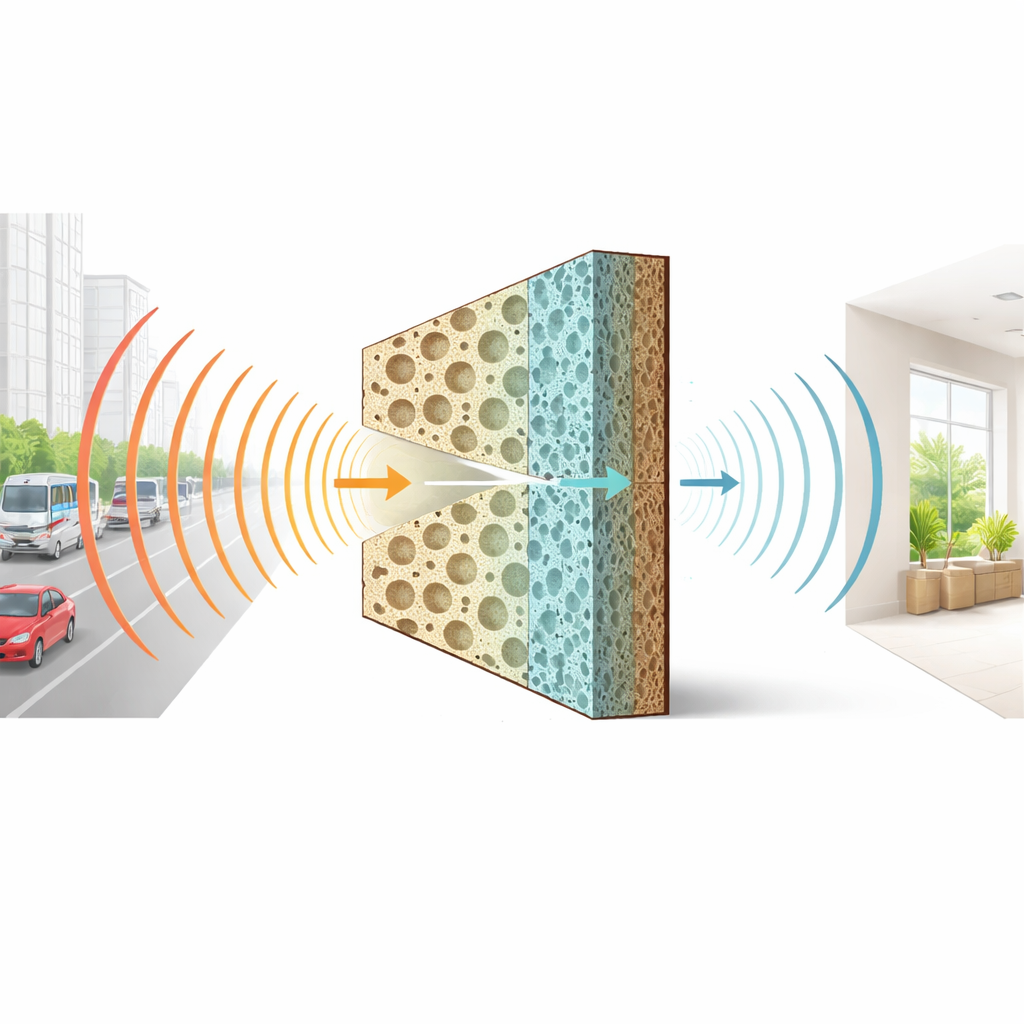
City life comes with a constant roar: traffic, machinery, and the low rumble of urban activity that seeps through walls and windows. Traditional soundproofing often struggles with these deep, low notes, which are the hardest to tame. This study introduces a new kind of clay–cement wall material that is engineered from the inside out to soak up a wide range of sound, especially low-frequency noise, while also blocking sound from passing through. It points to future buildings where the walls themselves quietly manage noise without bulky add-ons.
Why Ordinary Walls Struggle with Noise
Most common sound-absorbing materials rely on pores—tiny holes and channels—inside foam, concrete, or fiber boards. When sound travels into these pores, some of its energy is lost as heat through friction with the pore walls. But conventional porous concrete usually has pores of similar size throughout. This uniform structure tends to work well only over a narrow slice of the sound spectrum and is especially weak at handling low-frequency sounds, like the thrum of engines or heavy machinery. In addition, many existing materials either lack durability, are expensive, or cannot provide both good sound absorption and strong sound insulation at the same time.
Building a Multi-Layer Sound Trap
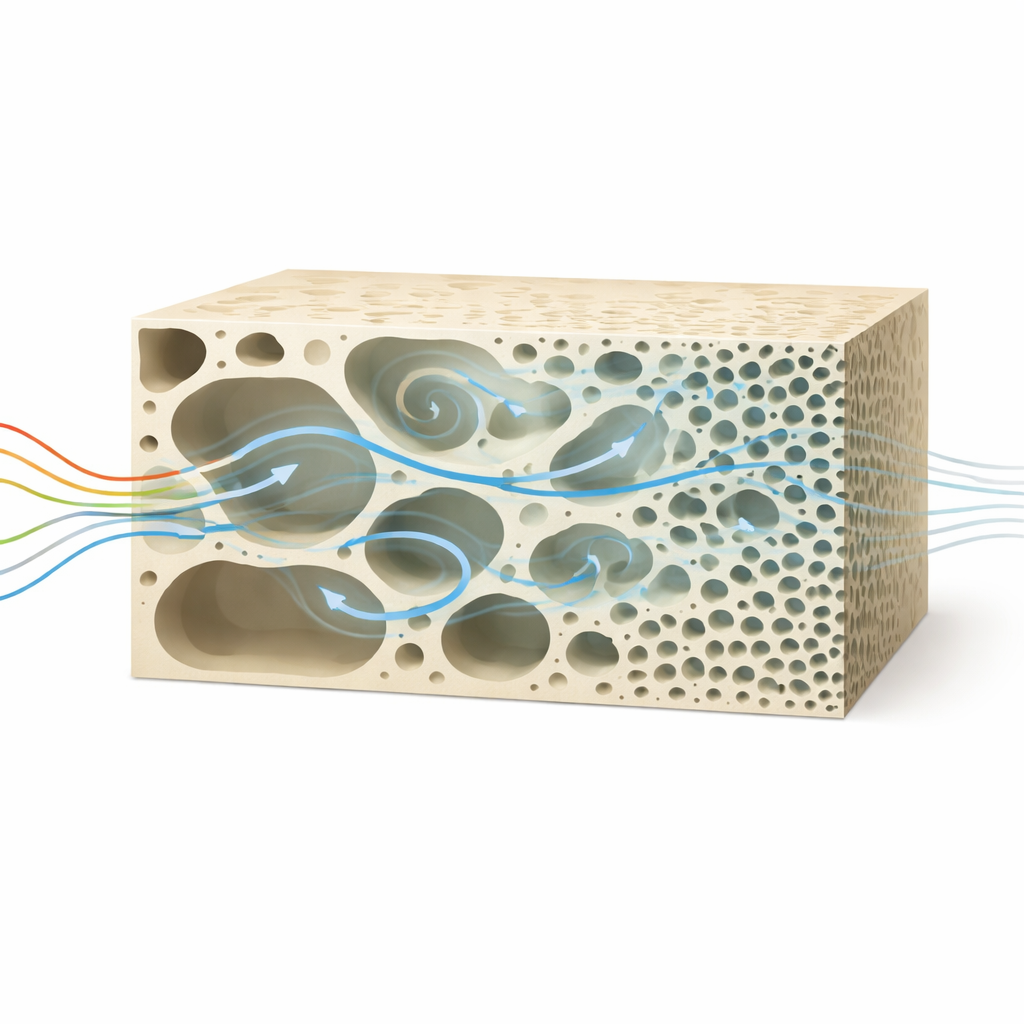
The researchers tackled this problem by redesigning the internal architecture of a clay–cement composite so that its pores form a deliberate gradient from large to tiny. They mixed clay, cement, and a water-reducing agent with specially shaped hydrogel particles and a foaming agent. As the material sets and dries, the foaming agent creates large and small air pockets, while the hydrogel pieces dry out and leave behind medium-sized voids. The result is a solid block filled with a connected hierarchy of pores: big cavities, mid-sized channels, and fine micro-pores all coexisting. X-ray diffraction confirmed that the solid part of the material is mainly common minerals from clay and cement, while scanning electron microscopy and CT scans visualized how the pores are spread and linked throughout the block.
How Layered Pores Turn Sound into Heat
When sound waves hit this composite, they do not simply bounce off its surface. Instead, the large pores near the exposed side invite low- and mid-frequency sound waves in, where the air vibrates and rubs against the walls, losing energy. These big cavities can also set up internal resonances, temporarily trapping sound and feeding it into smaller regions. As the waves move deeper, they encounter medium and then tiny pores, where the surface area grows and the pathways become more tortuous. Here, friction and tiny temperature changes between air and solid walls convert more of the sound into heat. At the same time, the many interfaces between clay, cement, and the remnants of the hydrogel cause repeated reflections and refractions inside the material, leading to further energy loss. Together, these effects create a “multi-stage” sound trap that works across a broad range of frequencies.
Proving Performance in the Lab
To test how well this new material performs, the team used an impedance tube, a standard tool in acoustics that sends sound down a rigid tube toward a sample and measures both the sound that is absorbed and the sound that passes through. Across the important 300–1500 Hz range, the average sound absorption coefficient reached 0.64, with a peak of 0.75 around 421–437 Hz, a relatively low frequency where many materials perform poorly. Above 300 Hz, absorption stayed above 0.6, showcasing reliable wide-band behavior. The same samples also showed strong sound insulation: the average loss of sound energy passing through was almost 38 dB, with peaks above 55 dB in the 500–800 Hz region. Computer simulations using standard acoustic models closely matched these measurements, lending confidence that the design principles are sound and can be further optimized.
Strength, Durability, and Future Uses
Because walls must also bear loads, the researchers examined how the porous structure affects strength. CT-based 3D models and compression tests showed that, even with over 80% porosity, millimeter-scale pillars withstand stresses of hundreds of megapascals before local failure begins, with the most vulnerable spots at the thinnest pore walls. Dynamic tests confirmed that the material holds significant force before breaking, suggesting it can be engineered for real-world building use. The authors point out that long-term moisture and environmental cycles may still affect performance and call for future work on more robust foaming strategies, fine-tuning of pore gradients, and standards for construction and inspection. Still, the combination of strong low-frequency absorption, broad-band noise control, and good insulation makes this clay–cement composite a promising candidate for quieter homes, offices, transport corridors, and public spaces.
What This Means for Everyday Life
For non-specialists, the bottom line is simple: this study shows that by cleverly arranging pores of different sizes inside an otherwise ordinary clay–cement mixture, it is possible to build walls that both soak up noise and block it over a wide range of troublesome frequencies. Instead of relying on thick, heavy barriers or delicate fibrous panels, future buildings might use structural materials that quietly manage sound as part of their basic function. If further developed and scaled, this gradient-pore concrete could help tame the background roar of cities, making homes, workplaces, and public areas noticeably calmer without obvious changes to how buildings look.
Citation: Hou, Z., Zhou, Z., Chen, X. et al. Broadband low-frequency sound absorption and high insulation in a clay-cement composite with hydrogel-foaming engineered gradient porosity. Sci Rep 16, 14374 (2026). https://doi.org/10.1038/s41598-026-44654-7
Keywords: sound-absorbing concrete, urban noise control, porous building materials, acoustic insulation, gradient pore structure