Clear Sky Science · en
Enhancing MTC device security in LTE networks for the fast and secure BC-based group handover authentication protocol
Why smarter machines need safer phone networks
From smart streetlights and factory robots to medical monitors, countless small machines now talk to each other over the same mobile networks our phones use. As their numbers explode, keeping these machine-type communication (MTC) devices secure, fast, and energy‑efficient becomes a pressing challenge—especially when groups of devices move together from one cell tower to another. This study presents a new way to handle those hand‑offs so they stay safe, quick, and gentle on battery power.
The problem with crowded machine traffic
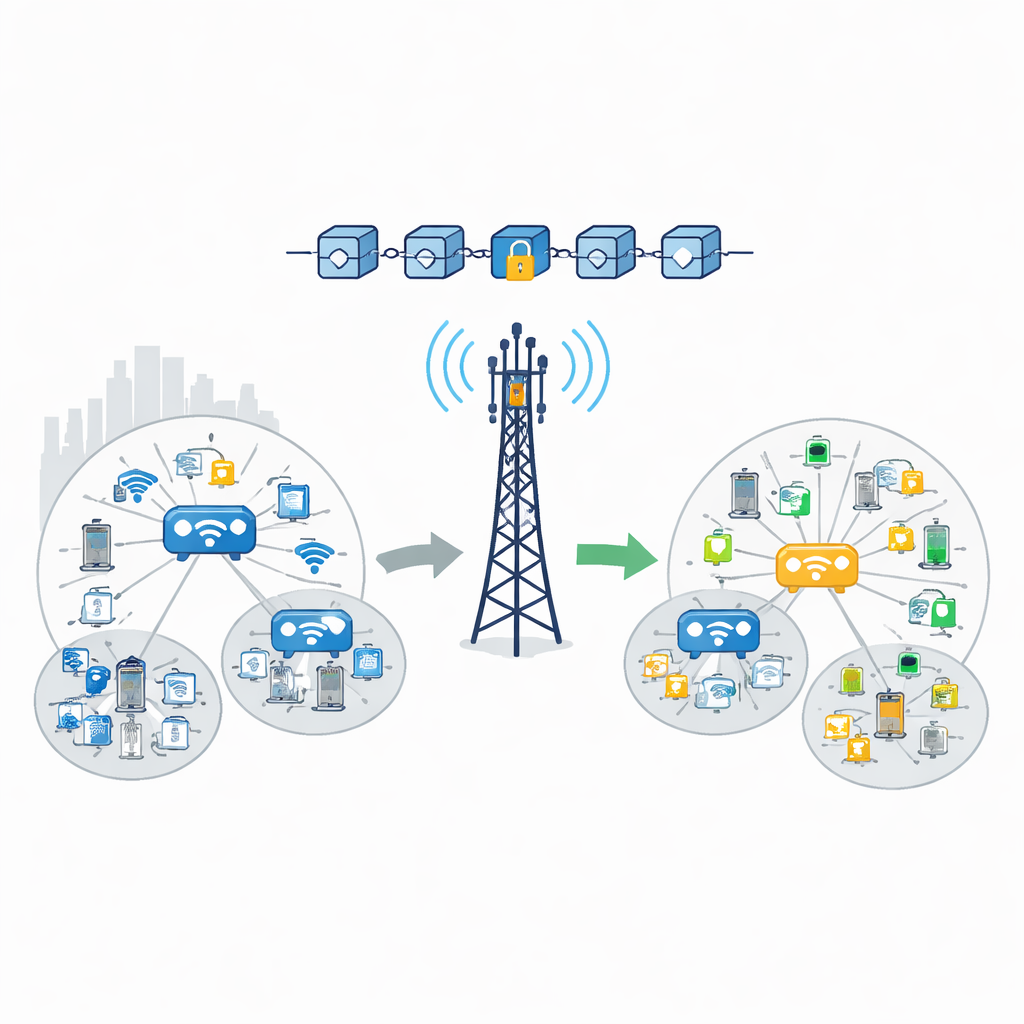
In today’s 4G Long-Term Evolution (LTE) networks, every device must prove its identity to the core system before sending sensitive data. Traditional methods rely on a central authority that checks each device individually. That model works for people with phones, but it strains under swarms of sensors and meters. When many devices move at once—say, sensors on a vehicle fleet changing towers—this “group handover” can cause long waits, heavy signaling traffic, and a dangerous single point of failure if the central server is attacked or goes offline.
A new way to group and trust devices
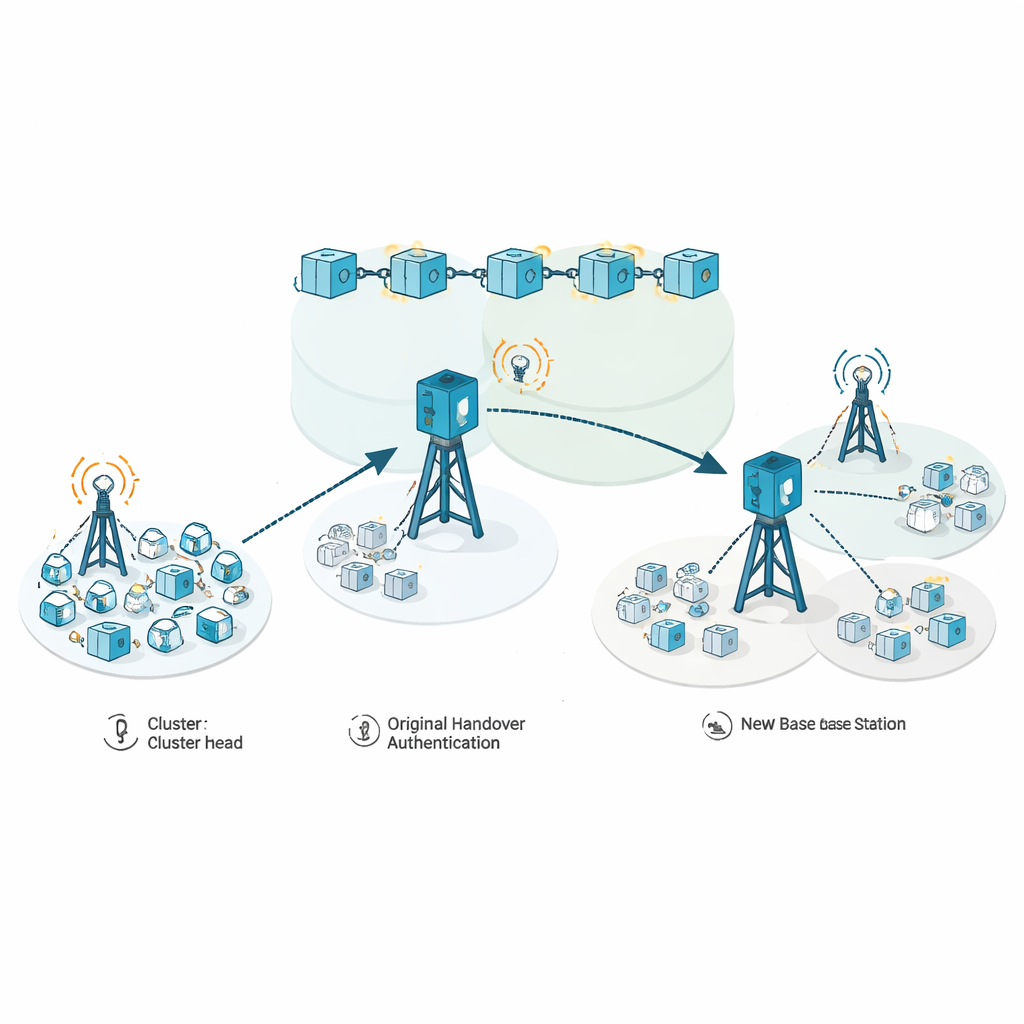
The authors propose a framework that rearranges how machines are organized and authenticated. First, nearby devices are grouped into clusters, and one machine in each group becomes the “cluster head,” acting as spokesperson for its neighbors. Instead of picking this leader at random, the system uses an optimization method inspired by chimp hunting behavior, known as the Chimp Optimization Algorithm. This method weighs three simple but crucial factors—how much battery a device has left, how far it is from other devices and the base station, and how quickly it can respond—to choose the most suitable leader in each cluster.
Using shared digital ledgers to lock in trust
Once leaders are chosen, the framework turns to blockchain, a tamper‑resistant shared ledger, to record who is who. Each cluster head and its member devices register their identities and public keys on a permissioned blockchain maintained inside the operator’s network. When devices want to join or move between clusters, the cluster head checks their credentials using lightweight elliptic-curve cryptography, then consults the blockchain to confirm those details. Because entries on the blockchain are replicated across many nodes and validated by a consensus process, no single server can silently alter or forge identities.
Faster, lighter handovers for moving groups
During a group handover, the system no longer re‑authenticates every device from scratch. Instead, when a cluster moves toward a new base station, the current cluster head sends a single request via the mobility controller in the LTE core. The target cluster head retrieves the group’s credentials from the blockchain and performs a collective check, while the subscriber database confirms parameters only once for the whole cluster. This cuts signaling traffic and processing time. Simulations with 100 devices show that, compared with several well-known clustering and optimization schemes, the new method keeps more devices alive over 100 rounds of operation, lowers the average distance between devices and their leaders or base station, and reduces overall energy use and authentication delay.
What this means for everyday connected things
In plain terms, the study shows that organizing connected machines into smartly chosen groups, and using a shared digital ledger to manage their identities, can make mobile networks safer and more efficient at the same time. Devices spend less energy proving who they are, handovers happen more quickly when they move, and the system no longer depends on a single vulnerable server. That combination makes this approach promising for large-scale deployments such as smart cities, industrial automation, and future 5G and 6G systems, where billions of devices will need to roam securely with minimal delay.
Citation: Jyothi, K.K., Srilakshmi, K., Ragava, M. et al. Enhancing MTC device security in LTE networks for the fast and secure BC-based group handover authentication protocol. Sci Rep 16, 10764 (2026). https://doi.org/10.1038/s41598-026-44649-4
Keywords: machine-type communication, LTE security, blockchain authentication, energy-efficient handover, IoT networks