Clear Sky Science · en
Comparing daylight performance of dynamic and static shadings in office façades across multiple U.S. cities with various sky conditions
Bringing More Comfortable Daylight into Offices
Anyone who has struggled with a too-bright office in summer or a gloomy workstation in winter knows that windows are both a blessing and a curse. This study explores how different kinds of window shades can make offices brighter, more comfortable, and potentially more energy-efficient across a range of U.S. climates. By comparing traditional fixed shades with "smart" moving shades, and by looking carefully at sunny, partly cloudy, and overcast skies, the researchers show when high-tech façades really help—and when they may simply get in the way of scarce daylight.
How Window Shades Shape Our Daily Light
Modern office buildings often rely on large glass façades to bring in natural light and views, but unchecked sunlight can cause glare, eye strain, and overheating. To manage this, architects use shading systems that either stay still (static) or move in response to the sun (dynamic). Static shades are simple and inexpensive but cannot adapt as the sun travels across the sky. Dynamic façades, on the other hand, can rotate or change shape throughout the day to block harsh direct sun while still admitting soft, usable daylight and preserving the view outside. This study focuses on movable shades that rotate, since earlier work suggested rotation is especially powerful for controlling daylight.
Testing Shades Across Different Skies and Cities
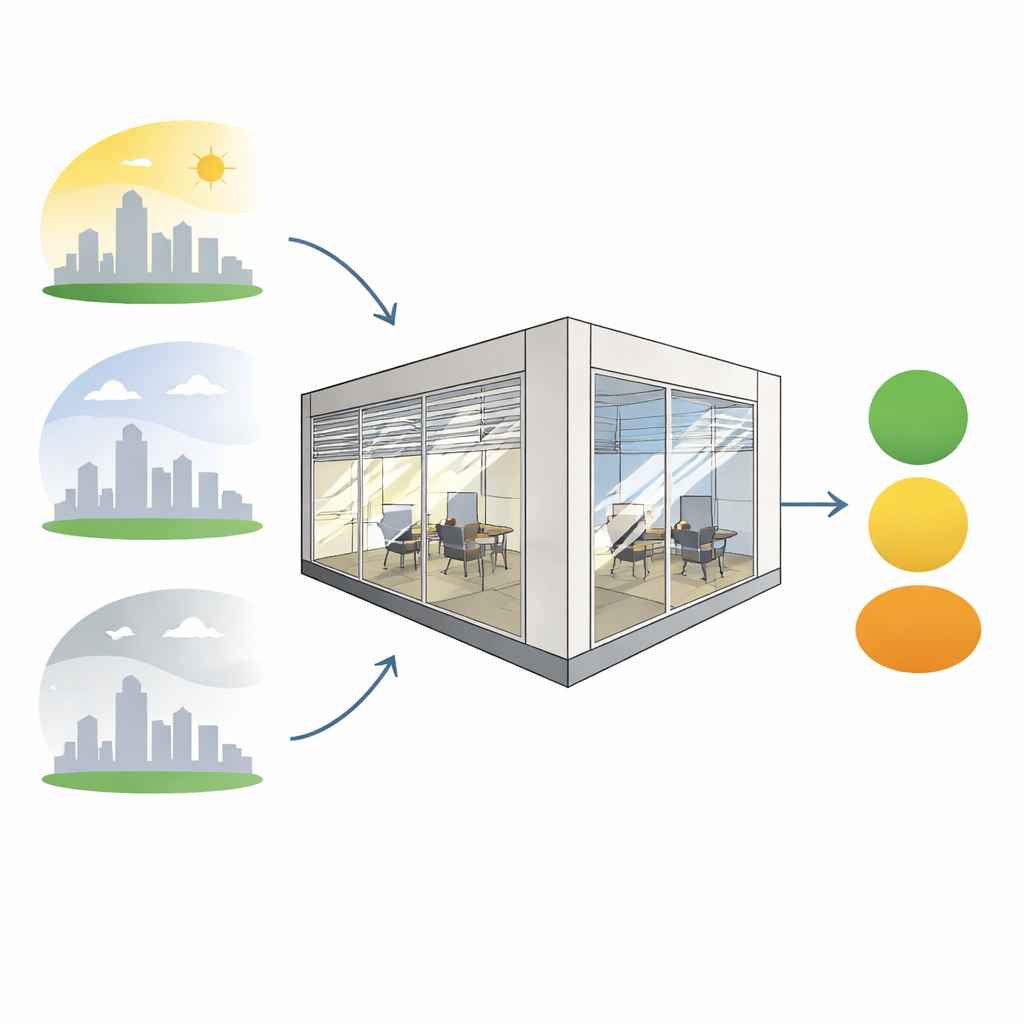
The researchers built a detailed computer model of a nearly fully glazed office room and tested two simple shade shapes: one made of repeating triangles and one made of rectangles. They simulated how these shades performed at various rotation angles, from slightly tilted to almost fully closed, and compared them with a plain glass façade that had no shading at all. To capture different real-world conditions, they used three U.S. cities as stand-ins for three typical sky types: sunny Las Vegas, intermediate New York with a mix of sun and clouds, and cloudy Seattle. For each city, they calculated interior light levels every hour from morning to late afternoon on representative days throughout the year.
A New Way to Judge "Just-Right" Daylight
Because people need enough light to work comfortably but can be bothered by glare or excessive brightness, the team developed a new measure called Hourly Useful Illuminance. Instead of simply asking how bright a room is, this metric looks at what fraction of the work area falls within a "just-right" band of light at a specific hour. It counts points that are too dim and too bright separately, and focuses on the share of the space that is comfortably lit. This hourly focus makes it possible to see how shade settings should change over the course of a day and across seasons, and in future could also be applied to combinations of daylight and electric lighting.
What Works Best in Sun, Cloud, and In-Between
In bright, sunny Las Vegas, both dynamic and well-chosen static shades clearly improved daylight conditions compared with an unshaded façade. By rotating to steeper angles around midday, the dynamic shades blocked the harshest rays while still letting in high levels of useful light for most of the day. Static shades set to a strong tilt angle performed fairly well, but the dynamic system still delivered several percentage points more comfortable light on average. Under intermediate skies like New York’s, the benefit of dynamic control shrank: dynamic shades were still better than any single fixed setting, but only by a modest margin, and in some months both types of shading actually reduced useful daylight compared with bare glass. In cloudy Seattle, adding any shading hurt daylight performance—there was almost no risk of too much sun, and the shades mainly blocked already limited light.
Small Shape Differences, Big Role for Rotation
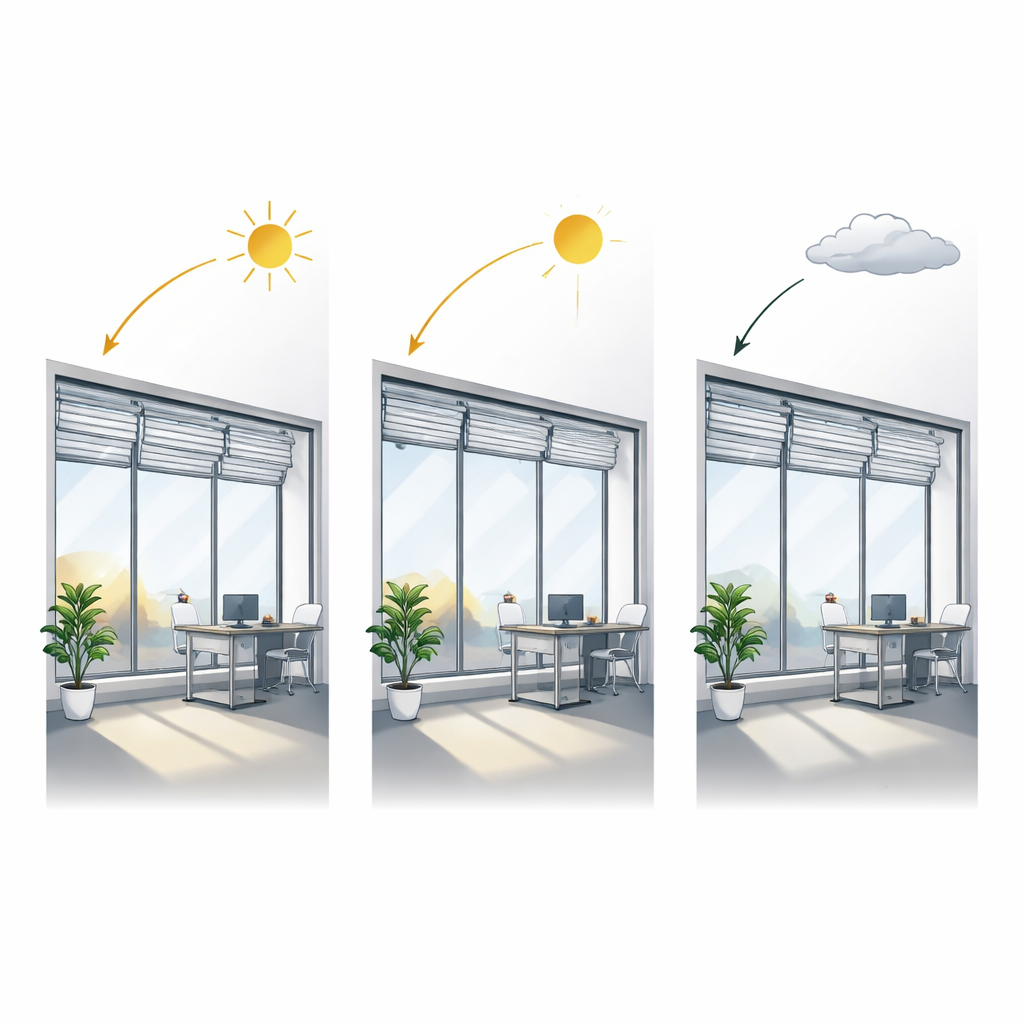
Interestingly, the exact shape of the shade modules—triangular versus rectangular—had only a minor impact. Rectangular panels tended to perform slightly better under sunny and intermediate skies, but the difference in useful daylight was typically just a few percent. Far more important was how much the panels could rotate. In sunny conditions, the best angles varied widely through the day, often reaching nearly horizontal positions around noon to shield against high-altitude sun. Under more overcast skies, the range of helpful angles narrowed, and in very cloudy Seattle the ideal angle was essentially fully open all day, underscoring that adaptability matters most where sunlight is strong and variable.
What This Means for Future Offices
For readers wondering whether advanced moving façades are worth the investment, this work offers a nuanced answer. Dynamic shading can substantially improve daylight comfort in very sunny climates, offering more evenly lit workspaces and better control of glare compared with either no shading or a single fixed setting. In locations with mixed skies, the advantages are smaller and may not by themselves justify the extra cost and complexity. Under persistently cloudy skies, fixed or minimal shading—or even no shading at all—may be the better choice for daylight. Overall, the study suggests that the smartest façade is one carefully matched to its climate, sky conditions, and the real needs of its occupants, rather than a one-size-fits-all high-tech solution.
Citation: Ziaee, N., Ghiai, M. Comparing daylight performance of dynamic and static shadings in office façades across multiple U.S. cities with various sky conditions. Sci Rep 16, 14461 (2026). https://doi.org/10.1038/s41598-026-44644-9
Keywords: daylighting, dynamic facades, office buildings, solar shading, visual comfort