Clear Sky Science · en
Kinetic Jeans instability in FOG framework
Why cosmic clouds don’t always crumble
When we picture stars being born, we often imagine giant clouds of gas simply collapsing under their own gravity. But recent telescope observations hint that this story is incomplete: some clouds seem to resist collapsing into many small pieces, instead giving rise to fewer, more massive structures. This paper explores a new twist on gravity itself to explain how huge clouds of gas might fragment differently, reshaping how galaxies, star clusters and even giant cosmic structures emerge over time.
Gravity’s classic recipe for making stars
For more than a century, astronomers have relied on the idea of “Jeans instability” to understand when a gas cloud collapses. In the classic picture, gravity tries to pull matter together, while the cloud’s internal heat pushes outward. If a patch of gas is heavy and large enough, gravity wins and that patch collapses, setting a minimum “Jeans mass” for forming stars and other structures. This traditional framework assumes ordinary Newtonian gravity and treats the gas like a smooth fluid, which works reasonably well but struggles to explain all the structures we now observe in our expanding, richly structured Universe.
A new kind of gravity for big cosmic systems
The authors investigate a modified theory known as fourth order gravity, which gently alters how gravity behaves on large scales without invoking invisible components like dark matter or dark energy. In this theory, gravity responds not only to how mass is arranged, but also to how that arrangement changes from place to place, introducing a natural length scale, called L, that grows with the total mass of the system. Using a detailed kinetic description that tracks the motions of individual particles rather than treating the gas as a simple fluid, they couple this refined gravity law to the standard equation that governs how a collisionless cloud of matter evolves. From this, they derive a new condition for when a gas cloud becomes unstable and starts to collapse, leading to a modified critical mass for structure formation.
Clouds that prefer big fragments over tiny pieces
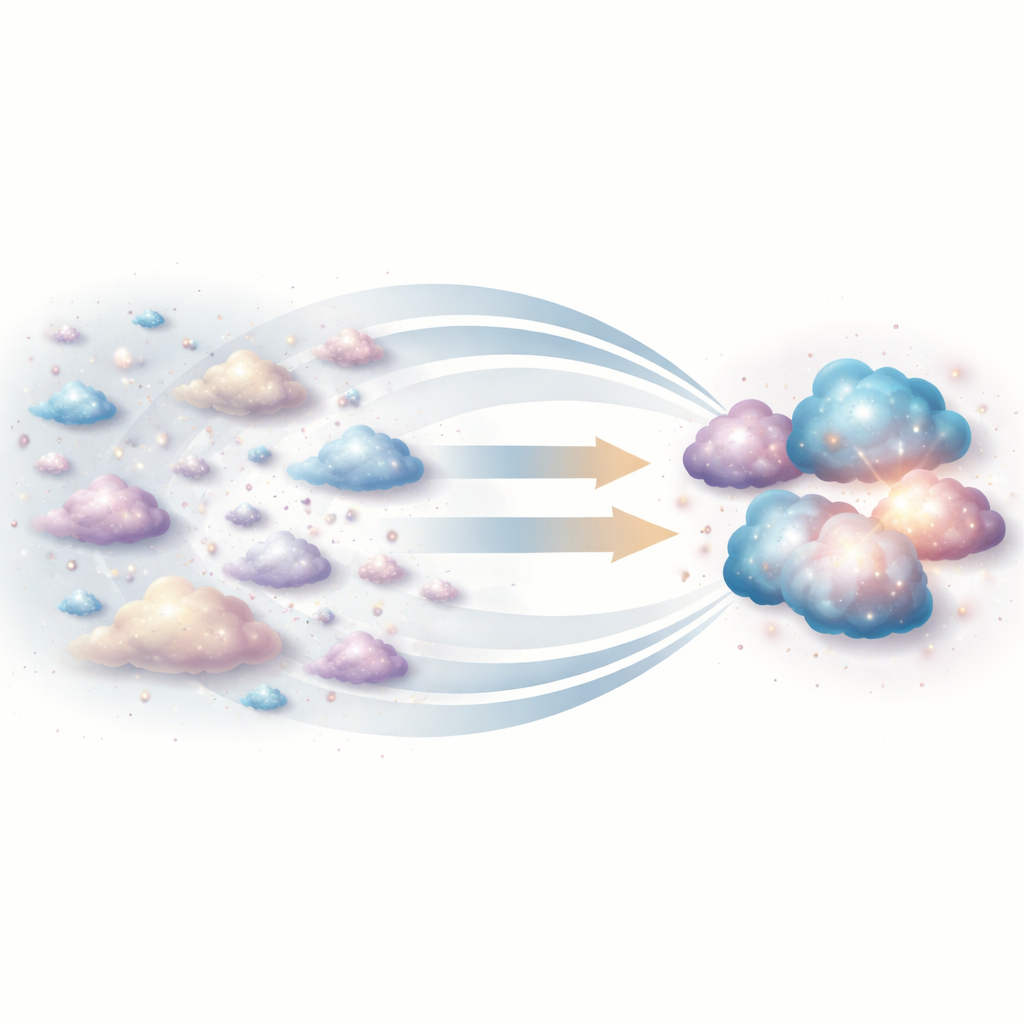
Applying their formalism to real astrophysical environments—giant molecular clouds, diffuse molecular clouds and small dark objects called Bok globules—the authors find that the modified gravity raises the mass threshold for collapse, especially in the largest systems. In giant molecular clouds, the critical mass can become several times, or even orders of magnitude, larger than the classical prediction. More intriguingly, as the background density increases, the critical mass in this framework does not simply drop steadily as in Newtonian gravity. Instead, for sufficiently large L it first decreases, reaches a minimum at an intermediate density, and then increases again. This non‑monotonic behaviour suggests that collapse is most efficient in a specific density range, favouring the formation of relatively massive clumps rather than numerous small fragments.
Temperature, growth rates and preferred scales
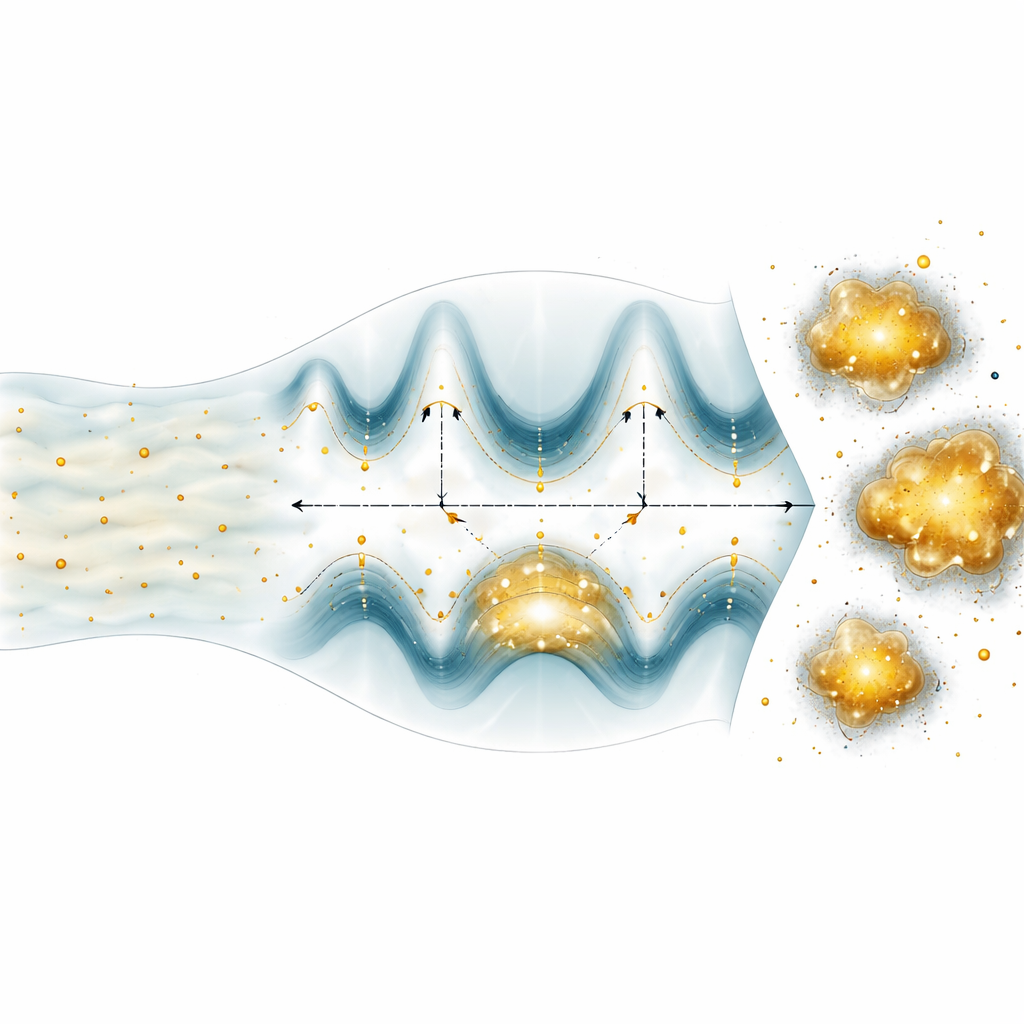
The new theory also changes how temperature and scale shape the onset of collapse. In standard gravity, the cloud’s temperature only modestly alters the critical mass, particularly at high densities. Under fourth order gravity, however, temperature has a much stronger regulatory role: warmer clouds require noticeably larger masses to collapse. By analysing how small ripples in density grow or fade, the authors show that the modified gravity term suppresses rapid growth at very small scales, narrowing the range of unstable wavelengths and shifting the fastest‑growing disturbances to larger sizes. This means the most likely building blocks of new structures—the clumps that grow fastest—tend to be more massive than in the classical case, especially in very large clouds where the length scale L is big.
From star clusters to the cosmic web
These findings point to a Universe in which gravity itself can bias structure formation toward larger, smoother building blocks, without appealing to unseen dark ingredients. Massive clouds may fragment into fewer, heavier pieces, potentially leading to star populations skewed toward higher masses and helping to explain unusually bright, massive galaxies seen in the early cosmos. While the study focuses on linear behaviour—early stages of collapse before full complexity sets in—it offers a framework for connecting modified gravity ideas with the detailed growth of cosmic structures, from star‑forming clouds up to galaxy superclusters and filaments. In plain terms, if gravity really behaves this way on large scales, the cosmos may be wired to grow big things first, with small objects emerging only where conditions are just right.
Citation: Das, M., Atteya, A. & Karmakar, P.K. Kinetic Jeans instability in FOG framework. Sci Rep 16, 14103 (2026). https://doi.org/10.1038/s41598-026-44639-6
Keywords: Jeans instability, modified gravity, molecular clouds, star formation, large-scale structure
See more on the researcher's website: https://sites.google.com/view/apndrl/home?authuser=0