Clear Sky Science · en
Non-linear and switchable light preferences of nocturnal loach (Misgurnus anguillicaudatus)
Why a night fish’s taste for light matters
Light does far more than let animals see. It quietly shapes when they feed, how they avoid predators, and where they choose to live. This study looks at a common bottom-dwelling fish, the loach, to ask a simple but revealing question: how does a supposedly “night-loving” animal really react to different levels and colors of light? The answers challenge the idea that nocturnal creatures just always prefer darkness and suggest a flexible, surprisingly subtle strategy for staying safe and spreading into new habitats.
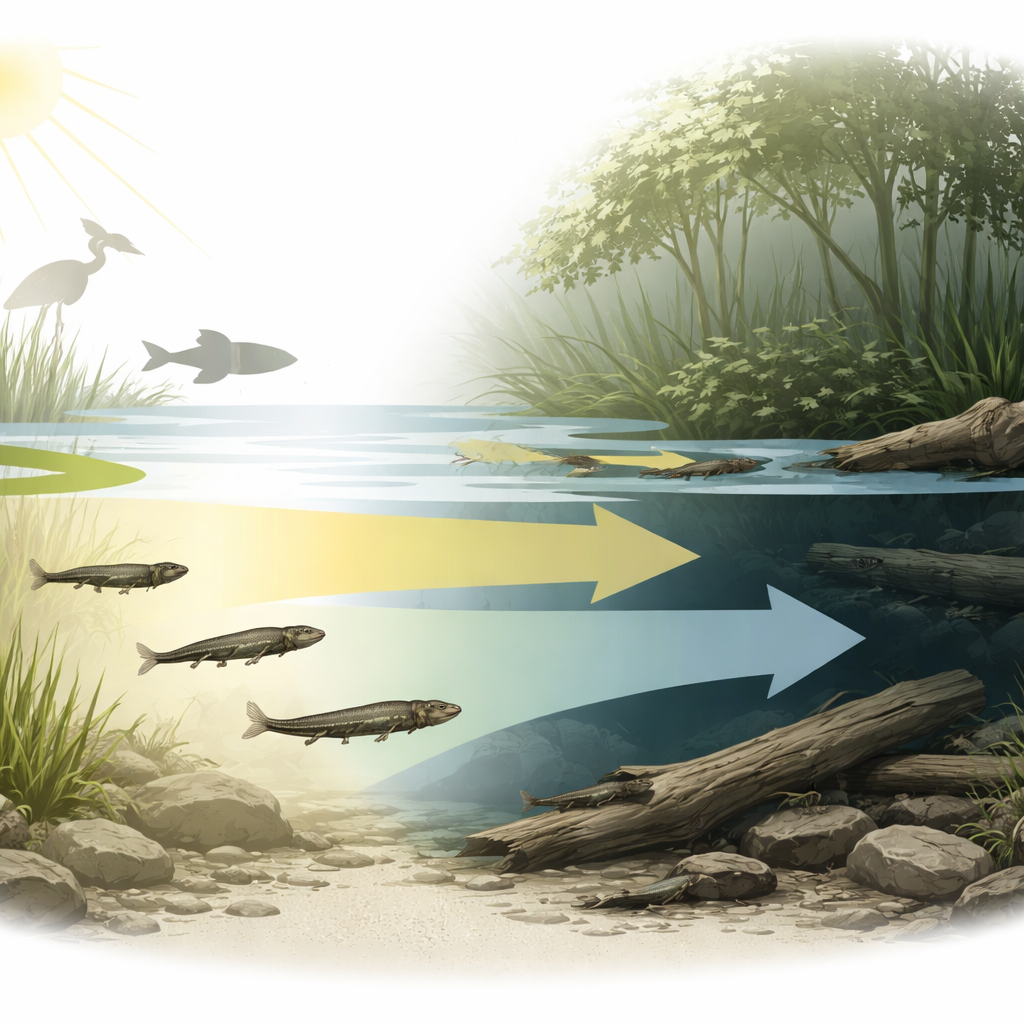
A small pond dweller under the spotlight
The Japanese loach is a slender freshwater fish often found in rice paddies and wetlands. It is generally considered nocturnal because it tends to be more active at night in standard day–night laboratory cycles. Yet earlier work showed that its daily rhythms weaken in constant darkness, hinting that outside light strongly steers its schedule. To probe how important light really is for these fish, the researchers built a special test tank divided into two connected sections: one lit, one shaded. Using carefully controlled light sources that could mimic sunlight or present a balanced mix of colors, they tracked where each fish chose to spend time and how vigorously it swam using video analysis.
Shades of preference, not simple fear of light
When exposed to a “sunlight-like” spectrum, most loaches indeed preferred the shaded side of the tank, spending more than half of the time there. However, roughly a quarter of the fish did the opposite and showed a clear liking for the brighter side. When the same individuals were tested again a month later, their choices often changed: some former shade-lovers ventured into the light, and light-seekers often reversed. Overall, there was no stable “personality” type. This suggests that the loach’s light preference is not a fixed trait but a state that can switch over weeks, likely influenced by internal condition or recent experience rather than hardwired fear of light.
Not all light is equal for a night fish
The team then focused on how the strength and color mix of light influence behavior. Under the mixed-color light, loaches consistently chose the darker side over a wide range of intensities, from very dim to quite bright. Their avoidance of light was strongest not in complete darkness or in the brightest conditions, but around a medium dim level. At that sweet spot, fish packed into the shaded compartment and swam there most actively. When the researchers directly pitted two lit sides of different brightness (for example, medium versus bright, or dim versus medium), the loaches always favored the relatively darker side. This shows that they respond to the contrast between areas at any given moment, not just to some fixed “too bright” value.
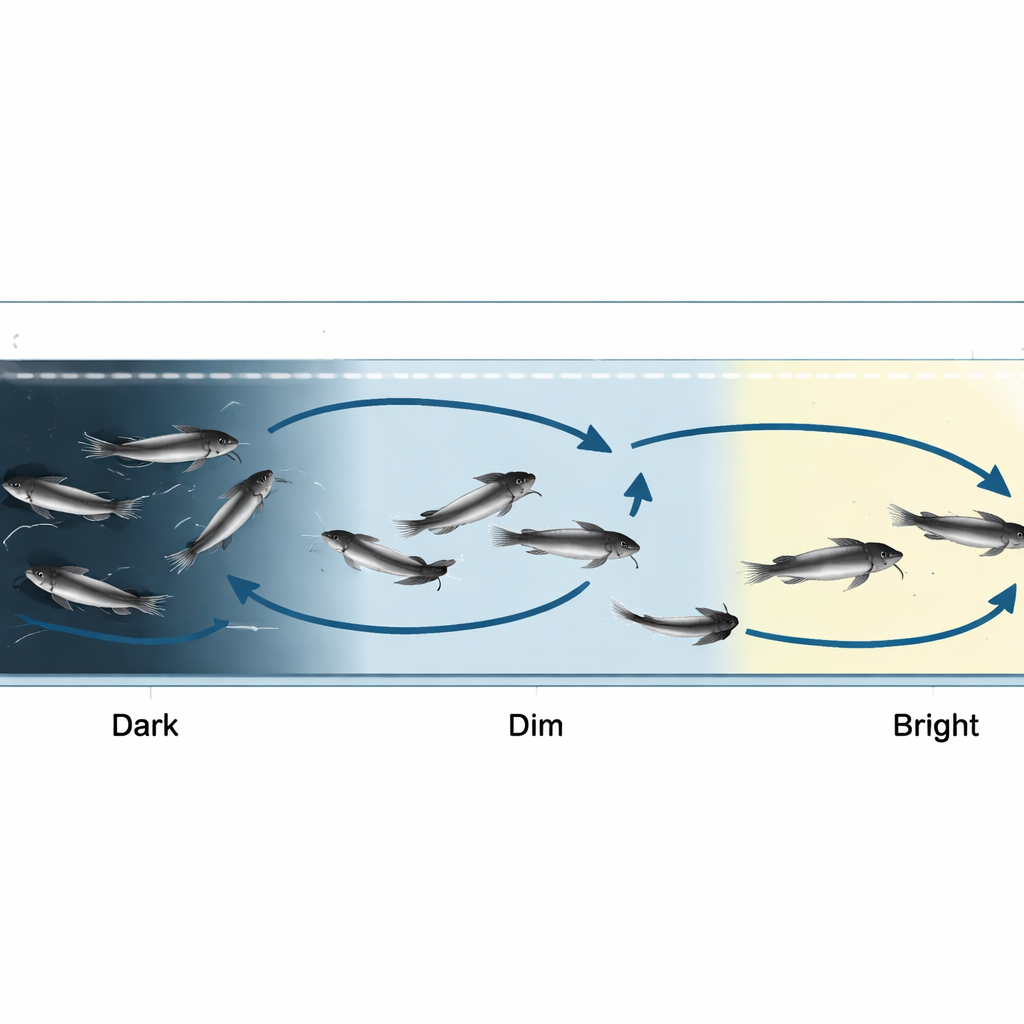
How light steers movement and safety
Swimming behavior added another layer to the story. Under the mixed-color light, loaches moved more in shaded compartments than in bright ones, especially at lower intensities. Those that strongly preferred shade were also more active there, while reducing motion in the lit side. Under the sunlight-like spectrum, these activity differences were much weaker, suggesting that specific parts of the light spectrum, such as blue light, may dampen swimming in bright areas. The authors propose that the fish’s visual system and higher brain centers adjust to the prevailing light range, so that what counts as “too bright” or “just right” can shift with conditions. They generalize this into a model comparing diurnal animals, which usually seek a comfortable brightness, with nocturnal animals, whose “comfort zone” lies closer to darkness yet can still shift and saturate under strong light.
Flexible darkness seeking as a survival plan
For a layperson, the key message is that these loaches are not simply afraid of light; they use it in a flexible way. In a sunny pond, a loach that wanders into an open bright patch is likely to slow down, quietly searching for darker shelter where it can resume active feeding while staying hidden from daytime predators. The edge zone between light and shade is especially important, because it is where the urge to seek darker refuge is strongest, effectively fencing off safe pockets of habitat. From time to time, some individuals temporarily lose their strong shade preference and venture into brighter regions. This switching behavior may let the species escape overcrowded safe spots, discover new shaded refuges, and expand its range. The study thus turns a simple question—does a night fish like the dark?—into a richer picture of how light helps animals balance safety, feeding, and exploration.
Citation: Yoshikawa, Y., Okano, K. & Okano, T. Non-linear and switchable light preferences of nocturnal loach (Misgurnus anguillicaudatus). Sci Rep 16, 13922 (2026). https://doi.org/10.1038/s41598-026-44631-0
Keywords: nocturnal fish, light preference, behavioral ecology, freshwater loach, predator avoidance