Clear Sky Science · en
Daily transient analysis of an integrated solar-driven direct contact membrane distillation for cogeneration production of freshwater and electricity
Turning Sunlight into Drinking Water
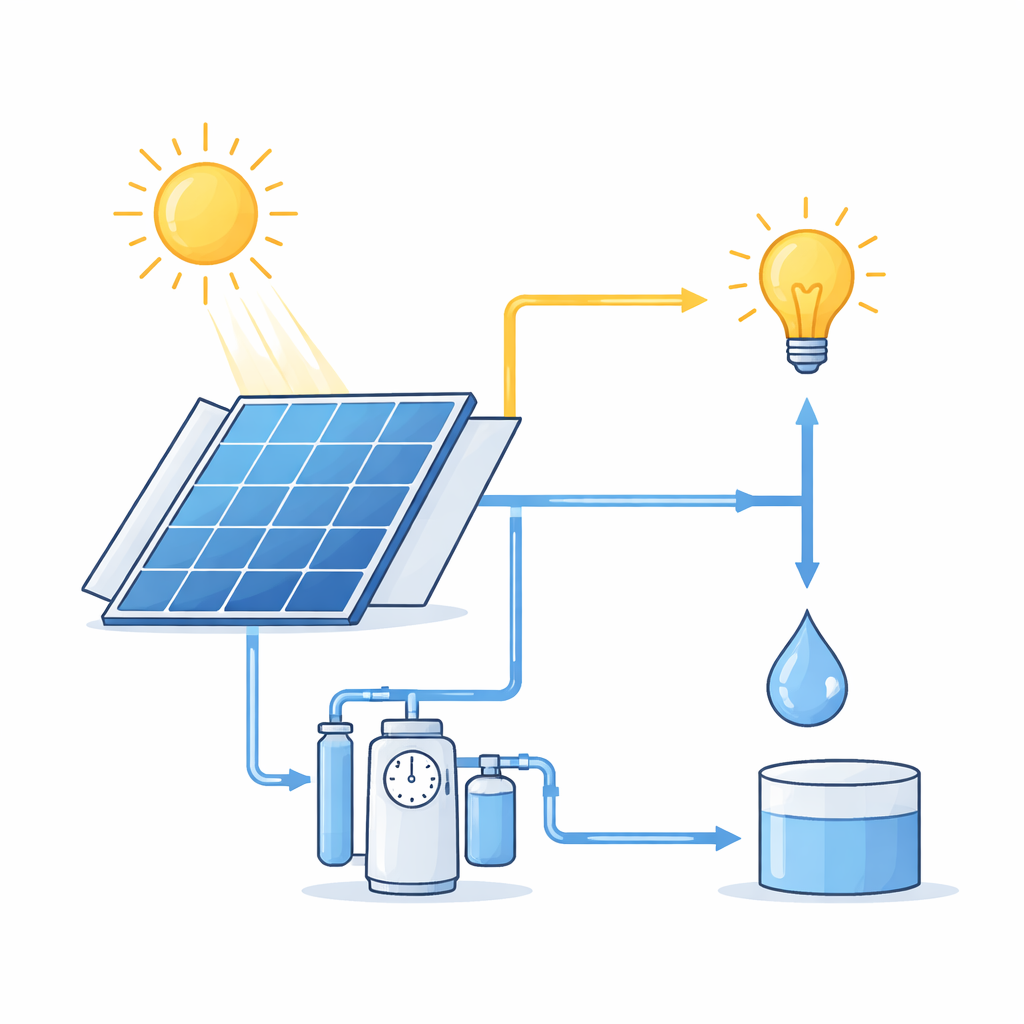
For many communities, two basic needs often go unmet at the same time: safe drinking water and reliable electricity. This study explores a compact device that tackles both problems using only sunlight. By combining solar panels with a special water-purifying unit, the system can simultaneously generate electrical power and produce fresh water from salty or brackish sources—without fuel, complex machinery, or a connection to the grid.
One Solar Setup, Two Useful Outputs
At the heart of the design is a hybrid solar collector known as a photovoltaic-thermal, or PVT, panel. Unlike a standard solar panel, which turns only part of the sun’s energy into electricity and wastes the rest as heat, this collector captures both. The panel’s front layer produces electricity, while a metal plate and water channels behind it soak up the leftover warmth. That heated water is then sent directly to a desalination unit called a direct contact membrane distillation (DCMD) module. In this way, a single surface exposed to the sun becomes a small cogeneration plant, providing both power and purified water for off-grid users.
How the Hidden Filter Makes Water Safe
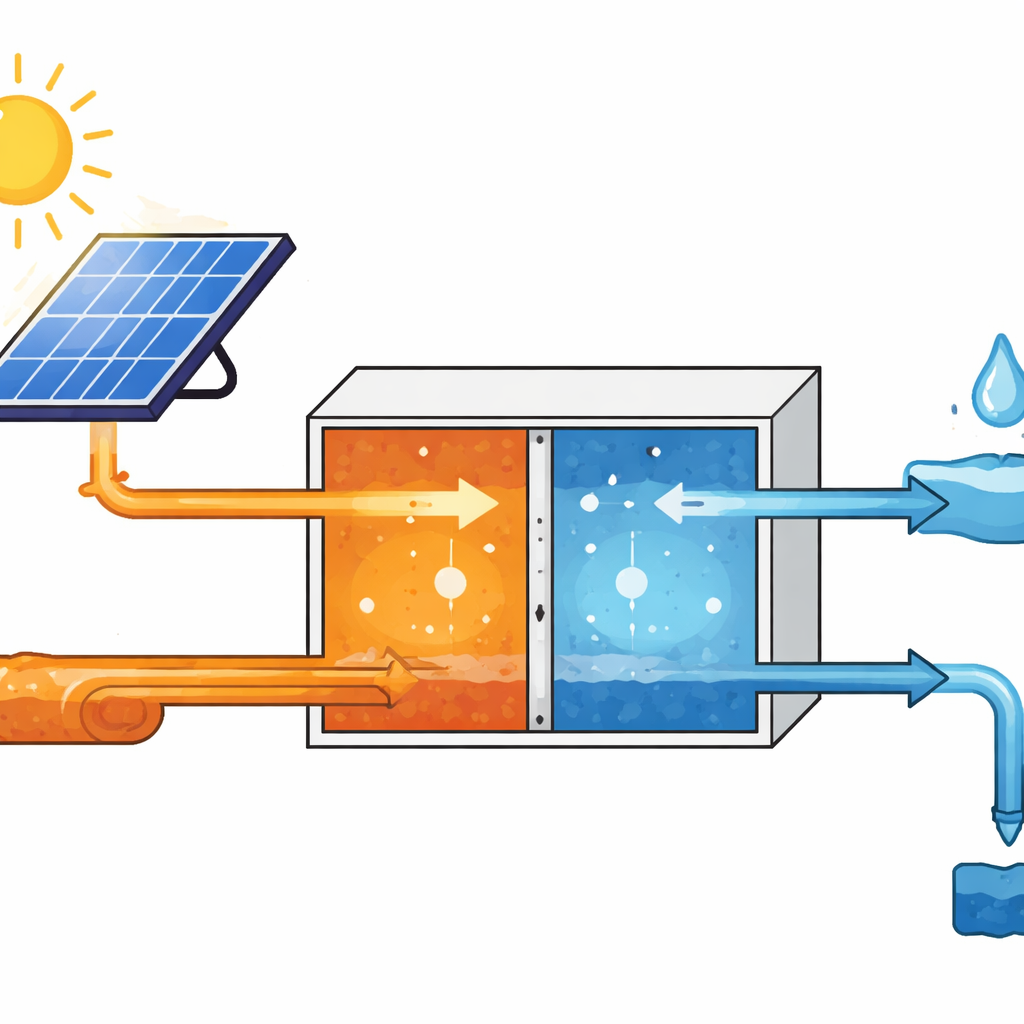
The DCMD unit operates on a simple physical idea rather than high pressure or chemicals. Warm salty water flows along one side of a thin, porous, water-repelling membrane, while cooler clean water (or previously distilled water) flows on the other side. Because one side is hotter, water molecules tend to evaporate from the warm stream, pass as vapor through the membrane’s tiny pores, and then condense back into liquid on the cooler side. Salt and other impurities are too large or not volatile enough to cross, so they remain behind in the feed stream. The result is high-purity distillate on the cold side and a more concentrated brine on the hot side, all driven by temperature differences created by the sun.
Chasing the Best Angles and Flow
The researchers did not just sketch the concept; they built a detailed computer model to follow the system’s behavior hour by hour over a sunny day. Using real weather data, they examined how the tilt of the solar collector and the angles of two reflective metal panels affect the total sunlight captured. Adjusting these angles changed how much radiation bounced onto the PVT surface, shifting the balance between power output and water production. They also varied the area of the solar collector and the rate at which water circulated through it. A larger collector warmed the feed water more and sharply increased daily freshwater output—from about 6.4 kilograms per day at 0.5 square meters to 54.1 kilograms per day at 2 square meters—but this also raised operating temperatures and heat losses, which lowered overall efficiency.
Balancing More Water Against Better Efficiency
The flow rate of water through the collector provided a second important control knob. When the flow was low, water stayed in the panel longer, became hotter, and boosted the driving force for evaporation in the DCMD module, yielding more distilled water. However, the solar cells themselves ran hotter, which hurt their electrical efficiency. When the flow was increased, the circulating water cooled the solar cells more effectively, raising electrical and thermal efficiencies but delivering cooler feed water to the membrane unit, cutting freshwater output. For the specific design studied, the authors found that a collector area around 1.0–1.5 square meters and a feed flow between 0.003 and 0.004 kilograms per second offered a sensible compromise between water production and energy performance.
What This Means for Thirsty, Off-Grid Regions
Under baseline settings with a 1.5 square meter collector, the system produced about 18.7 kilograms of fresh water per day and achieved an overall energy efficiency of roughly 36%, with the PVT section alone reaching about 43% thermal efficiency. Importantly, these values were obtained under realistic, changing sunlight rather than ideal laboratory conditions, and without relying on bulky lenses, tracking systems, or vacuum pumps. For people living in sunny but infrastructure-poor regions, such a simple, modular setup could be scaled by adding more units to meet local demand. While future work must still address long-term membrane fouling, costs, and environmental impacts, this study shows that carefully tuned solar cogeneration can turn ordinary sunlight into both clean water and reliable power using straightforward hardware.
Citation: Salavat, A.K., Ziapour, B.M. Daily transient analysis of an integrated solar-driven direct contact membrane distillation for cogeneration production of freshwater and electricity. Sci Rep 16, 10564 (2026). https://doi.org/10.1038/s41598-026-44630-1
Keywords: solar desalination, photovoltaic thermal, membrane distillation, cogeneration, freshwater scarcity