Clear Sky Science · en
A species rules syntax model accurately organizes birdsong syllables into songs
How birds learn to sing in the right order
Bird songs are not just pretty sounds; they are carefully arranged sequences that young birds must learn to perform and that other birds rely on to recognize their own kind. This study asks a simple but powerful question: do young birds copy the exact song patterns they hear from adults, or do they follow deeper, species-wide rules that shape how their syllables are put together into full songs?
From scattered notes to orderly songs
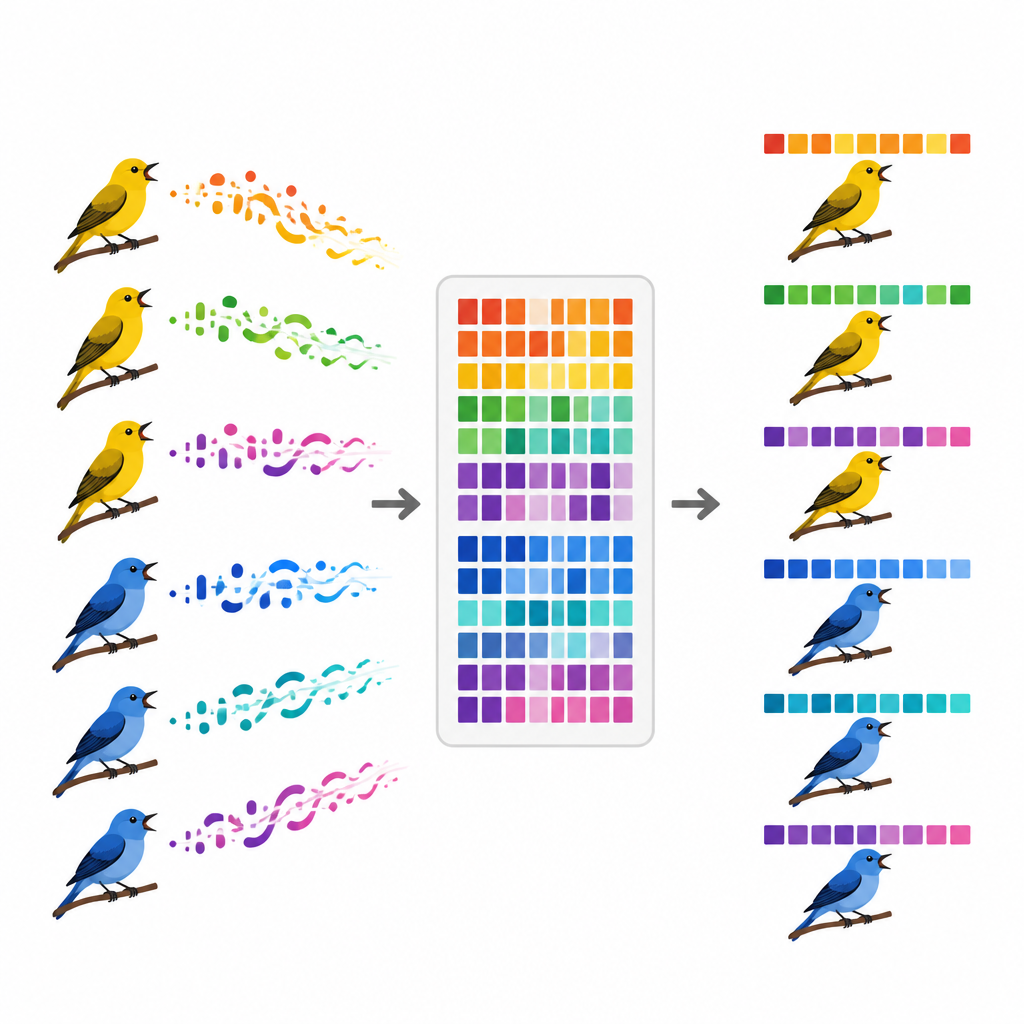
Many animals, including humans, communicate using sounds arranged over time. In speech, words are ordered into sentences using rules of grammar. In songbirds, short sound elements called syllables are strung together into songs with a kind of rhythm and order often called syntax. Earlier work showed that young birds usually imitate both the sounds and the sequences of their adult tutors, yet that their overall song structure tends to be very similar across a species even when tutoring is unusual or incomplete. This hints that birds may be guided by hidden rules that are shared by all members of a species, rather than only by the example of their parents.
Listening closely to two finch species
The authors focused on two closely related finch species, zebra finches and long-tailed finches, which share similar hearing abilities and song development but differ in how their songs are organized. They recorded songs from more than one hundred adult birds raised in family groups across three university colonies. For each bird, they broke song into syllables and measured 26 aspects of each sound, such as how long it lasted, how noisy or pure it was, and what pitch range it covered. Using these measurements, they grouped syllables into types and confirmed that pupils copied their tutors’ syllables very accurately, forming clear clusters of matching sound types in both species.
Discovering hidden rules in song structure
Next, the researchers asked whether the acoustic properties of syllables tended to occur at particular positions within a song. For example, in zebra finches, long syllables often appear at the end of a short repeated pattern, while in long-tailed finches, songs gradually shift from short, noisy sounds to longer, more tonal ones. By averaging measurements across many birds, they found that most acoustic features changed in systematic ways from the start to the end of a song motif. They captured these patterns in a "species rules" matrix: a map that links specific acoustic feature values to preferred positions in the sequence, separately for each species.
Letting the rules predict a bird’s song
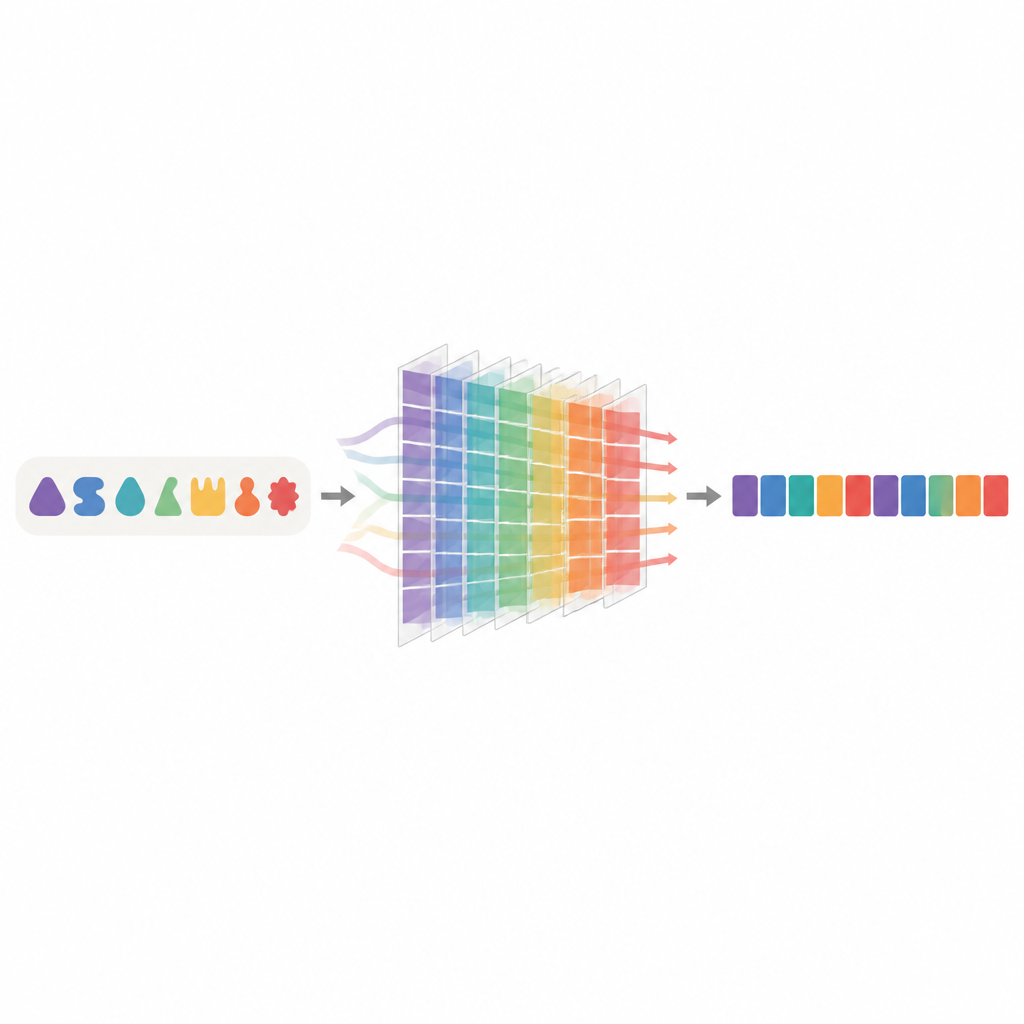
With these species rules in hand, the team tried to predict how a young bird would arrange its own set of syllables, without ever showing the model that bird’s tutor song. For each pupil, they compared the acoustic features of its syllable types to the species rules matrix to find which positions in the song each syllable best matched. A simple algorithm then filled the available positions, giving every syllable type at least one place. To judge how good these predictions were, they compared the predicted sequence to the bird’s actual song, and also to the tutor’s song and to random shuffles of the pupil’s syllables, using a standard measure that counts how many insertions, deletions, or swaps would be needed to turn one sequence into another.
Shared song rules across individuals and colonies
The predicted songs based on species rules matched the pupils’ real songs almost as well as the tutors’ songs did, and far better than random shuffles. This was true for both zebra finches and long-tailed finches, even though the species differ in how often syllables are repeated and how variable their motifs are from one performance to the next. Remarkably, rules learned from birds in one colony could accurately predict songs from birds raised in other colonies hundreds of kilometers away, suggesting that these rules capture stable, species-wide structure rather than local song dialects. In long-tailed finches, the model even produced frequent syllable repeats, a hallmark of that species’ style, despite not being explicitly told to repeat sounds.
What this means for birds and beyond
This work shows that much of the order in birdsong can be explained by species-specific rules that link what a syllable sounds like to where it tends to appear in the song, not just by direct copying of a tutor’s sequence. Young birds seem to learn a set of sound units, then arrange them using an internal rulebook shared across their species, producing songs that fit a common template while still allowing individual variation. Because the approach relies only on identifying sound units and their positions, similar models could help scientists uncover hidden structure in other complex vocal signals, from whale song to human speech, shedding light on how brains learn and organize sequences of behavior.
Citation: Edwards, J.A., Woolley, S.M.N. A species rules syntax model accurately organizes birdsong syllables into songs. Sci Rep 16, 14795 (2026). https://doi.org/10.1038/s41598-026-44602-5
Keywords: birdsong, song syntax, vocal learning, computational modeling, finch communication