Clear Sky Science · en
Fabrication and characterization of shape memory polyurethane/GNP/MWCNTs nanocomposite thin-films with enhanced UV resistance
Smart films that remember their shape
Imagine a thin plastic strip that you can twist, fold, or crumple, then gently warm and watch it spring back to its original form. Now imagine that same strip has to survive months or years of harsh sunlight without becoming weak, brittle, or yellow. This study explores how to build such smart, light responsive films by mixing a special memory plastic with tiny carbon additives that help it stay strong under ultraviolet (UV) light.
Why shape memory films matter
The base material in this work is a shape memory polyurethane, a kind of plastic that can be set into a temporary shape and later recover its original form when heated. Because it is light, flexible, and biocompatible, this plastic is attractive for uses such as soft actuators, flexible electronics, sensors, medical bandages, and smart coatings. However, on its own it has two big weaknesses: its mechanical strength is modest, and its ability to snap back to shape can fade, especially when it is exposed to UV light that slowly damages the polymer chains.
Adding tiny carbon helpers
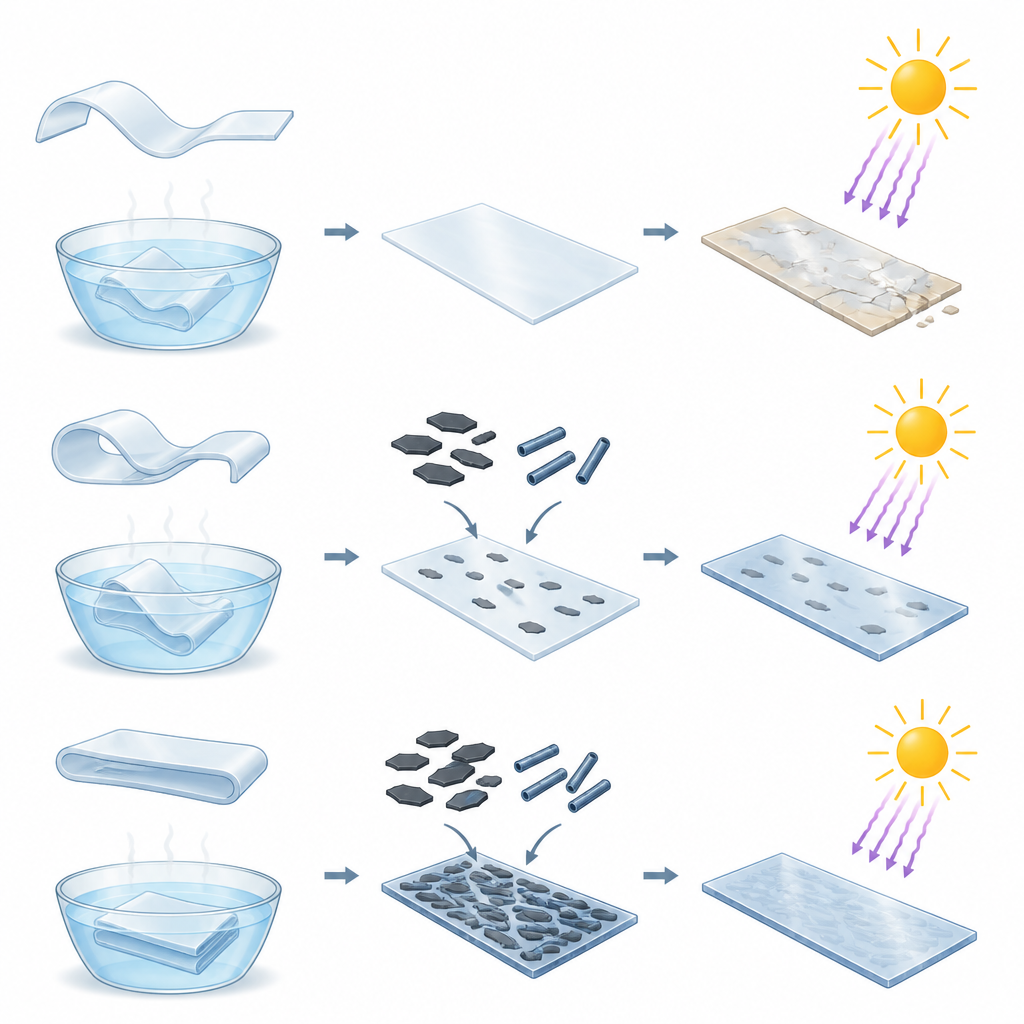
To tackle these problems, the researchers created very thin films of the memory plastic and then made two versions reinforced with nanometer scale carbon fillers. One version contained flat graphene nanoplatelets, while the other used long, hollow multi walled carbon nanotubes. Both were mixed at just one percent by weight using a solvent casting process that spreads a uniform liquid layer onto glass or plastic sheets and then cures it into solid films. These tiny additives are far smaller than the thickness of a human hair, but they can interact strongly with the surrounding plastic and change how it behaves when stretched, heated, or illuminated.
Stronger, tougher, and faster to snap back
The team measured how the films responded to pulling, heating, wetting by water, and controlled UV exposure. The reinforced films were far stronger than the pure plastic: the nanotube filled film reached more than double the original tensile strength and could stretch to well over twice the elongation before breaking. The added particles also nudged the material’s internal transition temperature upward and encouraged more ordered regions inside the plastic, which act like anchor points that help it remember its shape. In shape recovery tests using folded origami like cones in hot water, the filled films returned to their original shape in roughly half the time of the unfilled plastic, while keeping nearly perfect recovery in one direction of motion.
Standing up to harsh UV light
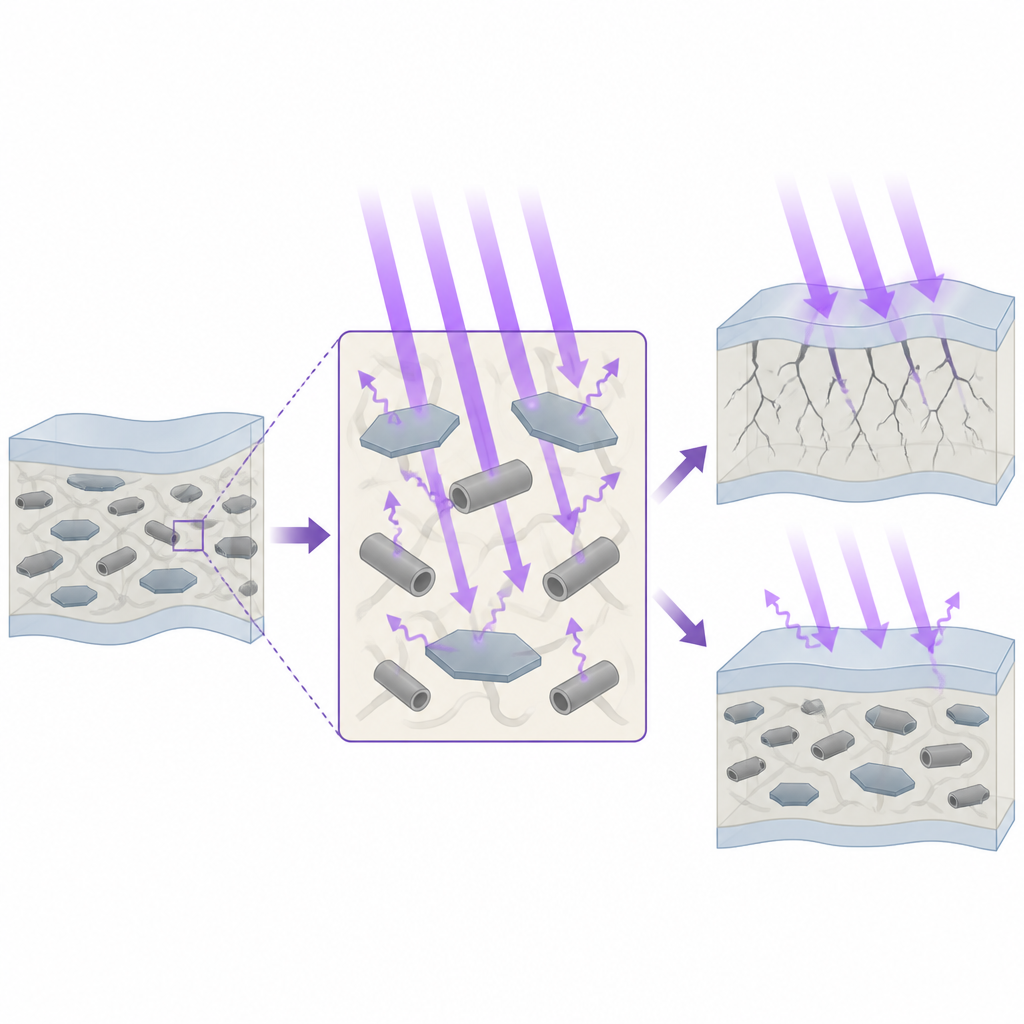
Sun like UV radiation is notorious for breaking chemical bonds and turning clear polymers yellow and brittle. The researchers exposed the films for up to 72 hours in an accelerated weathering chamber and watched how their chemistry, structure, and strength changed. All samples showed some aging, but the pure plastic degraded much faster: its color shifted, its strength eventually fell below its starting value, and its shape recovery slowed and became less complete. In contrast, the graphene and nanotube filled films gained strength after short exposure and then lost it only gradually over longer times, kept a higher degree of internal order, and held on to their shape memory function. Spectroscopic measurements showed that the filled films formed fewer oxidation products, indicating that the carbon fillers were absorbing UV light and quenching reactive fragments before they could damage the polymer.
What this means for future devices
By blending a small amount of graphene sheets or carbon nanotubes into shape memory polyurethane, the study shows that it is possible to make thin, flexible films that are stronger, recover their shape more quickly, and resist the harmful effects of UV light. For a lay reader, the key message is that a tiny dose of engineered carbon can act like invisible sunscreen and internal scaffolding for smart plastics. This combination could help future wearable gadgets, medical patches, soft robots, and protective coatings keep working reliably even after long exposure to sunlight and outdoor weather.
Citation: Namathoti, S., Elfar, A.A., Avvari, V.D. et al. Fabrication and characterization of shape memory polyurethane/GNP/MWCNTs nanocomposite thin-films with enhanced UV resistance. Sci Rep 16, 14785 (2026). https://doi.org/10.1038/s41598-026-44601-6
Keywords: shape memory polymer, polyurethane films, graphene, carbon nanotubes, UV resistance