Clear Sky Science · en
Enhancing financial stability in healthcare through data-driven risk assessments with machine learning
Why money and data matter for our health
Why do people in some countries live much longer than in others, and what does money have to do with it? This study explores how health spending, family medical bills, and government budgets together shape life expectancy around the world. By pairing global health and financial data with modern computer models, the authors show how smarter use of resources can both steady healthcare finances and help people live longer, healthier lives.
Following the trail of health dollars
The researchers started with a worldwide dataset that tracks how much countries spend on healthcare in several key ways. They looked at average health spending per person, how much comes directly out of people’s pockets, how large the health budget is compared with the whole economy, and how long people live in each country. These numbers reveal not only how much money flows into clinics and hospitals, but also how heavy the financial burden is for ordinary families seeking care.
What the trends over time reveal
When the team examined changes from 2000 to 2018, clear patterns emerged. Average health spending per person rose steadily around the globe, and public health budgets claimed a growing share of national income. At the same time, the share that patients paid directly from their own wallets tended to fall, while life expectancy climbed from about the late 60s to the early 70s in many places. Taken together, these trends suggest that when countries invest more in healthcare and protect people from large personal bills, their populations tend to live longer.

Teaching computers to spot hidden patterns
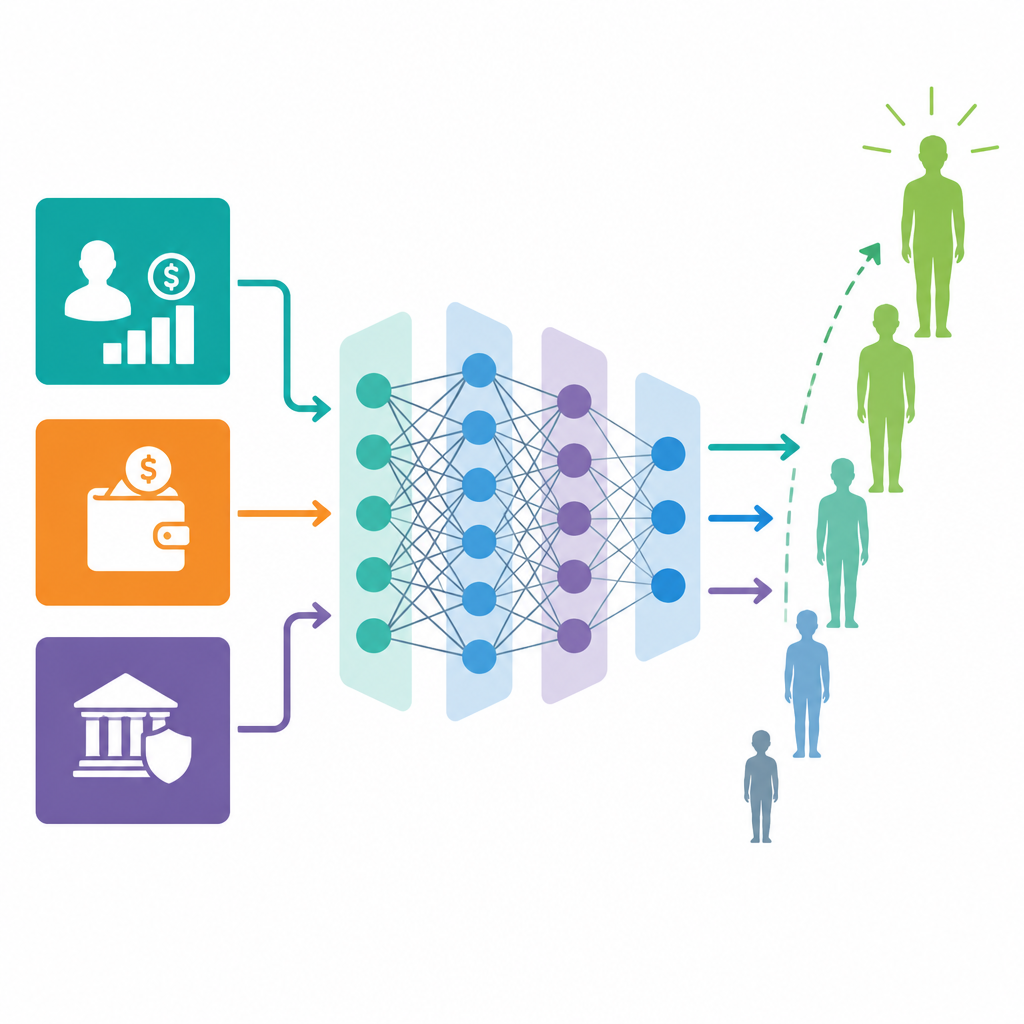
To go beyond simple averages, the authors turned to machine learning, a branch of artificial intelligence that learns patterns from data. They compared several types of models, ranging from basic linear regression to deep neural networks and advanced designs that specialize in time-based patterns. One standout approach, called a bidirectional long short-term memory network, was able to use both past and future data points in a time series to refine its predictions. Trained on the global dataset, this model predicted national life expectancy with high accuracy, capturing subtle links between different kinds of spending and health outcomes.
Which kinds of spending matter most
Using additional tools that explain how models make decisions, the researchers ranked the importance of each spending measure. By far the strongest signal came from average health expenditure per person. Countries that spent more per individual tended to achieve higher life expectancy. Out-of-pocket costs for patients came next, followed by overall health spending as a share of the economy, while the precise size of the public budget slice mattered somewhat less. Sensitivity checks and feature-importance scores agreed: protecting households from heavy medical bills and ensuring adequate overall investment are central to better health and more stable healthcare finances.
From predictions to practical choices
The study does not claim that computers can fix health systems on their own, nor that money alone determines how long people live. The models work best when paired with careful planning, fair policies, and attention to social factors like education, employment, and living conditions. Still, the findings send a clear message to decision-makers: investing enough in healthcare, reducing the financial shock of illness for families, and tracking these choices with transparent data tools can strengthen both public health and financial stability. In simple terms, when countries spend wisely to keep people healthy without pushing them into debt, their citizens are more likely to enjoy longer lives.
Citation: Chai, D., Du, S. Enhancing financial stability in healthcare through data-driven risk assessments with machine learning. Sci Rep 16, 15659 (2026). https://doi.org/10.1038/s41598-026-44599-x
Keywords: healthcare finance, life expectancy, machine learning, health spending, risk assessment