Clear Sky Science · en
A hybrid unified decoding analytics system for end-of-life strategies in mass-produced EV battery projects
Why old car batteries still matter
As electric cars spread across the globe, their batteries are quietly creating a new challenge: what to do with the first wave of large lithium-ion packs as they reach the end of their useful life in vehicles. These heavy, material‑rich devices can either become a waste problem or a valuable resource. This study asks a simple but pressing question: among many possible ways to invest in and reuse these batteries, which options should governments, companies, and investors prioritize to get the most environmental and economic benefit under deep uncertainty?
Choosing a path for tired batteries
The authors focus on “first‑generation” mass-produced electric vehicle batteries—those that helped push electric cars from niche products to mainstream transportation. These early investments cut costs and boosted driving range, but they also increased demand for critical raw materials and put pressure on recycling systems. As millions of packs approach retirement, decision makers must choose between different end‑of‑life paths: creating regional mini‑factories to process packs locally, storing them until better technology emerges, reusing components, recycling key materials directly, or combining several refining methods. Each option offers a different balance of cost, flexibility, and environmental impact, and existing research tended to look at these pieces separately rather than as a connected system. 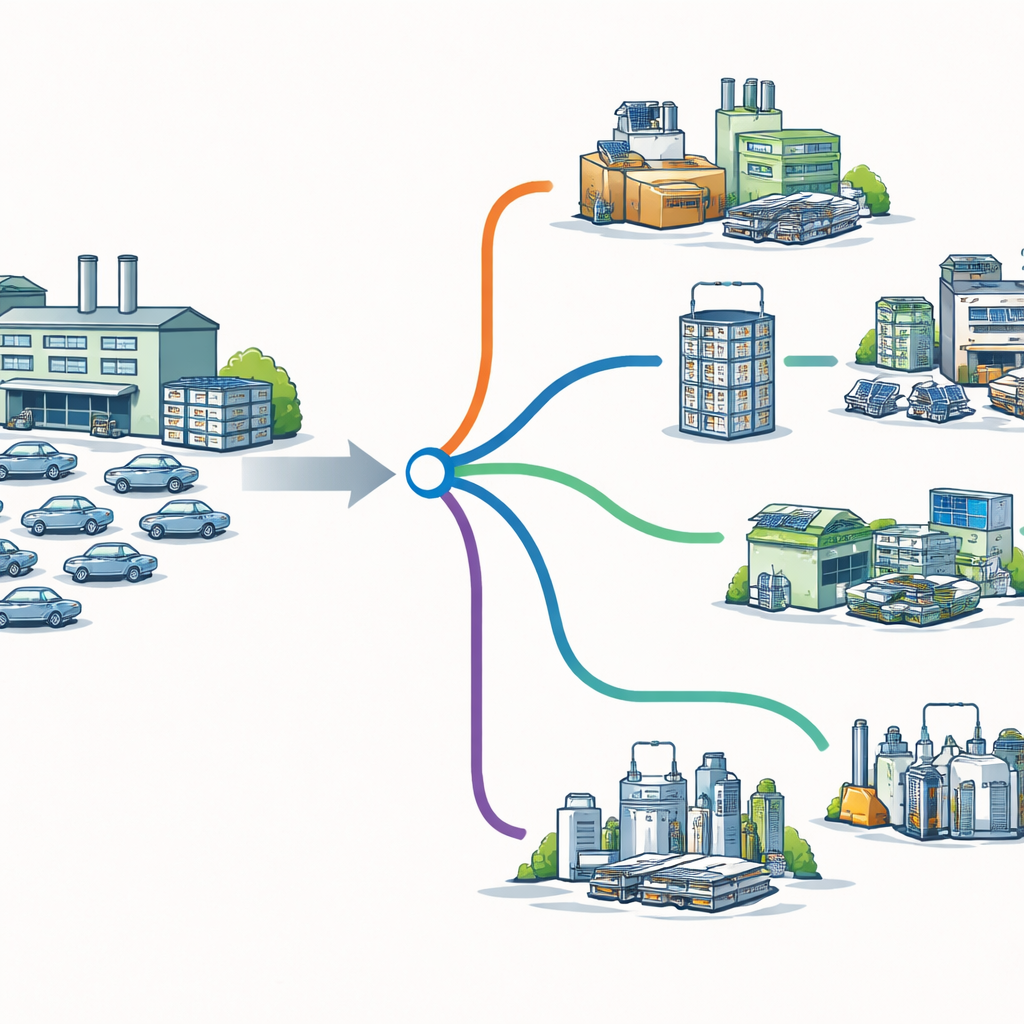
What really matters when making these choices
To compare strategies fairly, the study identifies five broad criteria that capture both business and sustainability concerns. “Circular value add” reflects how well a strategy keeps materials in use through reuse, repair, and recycling, rather than sending them to landfills or requiring new mining. “Closed‑loop potential” captures how completely materials can be cycled back into new batteries. “Technology readiness” gauges how mature and reliable a given process is in real‑world conditions. “Second‑life market size” measures the opportunity to repurpose used batteries, for instance in stationary storage. Finally, “energy efficiency” looks at how much energy is required across production, use, and end‑of‑life treatment—key for both cost and climate impact. Ten seasoned experts in energy and environmental engineering rated how these criteria influence one another and how well each end‑of‑life strategy performs on them.
A smarter way to read expert judgment
Because experts often disagree and their opinions can be biased or uncertain, the researchers developed a new analytical tool they call cipher fuzzy sets. Rather than treating each verbal rating (“high”, “low”, and so on) at face value, the method mathematically decodes underlying patterns such as optimism, pessimism, or hesitation. It corrects for distortions and avoids compressing rich fuzzy judgments into single crude numbers, which can throw away useful information. Alongside this, the team uses a distance‑based method to identify the expert whose ratings best represent the group as a whole, cognitive maps to capture how criteria influence one another, and a robust ranking technique that blends several mathematical distance and correlation measures. Together, these steps form a unified pipeline that moves from raw expert opinion to a stable ranking of strategies. 
Which strategies come out on top
After running the model under several different “what if” scenarios that change how much weight is given to confidence versus hesitation, a clear pattern emerges. Two criteria dominate across nearly all cases: circular value add and energy efficiency. In simple terms, the best investments are those that keep as much battery value as possible in circulation while using as little energy as possible to do so. When the end‑of‑life options are ranked, component‑level reuse—harvesting working modules or cells for second‑life uses—and direct cathode‑to‑cathode recycling—recovering cathode material in a form ready to go into new batteries—consistently rise to the top. More traditional options, such as long‑term storage or broad, complex refining schemes, tend to lag because they either lock up value or consume more energy without offering proportionate gains.
What this means for the future of electric cars
For non‑specialists, the message is straightforward: managing old EV batteries wisely is essential for making electric mobility truly sustainable, and not all recycling or reuse paths are equal. The study suggests that policies and investments should focus first on strategies that retain the highest value with the lowest energy use—specifically reusing components where possible and directly recycling critical materials in a form ready for new batteries. By providing a transparent, step‑by‑step way to weigh complex trade‑offs under uncertainty, the proposed analytical system gives policymakers, investors, and industry leaders a practical guide for turning yesterday’s car batteries into tomorrow’s energy assets rather than tomorrow’s waste.
Citation: Dinçer, H., Yüksel, S., Zavadskas, E.K. et al. A hybrid unified decoding analytics system for end-of-life strategies in mass-produced EV battery projects. Sci Rep 16, 14319 (2026). https://doi.org/10.1038/s41598-026-44597-z
Keywords: electric vehicle batteries, battery recycling, circular economy, second-life storage, investment decision models