Clear Sky Science · en
FreshTrack: an innovative IoT-sensor-driven food freshness estimation framework integrating blockchain
Why keeping food fresh matters to everyone
Every time we toss wilted lettuce or a brown banana, we are throwing away money, nutrition, and the resources used to grow and ship that food. Around a third of all food produced worldwide is lost or wasted, much of it because we cannot see exactly how fresh it really is. This paper presents “FreshTrack,” a new way to continuously measure and manage food freshness using small sensors, smart devices, and blockchain technology, with the goal of making our food supply safer, more efficient, and less wasteful.
A new way to score how fresh food really is
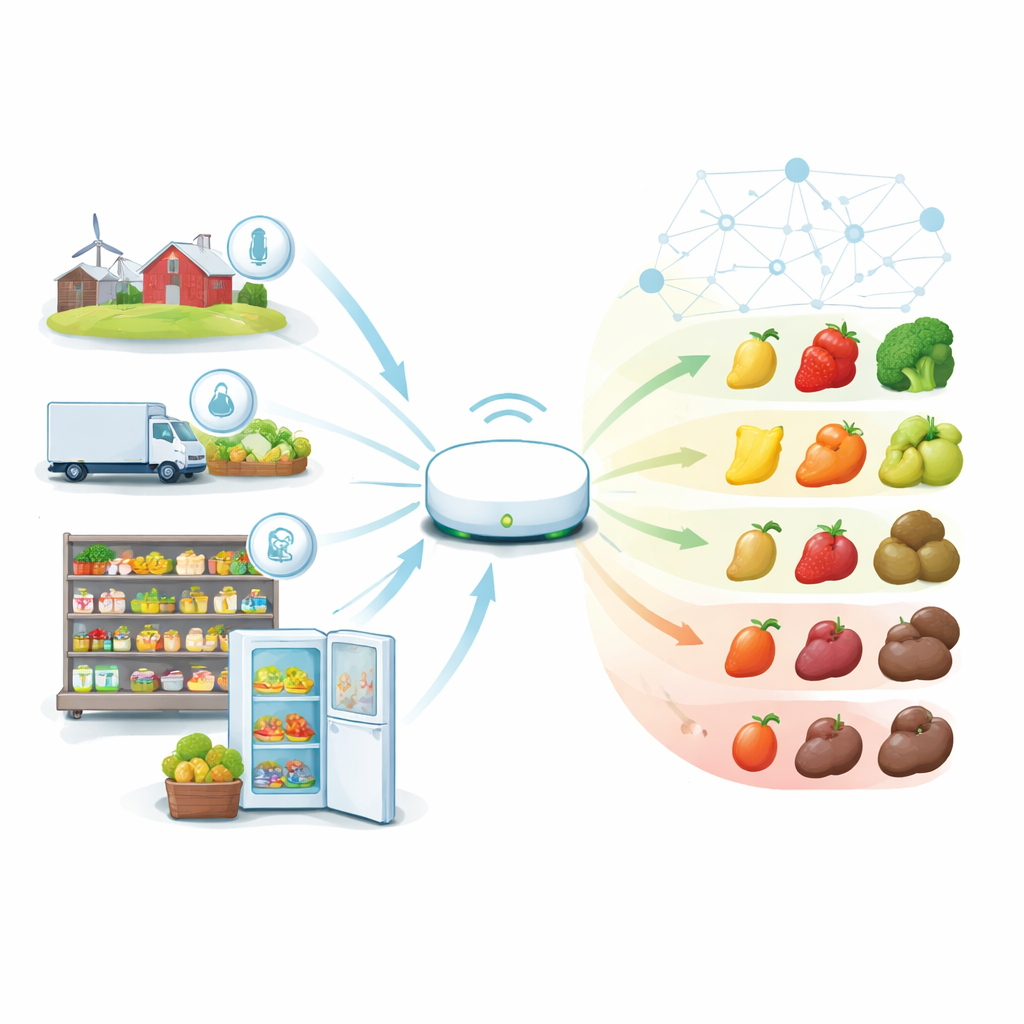
Most labels on food—like “best before” dates—are rough guesses based on ideal storage conditions. In reality, perishables such as fruit, meat, and dairy travel through trucks, warehouses, stores, and home fridges that all experience different temperatures and humidity. FreshTrack replaces one-size-fits-all dates and simple “fresh or spoiled” checks with a living freshness score that changes over time. Using well-known ideas from food science about how heat speeds up chemical reactions and how warm, damp conditions favor microbes, the authors design a mathematical model that turns temperature, humidity, and time into a single score between 1 and 100. High scores reflect just-picked quality; low scores signal that food is nearing or past the point when it should be eaten or discarded.
Smart sensors and devices watching food in real time
To feed the model with real-world data, the framework relies on inexpensive sensors that measure temperature and humidity next to the food. These sensors connect to a small computing unit, such as a Raspberry Pi, which plays the role of an on-site brain. Instead of sending raw readings to distant cloud servers, the device calculates the freshness score on the spot, every few minutes if needed. This local processing avoids delays, works even with shaky internet connections, and keeps detailed data private. The system then classifies each item into one of five easy-to-understand categories—Excellent, Good, Average, Below Average, or Bad—so people and automated systems can act quickly without digging into technical details.
Locking in trust with blockchain and automatic actions
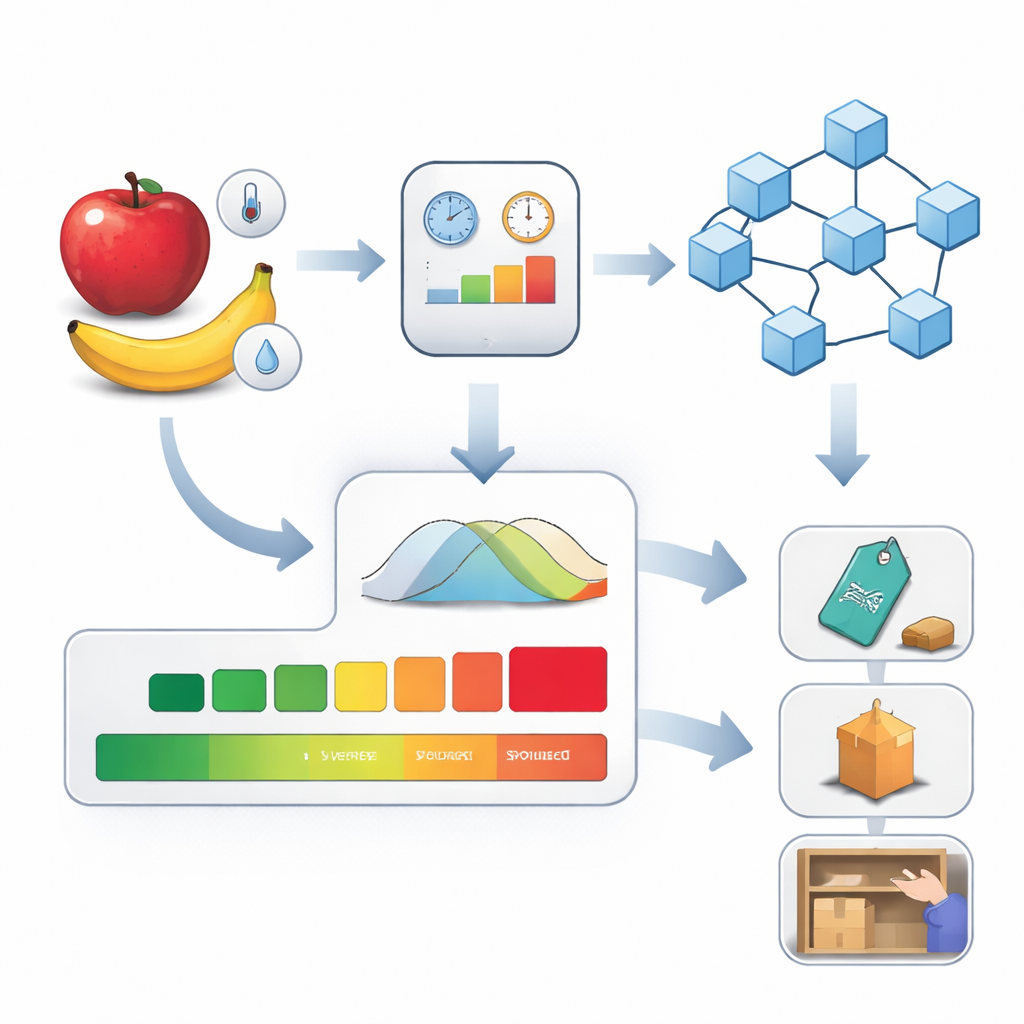
A major challenge in shared food chains is trust: if one company controls the database, others may worry that records can be changed after the fact. FreshTrack tackles this by writing only important changes—such as when an item moves from Good to Average quality—to a blockchain, a shared digital ledger that is extremely hard to tamper with. Small programs called smart contracts run on this ledger. When a freshness category drops below a chosen level, these contracts automatically carry out actions, such as sending alerts, suggesting price discounts to sell items faster, or flagging products for removal. Because only category changes, not every sensor reading, are stored on the blockchain, the system remains efficient even when monitoring thousands of items.
Putting the system to the test with real fruit
The authors tested FreshTrack using apples and bananas kept in a temperature-controlled chamber at four conditions, from cool (5 °C) to warm (35 °C), while tracking humidity. Simple DHT11 sensors fed data to a Raspberry Pi, which computed freshness scores over ten days. As expected, cooler and drier conditions kept fruit fresh far longer, while warmth and higher humidity sped up decline. The model captured well-known differences between fruits: apples held their quality better than bananas under the same conditions, ending with higher scores and better visual appearance. The team also compared local processing to cloud-based processing and found that doing the calculations directly on the IoT device drastically reduced delay, especially when encryption was added in cloud scenarios.
How this approach could change daily food decisions
For non-specialists, the key outcome is a system that turns invisible environmental stresses into a simple, trustworthy signal of how fresh food really is. FreshTrack shows that small sensors and local computing can deliver a continuous freshness score, translate it into intuitive categories, and then use blockchain and smart contracts to coordinate timely actions across the supply chain. If extended beyond fruit to meat, seafood, prepared meals, and supermarket pilots, such a system could help stores discount items at the right moment, divert near-expiry products to food banks, and give consumers or apps up-to-the-minute guidance on what to cook first—cutting waste while improving safety and transparency.
Citation: Masuduzzaman, M., Hassini, E., Rahaman, M.F. et al. FreshTrack: an innovative IoT-sensor-driven food freshness estimation framework integrating blockchain. Sci Rep 16, 13847 (2026). https://doi.org/10.1038/s41598-026-44579-1
Keywords: food freshness, internet of things, blockchain, food waste, smart packaging