Clear Sky Science · en
Cognitive offloading reduces internal memory processing in children
Why writing things down matters for kids
Many of us rely on notes, phone reminders, or online searches to keep track of information. These tools make life easier, but they may also change the way our brains remember. This study asked a simple question with big consequences for school and everyday life: when children know they can look something up later, do they stop really learning it in the first place?
Using the world as a mental notebook
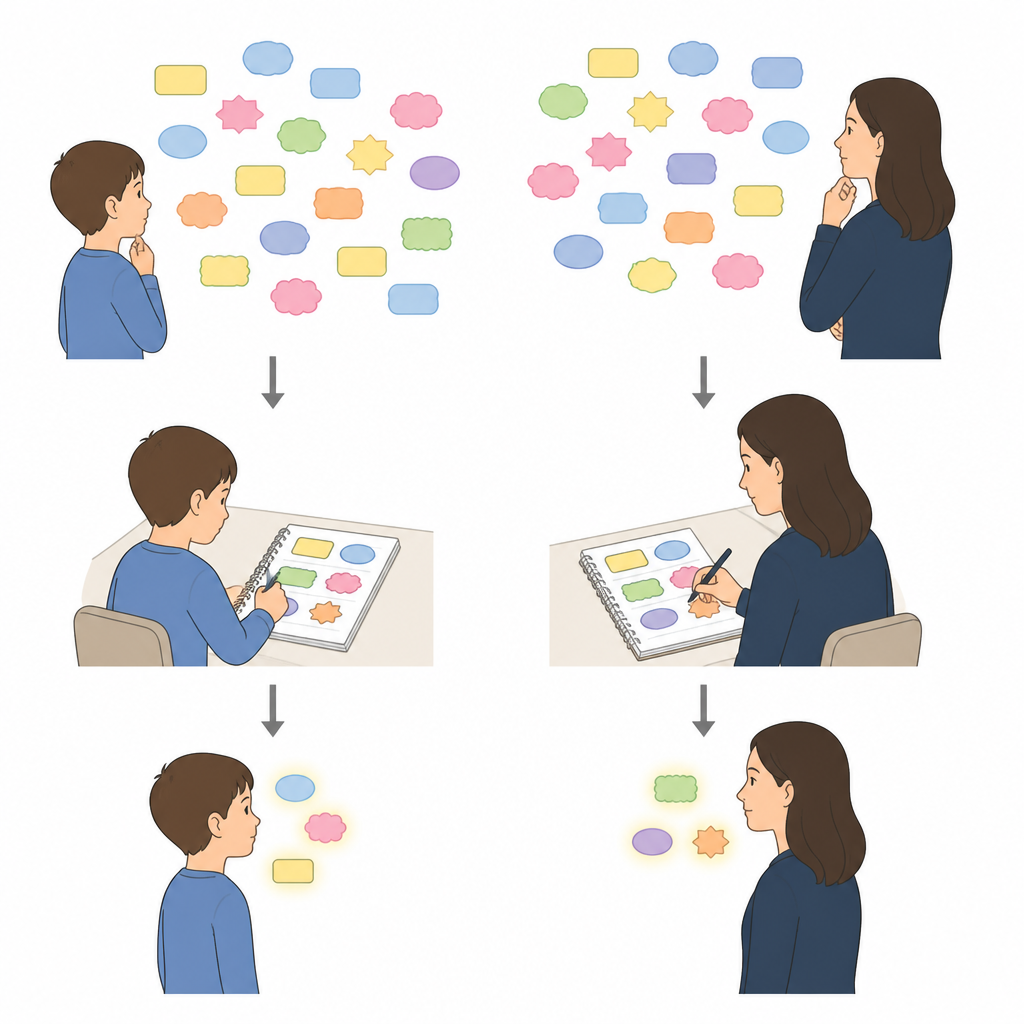
Psychologists call it cognitive offloading when we shift mental work onto the outside world, such as by writing a shopping list instead of memorizing it. Adults are known to benefit from this habit, but they also tend to remember less of what they have written down if the list suddenly disappears. The researchers wanted to know whether 10- and 11-year-old children show the same tradeoff between convenience and memory, and how this might affect their growing ability to use memory strategies like rehearsal, imagery, or building stories.
Putting children and adults to the test
The study included forty children and forty young adults. Everyone completed four rounds of a word memory task. In the first round, participants simply tried to memorize a list of 20 words and then recalled as many as possible from memory alone. This gave a baseline measure of how well children and adults could remember without any help. As expected, adults recalled more words than children when they had to rely only on their own minds.
When notes make everyone look equally strong
In the next two rounds, participants again saw 20-word lists, but this time they wrote each word on paper and later used their own lists to help with recall. With this external aid, both children and adults performed almost perfectly, and the age gap in memory vanished. The notes allowed children to perform at adult levels, showing that even at 10 or 11 years old they can use outside tools very effectively when those tools are reliably available.

The hidden cost when the notes vanish
The crucial test came in the final round. Everyone still wrote the words down during study, but the lists were secretly removed before the test. Half of the participants had been warned in advance that the list would not be available, so they focused on memorizing the words internally. The other half assumed they would be able to use their notes, just as before. When the lists were taken away, both children and adults who had expected access to their notes recalled fewer words than those who had prepared to rely on memory alone. They also reported using fewer memory strategies while studying, suggesting that they had invested less mental effort in truly learning the words.
What this means for growing minds
For a lay reader, the takeaway is that external aids are a double-edged sword. In this study, writing lists helped children keep up with adults when the notes were available, but it also encouraged them to cut back on mental practice when they trusted those notes too much. When the safety net disappeared, their inner memory suffered. The findings suggest that children, like adults, treat the outside world as an extra memory store and may learn less deeply when they expect information to be easily accessible later. The authors argue that parents and teachers should not avoid tools like notebooks or digital reminders, but should pair them with guidance that keeps children actively engaged in remembering, so that external help supports rather than replaces their growing memory skills.
Citation: Goldberg, E., Magen, H. Cognitive offloading reduces internal memory processing in children. Sci Rep 16, 14914 (2026). https://doi.org/10.1038/s41598-026-44574-6
Keywords: children, memory, external aids, cognitive offloading, learning