Clear Sky Science · en
Advanced gravitational decision-making method inspired by newton’s law of universal gravitation
Why gravity can help tough choices
Every day, big decisions hinge on juggling many competing goals: a hospital choosing equipment, a city planning green energy, or an engineer designing safer concrete. Classic decision tools help compare options, but they often treat each option in isolation and struggle when data are uncertain or alternatives look very similar. This paper introduces a new method called GRAD (Advanced Gravitational Decision-Making), which borrows ideas from Newton’s law of gravitation to rank options more realistically when the stakes and the uncertainty are both high.
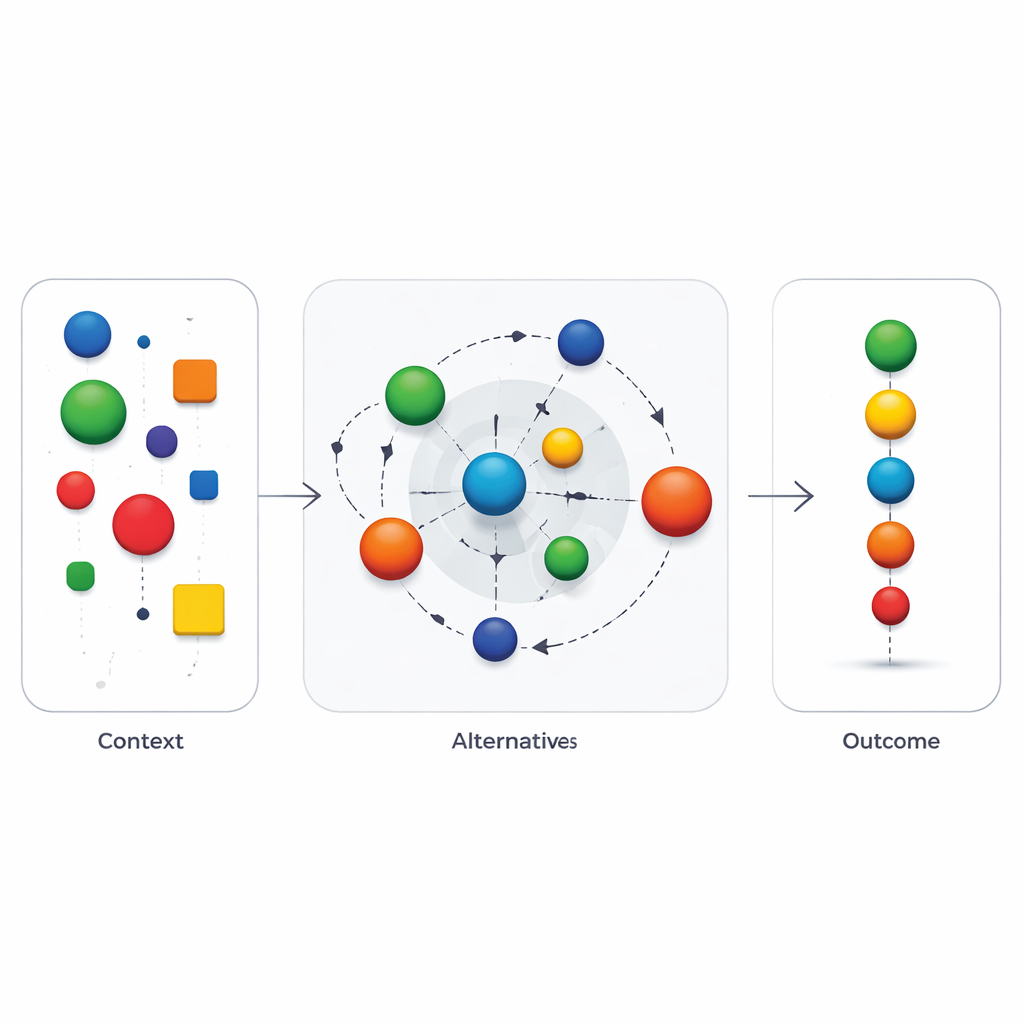
Turning choices into a gravity field
GRAD imagines each possible choice as if it were a small body in a gravitational field. In this picture, the “mass” of an option comes from how well it performs on different criteria—such as cost, quality, safety, or environmental impact—and from how volatile those criteria are in the data. Criteria whose values fluctuate more strongly, captured by a higher statistical spread, behave like heavier masses and pull harder on the final decision. Distance also matters: options that sit far from an ideal target point, or far from one another in terms of performance, exert weaker influence, while closely matched options interact more strongly. Instead of just measuring how far each alternative is from a single ideal, GRAD lets options attract or repel one another in a shared decision space.
From raw data to gravitational pull
The method starts in a familiar way: the decision maker defines the problem, lists the options, and selects the criteria. Raw numbers—such as costs, speeds, or strength values—are then converted to a common 0–1 scale so that “bigger is better” and “smaller is better” criteria can be compared fairly. Next, GRAD calculates how much each criterion varies across the options, and uses this variability directly inside its gravity-inspired formula instead of only as a background weight. For every option and every criterion, GRAD combines four elements: the criterion’s importance, its variability, the option’s normalized performance, and its distance from an ideal or expected target point. These ingredients generate a kind of gravitational force for each option, which is then summed across all criteria to give an overall pull.
Letting options interact with each other
GRAD does not stop at a single score per option. It also looks at how options relate to one another. Using distances between every pair of alternatives, the method adjusts each option’s score according to how strongly it is “pulled” or “pushed” by its competitors. Options that perform well and sit near other strong contenders experience intense interaction, teasing out subtle differences between closely matched choices. Weak or distant options exert little influence. This interaction-aware scoring is followed by a sensitivity analysis: the authors systematically tweak key parameters that control how strongly weights, performance differences, and distances matter. Across reasonable ranges, the rankings remain stable, suggesting the method is robust rather than overly sensitive to fine-tuning.
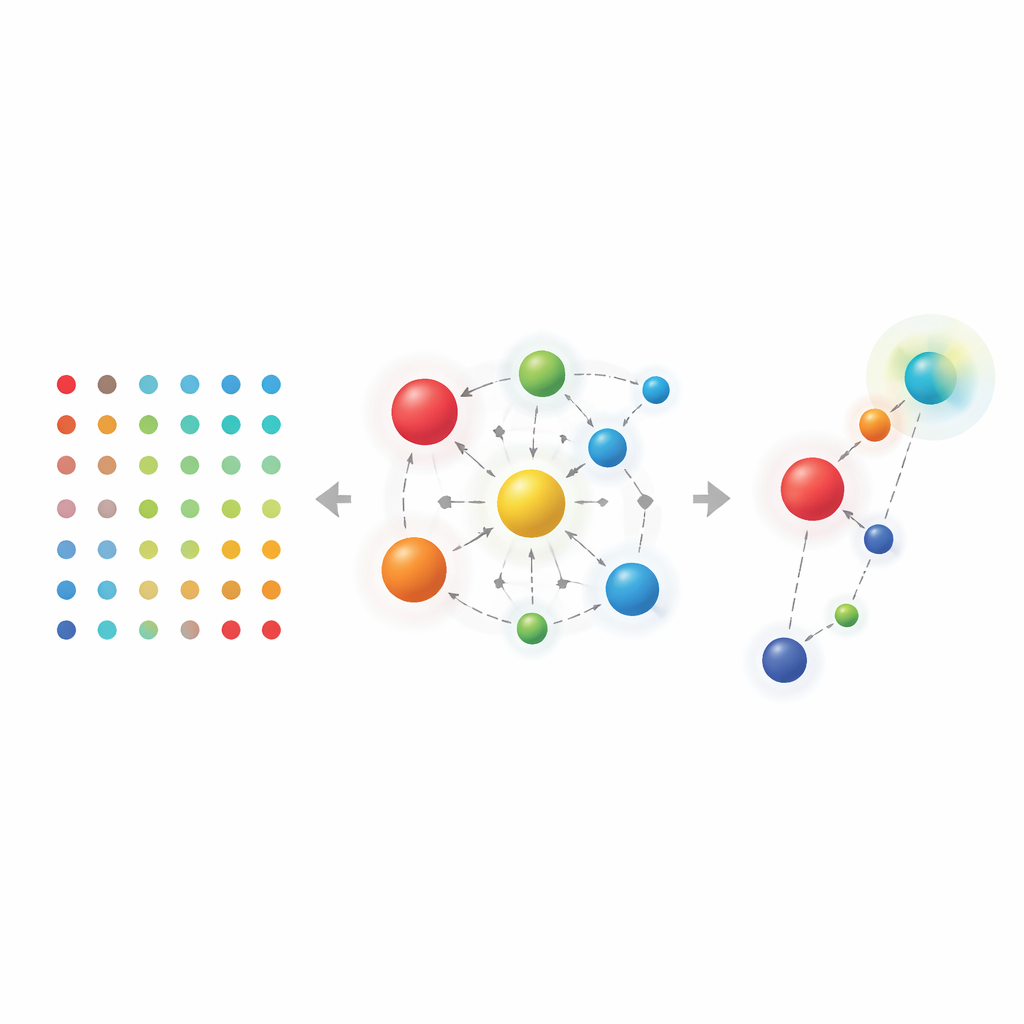
How GRAD performs in practice
To show how the method works, the researchers first apply GRAD to a small, synthetic factory example where four production systems are judged on cost, quality, speed, and environmental impact. They compare the resulting rankings to those produced by three well-known methods—TOPSIS, VIKOR, and CoCoSo—and then run 10,000 Monte Carlo simulations that slightly disturb the input data. GRAD proves better at keeping promising options near the top of the ranking when the numbers are noisy, a hallmark of robustness. In a more realistic test, the authors turn to a well-known concrete dataset from civil and mechanical engineering. Here, each candidate concrete mix is evaluated on material amounts, curing time, and achieved compressive strength. GRAD identifies a mix that balances high strength with reasonable material use and curing demands, and it produces a noticeably different, interaction-aware ranking than a classic distance-only method called SPOTIS.
What this means for real-world decisions
In everyday terms, GRAD offers a way to choose among complex options while acknowledging that risky criteria should weigh more heavily and that competing options do not exist in isolation. By weaving together uncertainty, similarity, and distance into one coherent model, the method can highlight not just which alternative looks best on paper, but which stays strong when the data are uncertain and rivals are close. While it requires good data and some parameter choices, GRAD provides decision makers in fields from engineering to finance and healthcare with a more nuanced, physics-inspired lens on difficult, multi-faceted choices.
Citation: Yerlikaya, M.A., Beytüt, H., Yildiz, K. et al. Advanced gravitational decision-making method inspired by newton’s law of universal gravitation. Sci Rep 16, 13144 (2026). https://doi.org/10.1038/s41598-026-44573-7
Keywords: multi-criteria decision making, gravitational decision model, uncertainty in rankings, engineering design choices, robust decision analysis