Clear Sky Science · en
Distinct social network structures and their cognitive and psychological correlates
Why Our Social Circles Matter as We Age
Many people have heard that staying socially active can help us stay sharp and feel happier as we grow older. But not all social connections are the same. This study asks a simple but powerful question: do different kinds of personal networks support our minds and moods in different ways? By closely mapping older adults’ friendships, family ties, and everyday contacts, the researchers show that certain social patterns are linked to better thinking skills, while others are more closely tied to emotional well-being.
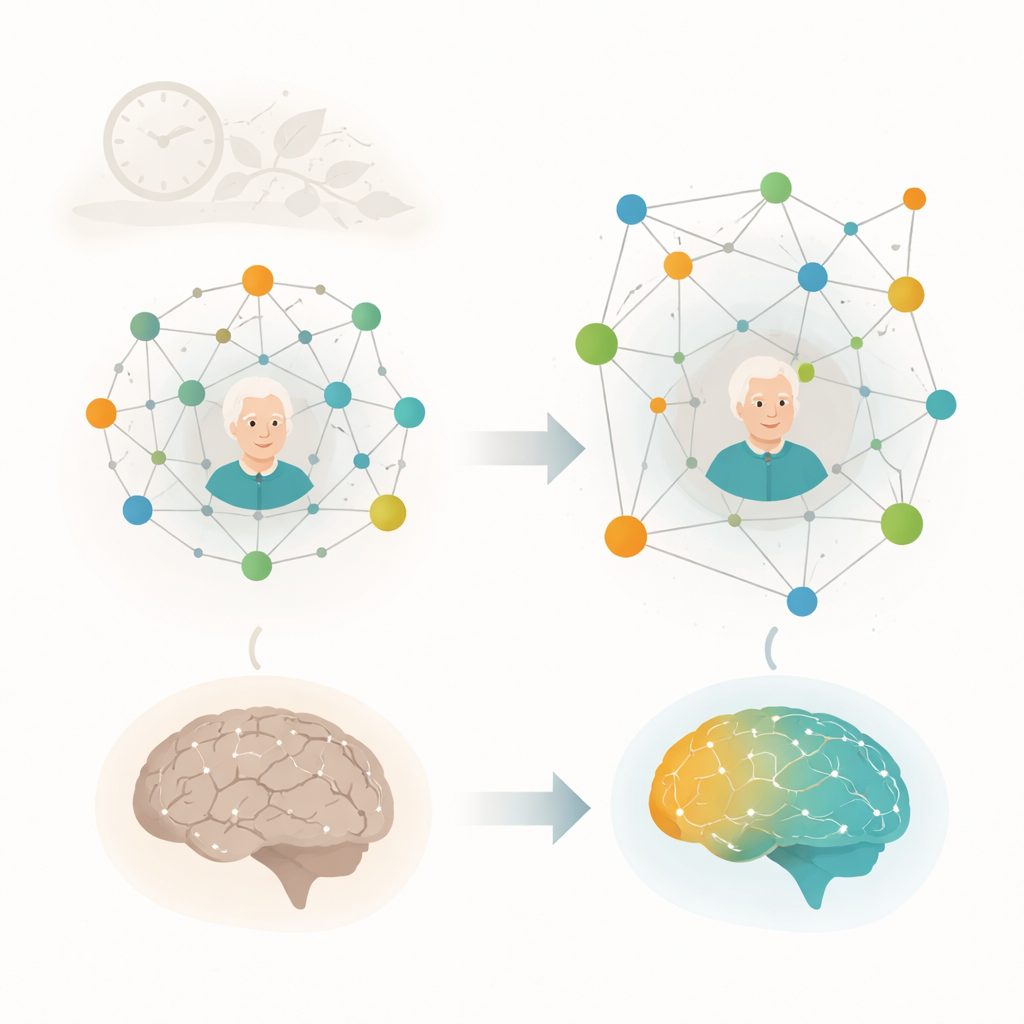
Two Different Kinds of Social Ties
The authors focus on two broad styles of social connection. The first, which they call "bonding," centers on a smaller circle of very close, emotionally warm relationships—often family members or a few trusted friends who know each other well. These networks feel safe, supportive, and tightly knit. The second style, "bridging," looks very different: it involves a larger mix of people—friends, neighbors, fellow volunteers, former coworkers—who do not all know one another and vary in how close they are. Bridging networks expose a person to more varied conversations, roles, and situations, which may place higher demands on the brain.
How the Study Followed Minds and Relationships
The researchers collected detailed information from 386 older adults, some cognitively healthy and some with mild memory or thinking problems. Interviewers asked participants to list the people they talk to about important or health-related matters, and then recorded how often they interact, how close they feel, how strong each tie is, and whether those contacts know each other. They also measured thinking skills using standard tests that probe memory, attention, language, spatial ability, processing speed, and higher-level planning, as well as a widely used screening tool for overall cognition. On the emotional side, they tracked depression, anxiety, loneliness, happiness, and perceived social support. A subgroup at high risk for dementia was followed over several years to see how changes in networks related to changes in thinking.
What Tightly Knit Circles Do for Feelings
When the team compared people’s social patterns with their emotional health, one pattern stood out. Those whose networks were smaller, closer, and more tightly connected—strong on bonding—tended to report fewer depressive symptoms and less loneliness, and they rated themselves as happier. These results fit long-standing theories that, in later life, emotionally meaningful relationships help people regulate stress and maintain a sense of security and belonging. However, when the researchers looked at changes over time, the emotional benefits of bonding were modest and less consistent, suggesting that while close ties are important, they may not be a simple shield against future changes in mood.
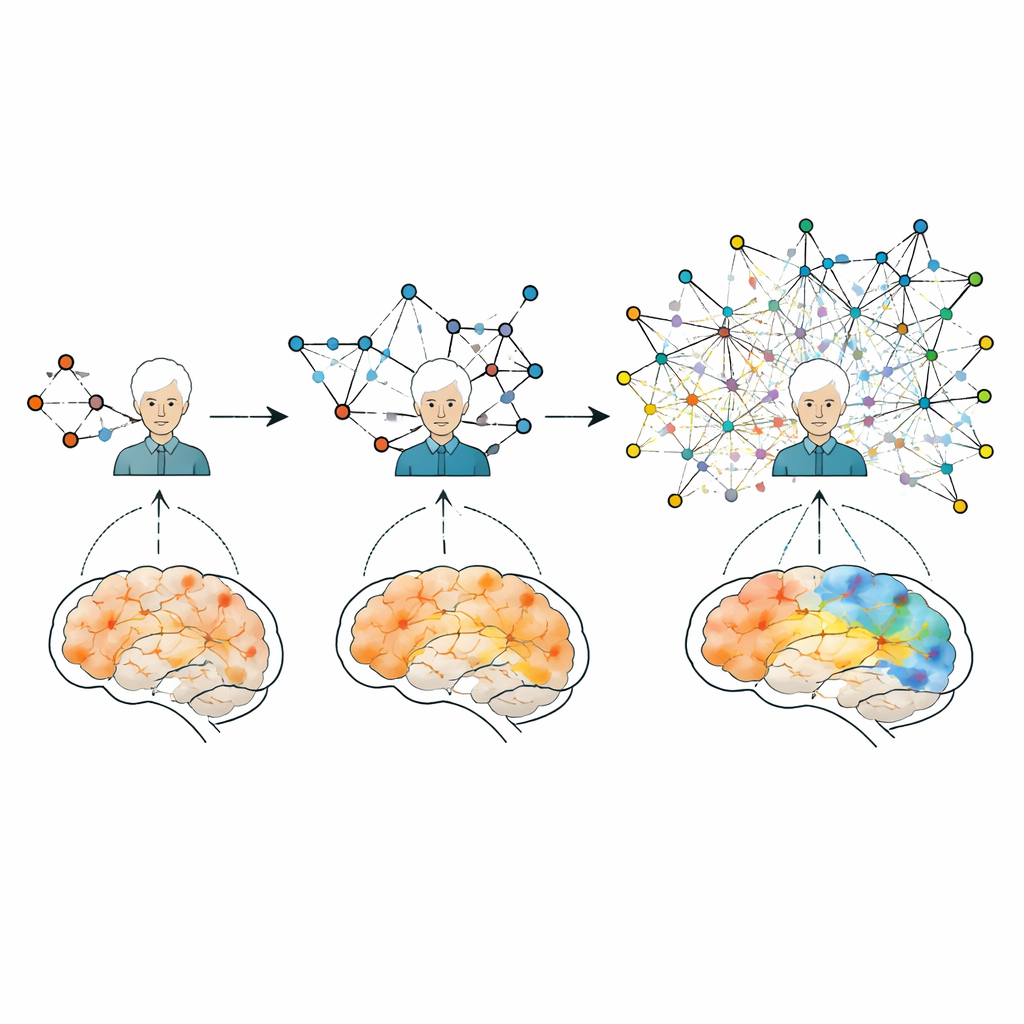
How Wider Circles Protect Thinking
The story was strikingly different for thinking skills. People whose networks were larger, more diverse in social roles, and less densely interconnected—strong on bridging—performed better on tests of memory, executive function (planning, organizing, and problem-solving), language, and overall cognition. These links were not just one-off snapshots. Among participants at higher risk for dementia, increases or drops in bridging over time went hand in hand with gains or losses in memory and language. In contrast, bonding was generally not helpful for cognition and was even weakly linked to poorer performance on complex thinking tasks, perhaps because familiar, repetitive interactions place fewer mental demands on the brain.
Is a “Balanced” Network Best?
The authors also asked whether having both strong bonding and strong bridging at once might offer the best of both worlds. Using a clustering approach, they grouped people into three broad network types: bonding-focused, bridging-focused, and “balanced” networks with moderate levels of each. Surprisingly, these balanced networks were not linked to better outcomes in either domain; in fact, they were associated with slightly worse memory than strongly bridging networks. One likely reason is that time and energy are limited: building many weak ties may come at the cost of nurturing a very dense core of close ties, and vice versa, making it difficult to maximize both forms fully.
What This Means for Everyday Life
For lay readers, the takeaway is that “being socially connected” is not just about how many people you know or how supported you feel. Close, dependable relationships appear especially important for emotional health, while a broader, more varied social world—seeing neighbors, joining clubs, volunteering, and maintaining looser ties—may give the brain the challenge it needs to stay resilient. The study suggests that encouraging older adults to build and maintain bridging connections could become a practical tool for delaying or reducing cognitive decline, complementing the comfort and emotional safety that close-knit circles already provide.
Citation: Hamilton, L.J., Peng, S., Coleman, M.E. et al. Distinct social network structures and their cognitive and psychological correlates. Sci Rep 16, 10642 (2026). https://doi.org/10.1038/s41598-026-44571-9
Keywords: social networks, cognitive aging, dementia risk, mental health, older adults