Clear Sky Science · en
An expectile-based framework for risk-calibrated credible capacity evaluation of virtual power plants under wind and PV forecast uncertainties
Why this matters for future power grids
As homes and businesses rely more on wind turbines and rooftop solar, power grids must handle electricity that rises and falls with the weather. This paper explores how groups of clean energy devices, bundled into a “virtual power plant,” can promise reliable power to the grid even when the wind drops or clouds roll in. The authors introduce a new way to decide how much power such a plant can safely promise, balancing income with the risk of coming up short.
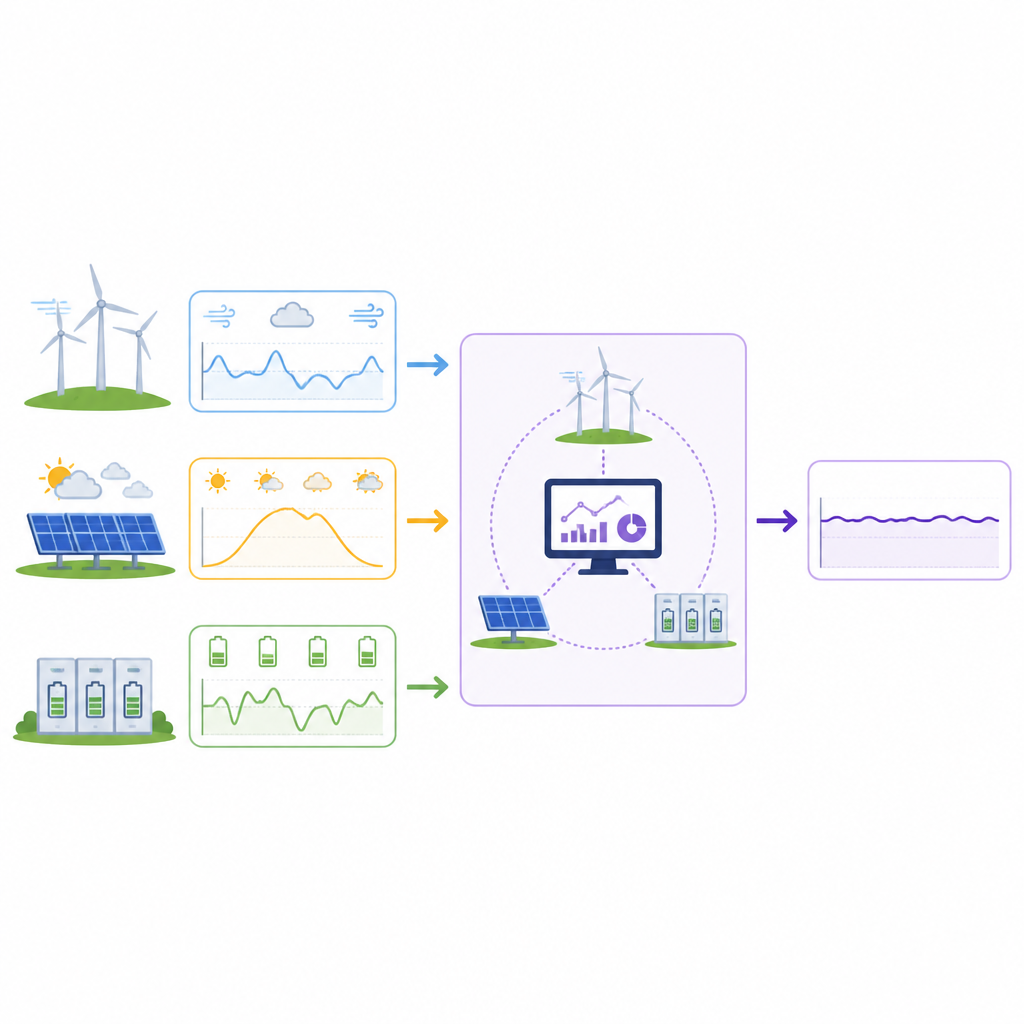
From scattered devices to a single smart power plant
A virtual power plant brings together many different resources, such as wind farms, large solar stations, batteries, and flexible users, and lets them act as if they were one big power station in the market. System operators want these plants to make firm promises about how much power they will deliver. However, wind and solar output can swing quickly and together during storms or calm periods. Traditional planning tools either ignore these joint swings or use overly simple safety margins, which can make operators too cautious or expose them to sudden shortfalls.
Seeing risk in the tails of the weather
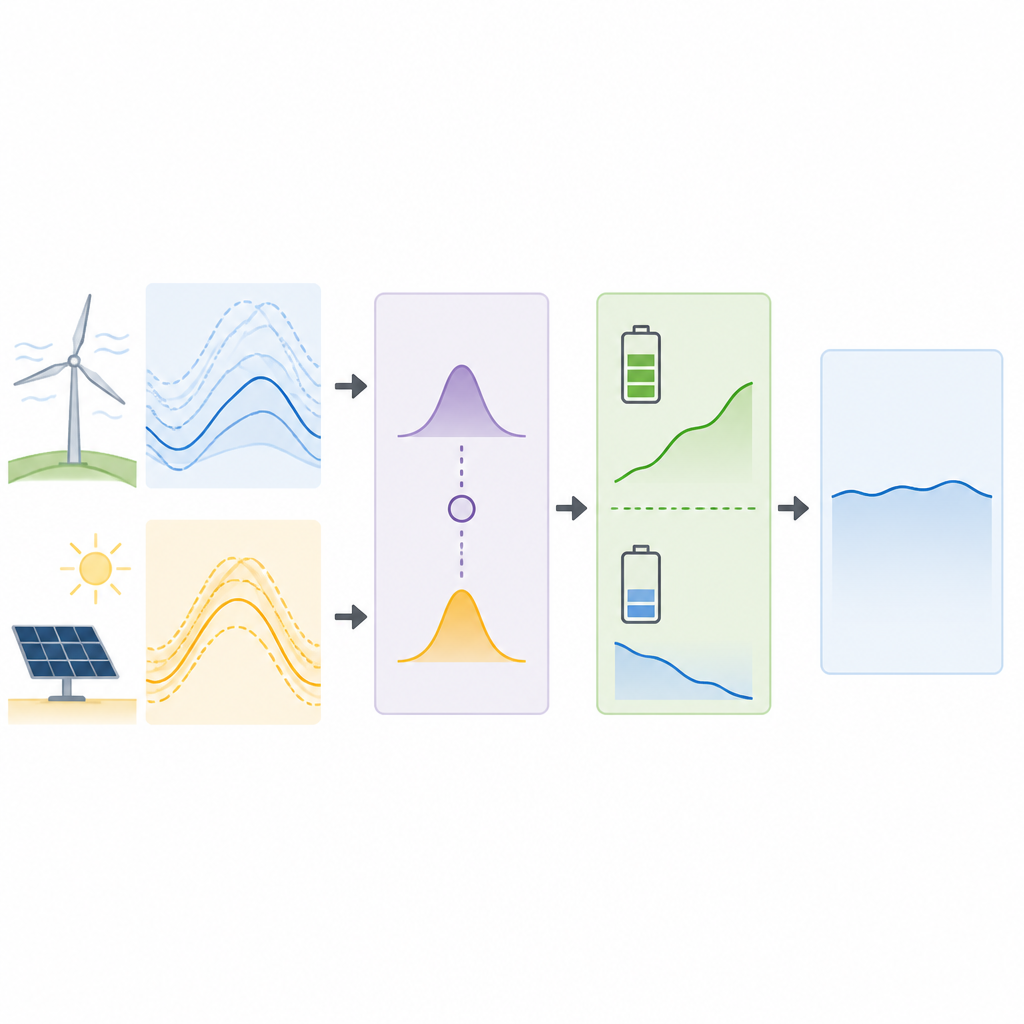
The study focuses on the rare but serious situations when both wind and solar output are unusually low at the same time. Instead of treating all forecast errors equally, the authors use a concept called an expectile to give extra weight to bad outcomes while still keeping the mathematics smooth and manageable for large-scale calculations. They build detailed weather-based models that capture how wind and solar at different sites move together, including during extreme events such as long wind lulls or widespread cloud cover. By blending normal forecast data with simulated extreme patterns, they create scenario sets that better reflect the true risk of joint shortages.
Letting storage and forecasting work together
The framework then connects these weather scenarios with a scheduling model that decides, hour by hour, how much power the virtual plant should promise and how its batteries should charge and discharge. The batteries are modeled with practical limits on charge levels, ramp rates, and wear and tear, so the plan remains realistic. Instead of using fixed safety margins, the credible capacity of the plant emerges directly from the optimization: the model finds the level of committed power that meets a chosen reliability target while using storage to soak up surplus power and back up the system when renewable output dips.
What the simulations reveal in real data
The authors test their approach on a real-world collection of five wind farms, four solar plants, and two large batteries in eastern China, using a full year of weather and power data at 15 minute intervals. They compare their method with more common approaches that use quantiles or a popular risk measure from finance. The expectile-based method yields tighter commitment ranges, meaning the plant can promise more power without taking on excessive risk. In numerical trials, shortfall events are cut by as much as 73 percent compared with quantile-based methods, while the virtual plant still earns up to 95 percent of the maximum possible revenue. The results also show that optimal battery use naturally shifts toward times when the statistics signal greater danger of shortfalls, such as rapid morning and evening ramps.
What this means for clean energy reliability
For a non-specialist, the key message is that the paper offers a smarter way for virtual power plants to decide how much electricity they can reliably promise when relying heavily on wind and solar. By focusing on the most damaging low power events and coordinating them with battery behavior, the method helps grid operators gain dependable capacity from variable renewables without wasting too much potential income. This kind of risk-aware planning can make it easier for clean energy portfolios to participate in capacity and reserve markets, helping future power systems stay both green and reliable.
Citation: Hua, D., Zeng, J., Lin, Q. et al. An expectile-based framework for risk-calibrated credible capacity evaluation of virtual power plants under wind and PV forecast uncertainties. Sci Rep 16, 15253 (2026). https://doi.org/10.1038/s41598-026-44559-5
Keywords: virtual power plant, wind and solar, energy storage, power system risk, renewable forecasting