Clear Sky Science · en
Projected compositional reorganization of Southern plant assemblages in South Korea under climate scenarios using species distribution models
Why future forests in Korea matter to everyone
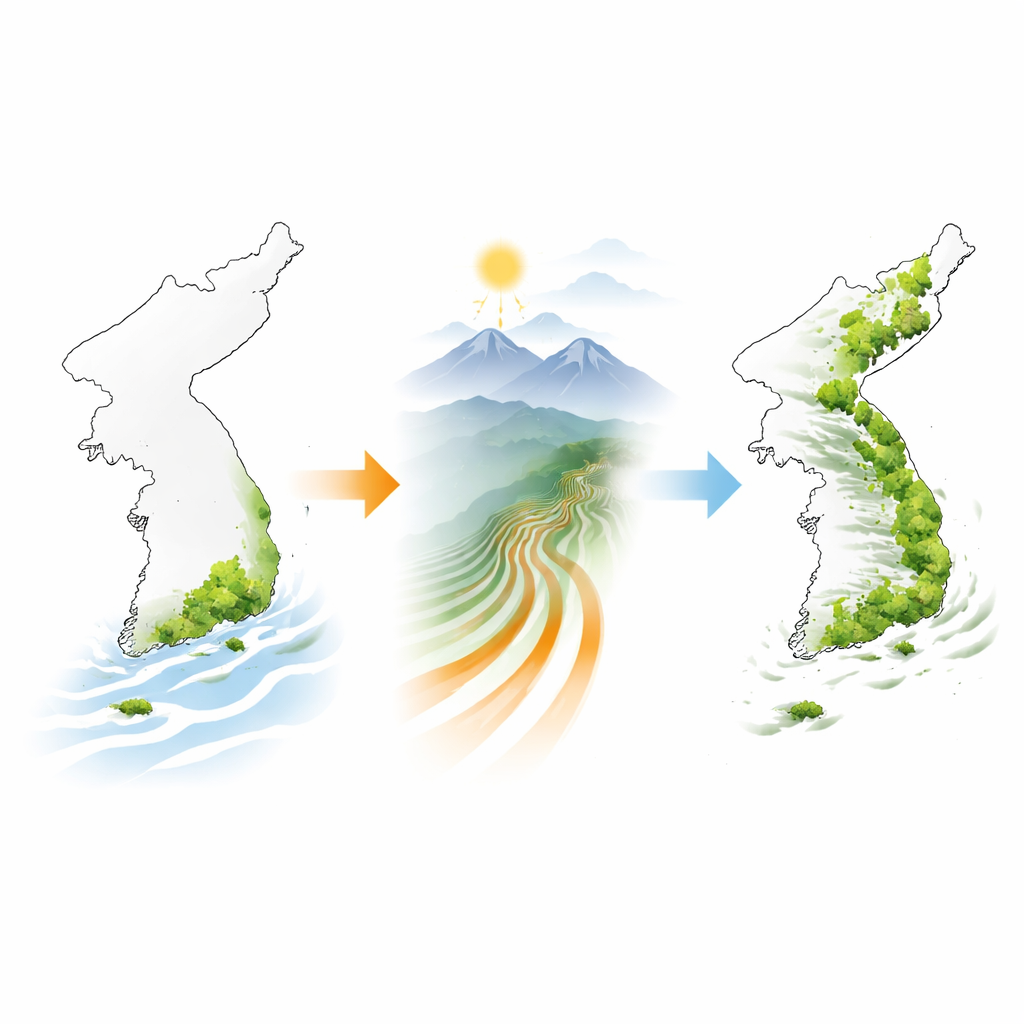
As the climate warms, the plants that make up our forests and hillsides will not simply march north in lockstep. In South Korea, many southern, warmth-loving species are squeezed between rising temperatures, steep mountains, and busy coastlines. This study asks a question with real-world consequences: how will these plant communities reshuffle in the coming decades, and what does that mean for where we choose to protect and restore nature?
Taking a community view of changing nature
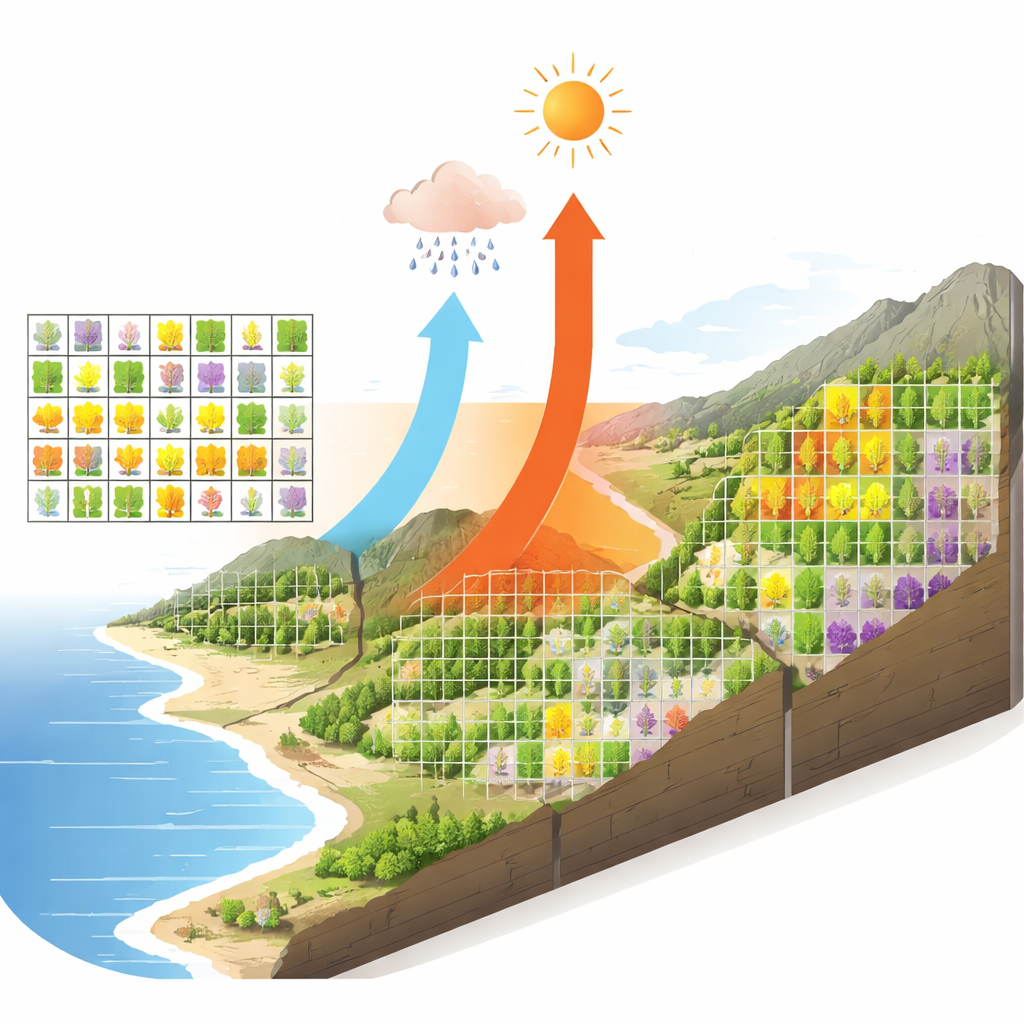
Most forecasts of climate impacts on biodiversity look at one species at a time. The authors instead treated southern vascular plants as members of living communities. Using observations of 95 warmth-affiliated species, they built computer models that predict where each species can live today and under three future climate pathways, from relatively mild warming to very strong warming, through the end of this century. They then overlaid these predictions on a 10-kilometer grid covering all of South Korea, so that every cell carries information about which southern species could be present now and in future decades.
Dividing the landscape into meaningful zones
To make sense of these many overlapping forecasts, the researchers first carved South Korea into nine environmental zones based on stable features such as elevation, distance from the sea, latitude, and longitude. These zones include southern coastal lowlands, central highlands, deep inland areas, and northern mountain regions. Because these features change little over time, they provide a fixed backdrop against which the team could watch plant communities move and reorganize through time and across climate scenarios.
Hotspots on the move
The team then searched for “core” areas where many southern species are projected to occur together. Using a statistical technique that highlights density hotspots, they outlined the 50 percent richest zones for these plants in each time period and climate scenario. Today, these hotspots are concentrated in low-lying southern and coastal regions. By late century, however, the overall hotspot area grows slightly, while individual patches merge into fewer, larger regions that creep northward, higher up mountains, and a bit farther from the coast. Some zones that are barely important today become much more central in future projections, especially inland and upland clusters that could act as new strongholds for southern species.
Tracing community journeys through ecological space
Beyond where plants might occur, the study also examines how entire communities change their internal makeup. The authors mapped each grid cell into an abstract “composition space,” where distance represents how different two communities are. Connecting each cell’s position through four time slices produced a trajectory that shows how much its community changes, how straight that change is, and how similar the paths are across cells within the same zone. They found that who your neighbors are in space matters more than when you are in time: the identity of the environmental zone explains far more of the variation in community makeup than the time period. Low-lying southern and coastal zones show short, relatively straight trajectories, indicating modest, orderly change. In contrast, northern and upland zones have long, winding paths, signaling large and often irregular reshuffling of species.
From stable havens to transformation zones
By combining the hotspot maps, the trajectories, and how well they line up with climate gradients such as latitude and temperature, the authors grouped zones into three types. “Stable” zones, mainly in southern coasts and islands, change little and move in step with climate, suggesting they could serve as long-term refuges where existing plant assemblages persist. “Transitional” zones, like central lowlands and highlands, show moderate change and may act as bridges that help species move and mix, supporting ecological corridors across the country. “Transformational” zones, largely in northern and inland uplands, show big shifts that do not simply track warmer or wetter conditions. Here, novel combinations of southern and colder-climate species are likely, and existing communities may be replaced by unfamiliar ones.
What this means for protecting nature
For a layperson, the core message is that South Korea’s plant communities are expected to reorganize in complex, place-dependent ways rather than slide smoothly northward. Some regions are poised to remain relatively stable, others will act as stepping stones, and some will undergo major ecological overhauls. Recognizing these differences can help planners choose where to anchor long-term protected areas, where to maintain or restore connections across the landscape, and where to monitor closely for rapid or surprising ecological change. The framework developed here offers a practical way to move beyond static maps and towards conservation strategies that follow living communities as they shift under a changing climate.
Citation: Kim, SJ., Lim, C.H. Projected compositional reorganization of Southern plant assemblages in South Korea under climate scenarios using species distribution models. Sci Rep 16, 13760 (2026). https://doi.org/10.1038/s41598-026-44558-6
Keywords: climate change, plant communities, species distribution models, South Korea biodiversity, climate-resilient conservation