Clear Sky Science · en
Repetitive after-discharges are more common in acquired demyelinating polyneuropathies
Why some nerve tests show extra "echoes"
When doctors test how well nerves work, they send tiny electrical pulses along them and record how muscles respond. In some people, the main response is followed by a string of smaller "echoes"—extra electrical bursts called repetitive after-discharges. This study asks a simple but important question: are these echoes just harmless quirks, or do they point to a specific kind of nerve damage that doctors need to recognize?
Looking at electrical echoes in nerve disease
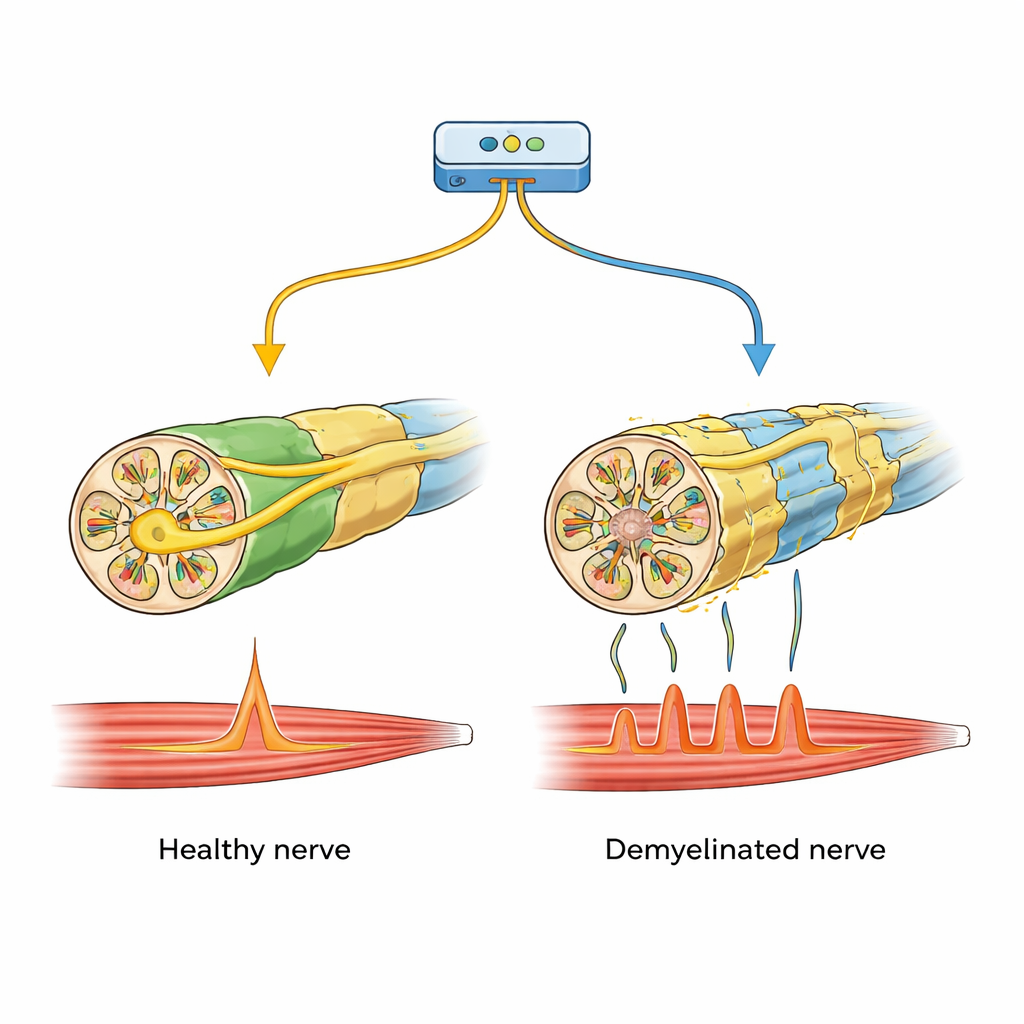
The researchers examined years of nerve test recordings from a university hospital’s electromyography laboratory. They focused on polyneuropathies, conditions in which many peripheral nerves are damaged, and compared three groups: people with demyelinating polyneuropathy (where the protective insulation of nerves is harmed), people with axonal polyneuropathy (where the inner wire of the nerve is mainly affected), and people whose tests were essentially normal. They searched especially for repetitive after-discharges—distinct, repeated electrical blips that appear shortly after the main muscle response to a stimulus.
Extra signals strongly linked to damaged insulation
Repetitive after-discharges appeared in the overwhelming majority of patients with demyelinating polyneuropathy: about 9 out of 10 had them. In contrast, fewer than one in three patients with axonal polyneuropathy showed these echoes, and they were almost absent in people with normal nerve tests. Among people with inherited forms of demyelinating disease, the finding was much less common than in those with acquired, immune-related forms. This clear difference suggests that these extra discharges are not random noise, but a meaningful sign that the nerve’s insulating layer is patchy or unstable.
Timing that rules out simple muscle tension
Because slight muscle tensing or poor relaxation can also create extra electrical activity, the team looked closely at when these echoes appeared. They measured their timing against a well-known "silent period" that normally follows a nerve shock while a muscle is gently contracted. During this brief window, activity in the motor fibers is effectively shut down by colliding signals. In more than four out of five recordings where both after-discharges and another late response (the F-wave) were present, the first extra discharge fell squarely within this silent period. That timing is difficult to explain by voluntary muscle activity, strongly supporting the idea that the echoes arise from abnormal nerve behavior itself, not from a patient unconsciously tightening a muscle.
What might be happening inside the nerve
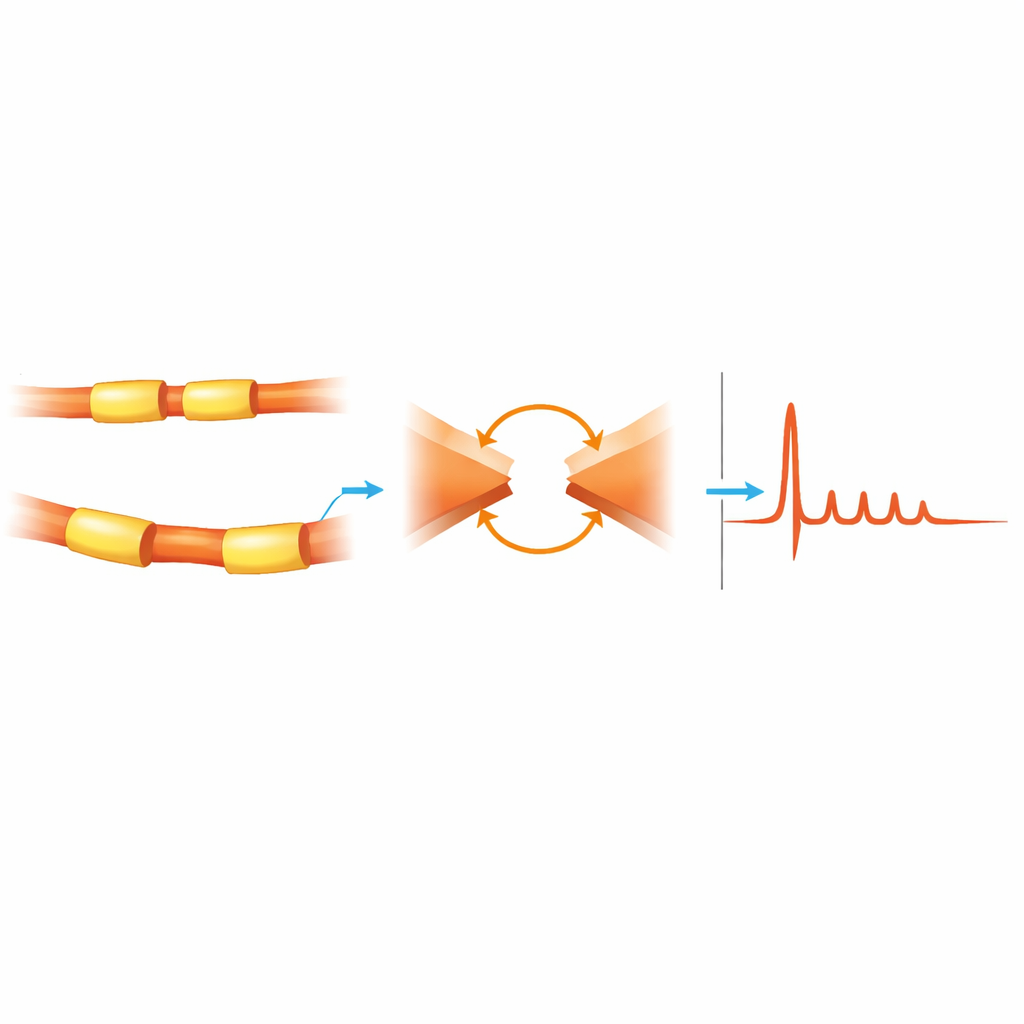
The authors discuss several possible mechanisms behind these extra signals. In demyelinated nerves, bare stretches of the nerve fiber may lie close together so that an impulse in one segment can jump across and re-excite a neighboring segment, creating a chain of repeated firings. Changes in ion channels—the microscopic gates that control electrical flow in nerve membranes—may also make damaged fibers unusually eager to fire again and again after a single shock. The study notes that some patients had highly regular, machine-like bursts, while others had more irregular patterns, hinting that multiple microscopic processes may be involved.
How this could help doctors and patients
By showing that repetitive after-discharges are far more frequent in acquired demyelinating polyneuropathies than in other nerve problems or healthy people, this work suggests that these electrical echoes can serve as a practical marker during routine nerve testing. They may help clinicians distinguish diseases that primarily damage insulation from those that mainly injure the nerve core, and may even aid in telling acquired forms from inherited ones—though larger, genetically well-defined studies are still needed. For patients, this means that what once looked like a puzzling squiggle on a nerve test could become a useful clue that guides diagnosis and treatment decisions.
Citation: Uzunçakmak-Uyanık, H., Yıldız, F.G. & Temuçin, Ç.M. Repetitive after-discharges are more common in acquired demyelinating polyneuropathies. Sci Rep 16, 10532 (2026). https://doi.org/10.1038/s41598-026-44557-7
Keywords: peripheral neuropathy, nerve conduction, demyelination, electromyography, nerve hyperexcitability