Clear Sky Science · en
UV-C LED wavelength effects on inactivation kinetics, DNA damage and membrane integrity in drinking water indicator bacteria
Why cleaner water matters
Safe drinking water is essential for health, yet tiny microbes that slip through treatment systems can still cause disease. This study explores how a new kind of ultraviolet light source, based on small UV-C light-emitting diodes (LEDs), can more efficiently shut down bacteria that signal whether water is clean. By tuning the color of the invisible UV light, the researchers show how to hit bacteria where it hurts most, paving the way for compact, mercury-free devices that could help protect water supplies around the world.
Shining a new kind of light on germs
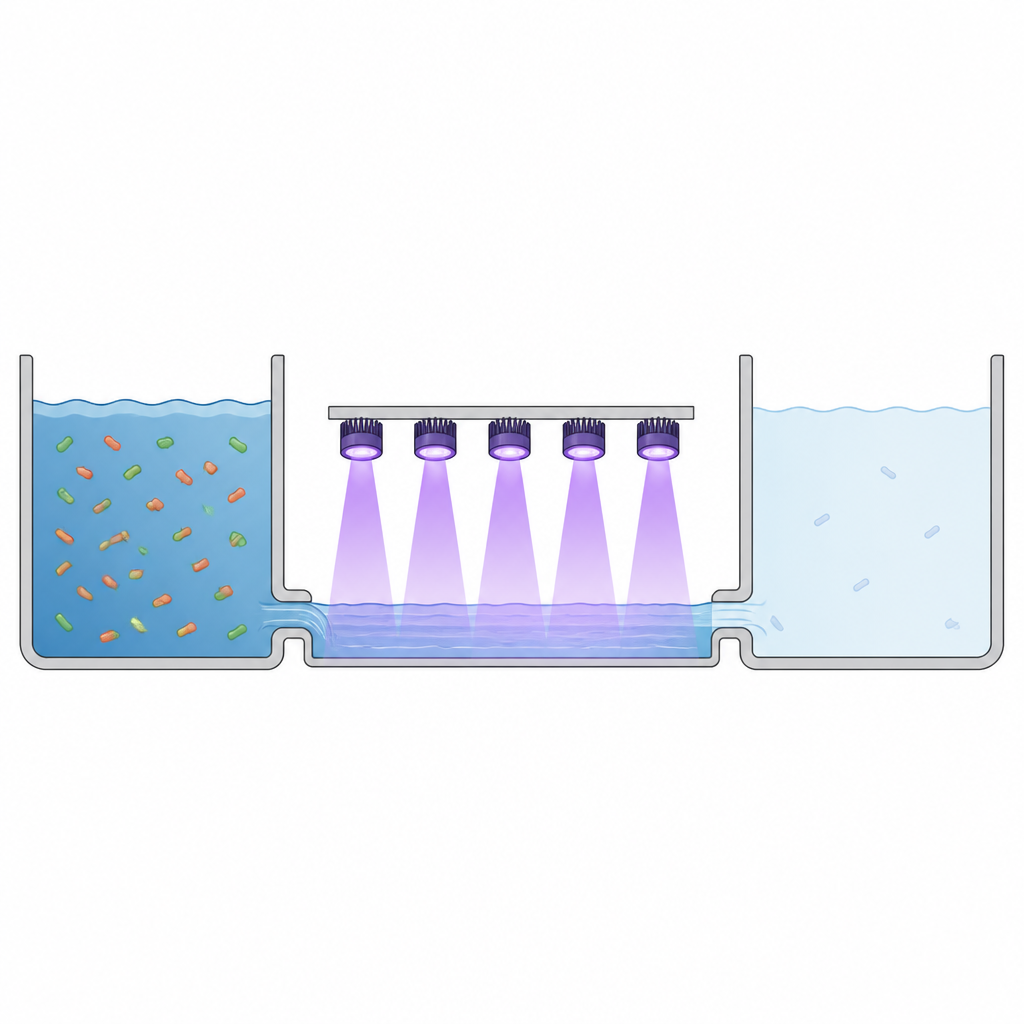
Traditional UV systems for water treatment rely on mercury lamps that give off light at a fixed color, raising environmental concerns and limiting design options. UV-C LEDs, in contrast, are tiny solid-state devices that can emit at slightly different UV colors, or wavelengths, across a key germ-killing range. The team tested LEDs that produced light at five wavelengths between 255 and 280 nanometers on two standard water indicator bacteria: Escherichia coli, a Gram-negative species, and Enterococcus faecium, a Gram-positive species with a thicker outer wall. They examined not only how many bacteria were inactivated, but also how their DNA and cell membranes changed, and whether survivors could bounce back after treatment.
Finding the sweet spot for bacterial knockdown
Across all the tested colors, the LEDs were highly effective, achieving up to a million-fold (6-log) reduction in both bacterial species at relatively low UV doses under laboratory conditions. Still, there were clear differences. Light near 265 nanometers gave the fastest inactivation of E. coli, matching the range where DNA absorbs UV most strongly. E. faecium was tougher at the lowest doses, likely because its thicker cell wall offers extra protection, but once the dose increased it too dropped sharply and showed similar sensitivity at wavelengths between 260 and 270 nanometers. Culture collection strains and bacteria freshly isolated from surface water behaved similarly, suggesting that the LED treatment would work both in controlled tests and with real-world isolates.
What the bacteria look like under the microscope
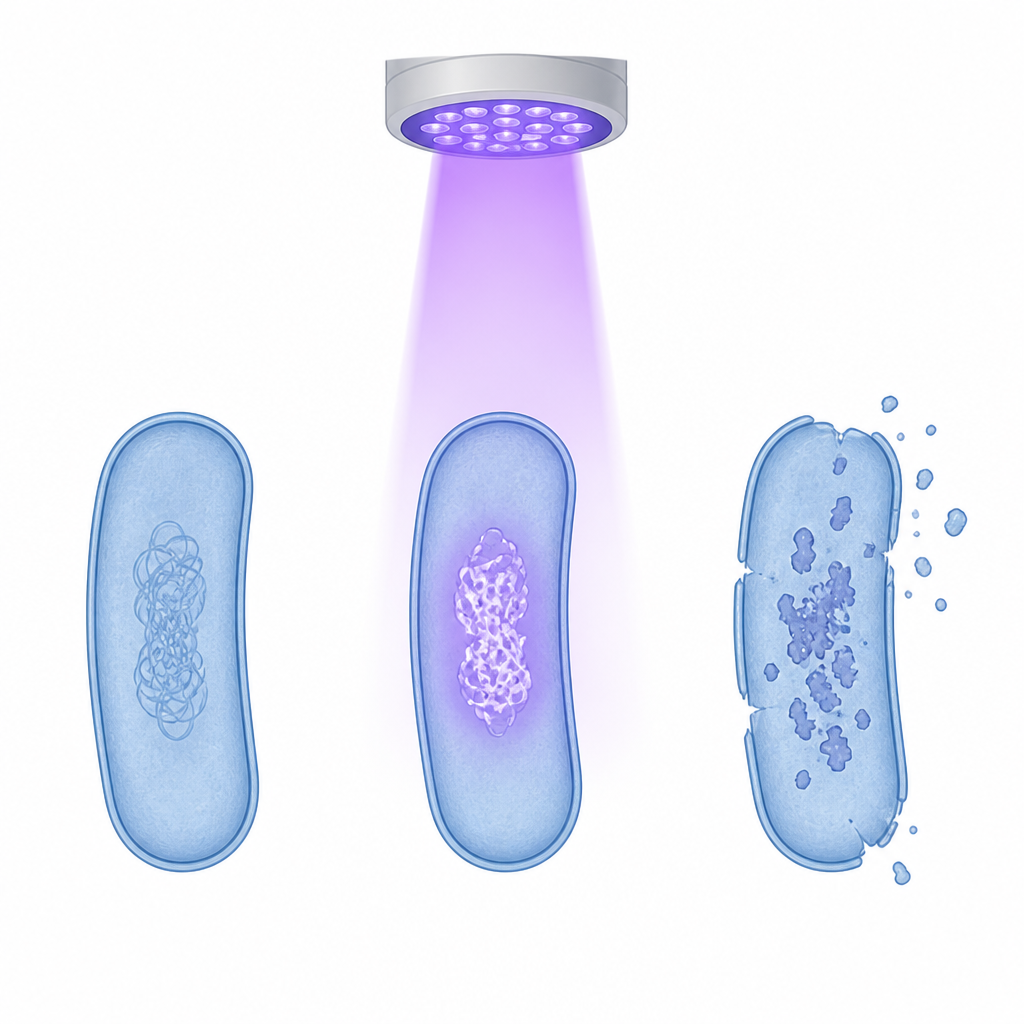
To peek inside the cells, the researchers stained bacterial membranes and DNA with fluorescent dyes and imaged them after UV exposure. At practical doses, most cells preserved their overall shape and outer outline, but their genetic material told a different story. DNA that appeared evenly spread before treatment became clumpy and uneven afterward, a sign of condensation and structural disruption. Some cells kept a clear membrane signal but lost detectable DNA staining altogether, hinting at severe genetic damage even when the outer shell seemed intact. At higher doses, a growing fraction of cells showed leaky membranes, and some E. coli elongated into filaments, a known stress response linked to blocked cell division.
Damage that bacteria cannot easily undo
A key concern for any disinfection method is whether treated microbes can repair themselves and regrow. After exposing the bacteria to a fixed UV dose, the team incubated them for hours in both light and darkness to allow common repair pathways to act. They then counted surviving colonies and measured specific UV-caused DNA lesions called cyclobutane pyrimidine dimers. Despite giving the cells ample time, E. coli and E. faecium showed almost no meaningful recovery in either condition. Even when some DNA lesions decreased in E. faecium, its ability to form colonies did not return, indicating that additional types of damage, including to membranes and repair proteins, helped lock in the effect of the UV treatment.
What this means for safer water
The work shows that UV-C LEDs can strongly inactivate key water indicator bacteria across several nearby colors, with a clear performance peak around 265 nanometers where DNA damage is greatest. The bacteria rarely recovered after treatment, suggesting that the inflicted harm is largely irreversible under typical conditions. Because LEDs are compact, energy-efficient, and mercury-free, these findings support their use in future water treatment units, from household devices to full-scale plants. By choosing LED wavelengths that best target bacterial DNA while also disturbing cell structure, engineers can design more reliable systems that help keep drinking water safer with minimal chemical use.
Citation: Sério, J., Santos, C., Martins, M.E. et al. UV-C LED wavelength effects on inactivation kinetics, DNA damage and membrane integrity in drinking water indicator bacteria. Sci Rep 16, 15919 (2026). https://doi.org/10.1038/s41598-026-44556-8
Keywords: UV-C LED disinfection, drinking water safety, bacterial DNA damage, Escherichia coli, Enterococcus faecium