Clear Sky Science · en
Development of a homogenizer-disperser of liquid fodder for pigs
Why smoother pig feed matters
Feed is the biggest expense on a pig farm, and how that feed is prepared strongly affects animal health, growth, and farm profits. This study presents a new machine that turns ground grains and water into a smooth, stable liquid feed for pigs while using less electricity. By carefully shaping how liquid swirls and bubbles inside the device, the authors show they can grind particles more finely, keep the mixture from separating, and cut energy costs compared with existing equipment.
Turning grain and water into an even mix
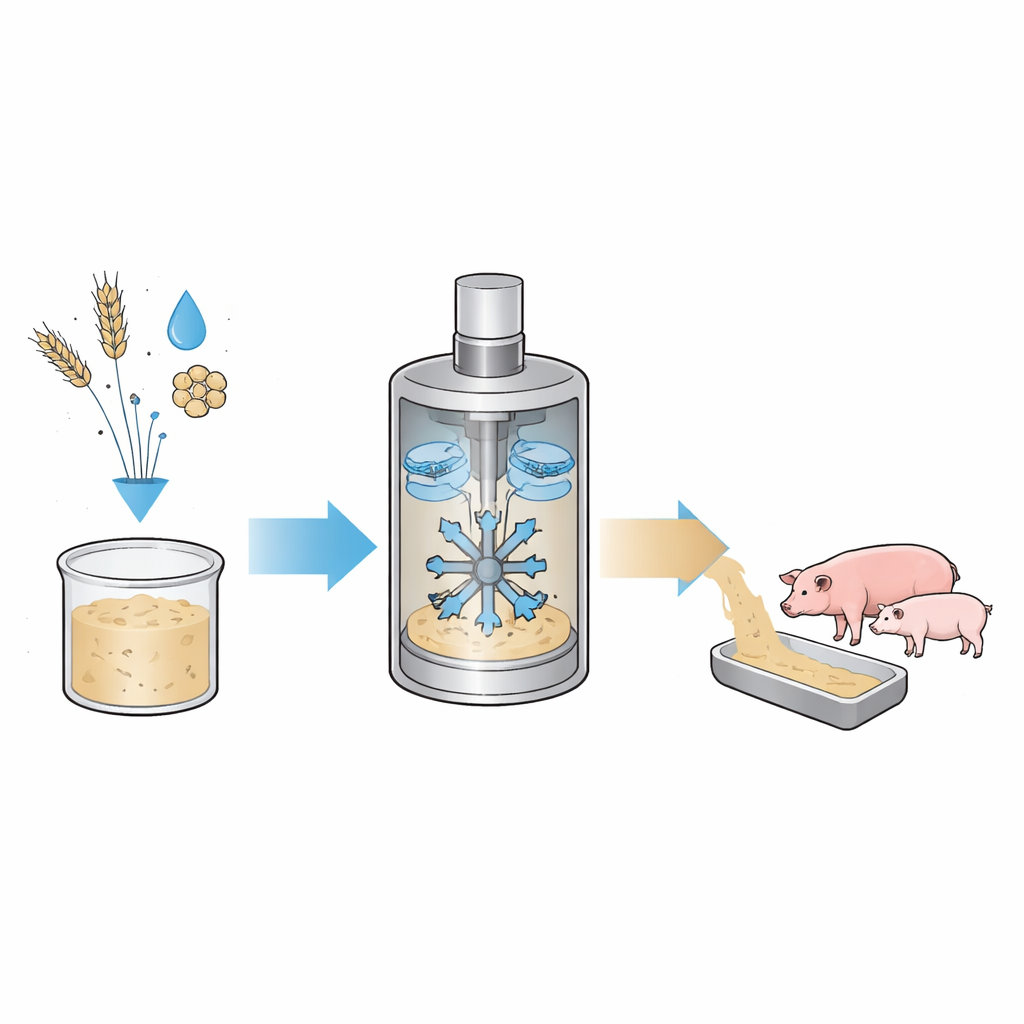
Modern pig farms increasingly use liquid feed, a porridge-like blend of water and ground grain such as wheat, barley, or soybeans. For pigs to digest this well, two things are crucial: particles must be small, and ingredients must stay evenly mixed instead of settling into layers. The team designed a new rotor–stator homogenizer, a compact vessel in which a fast-spinning inner drum (rotor) works against a fixed outer shell (stator) pierced with openings. As the mixture is drawn through these openings, intense swirling and the rapid formation and collapse of tiny bubbles break up grain pieces and stir the liquid thoroughly.
From computer model to working machine
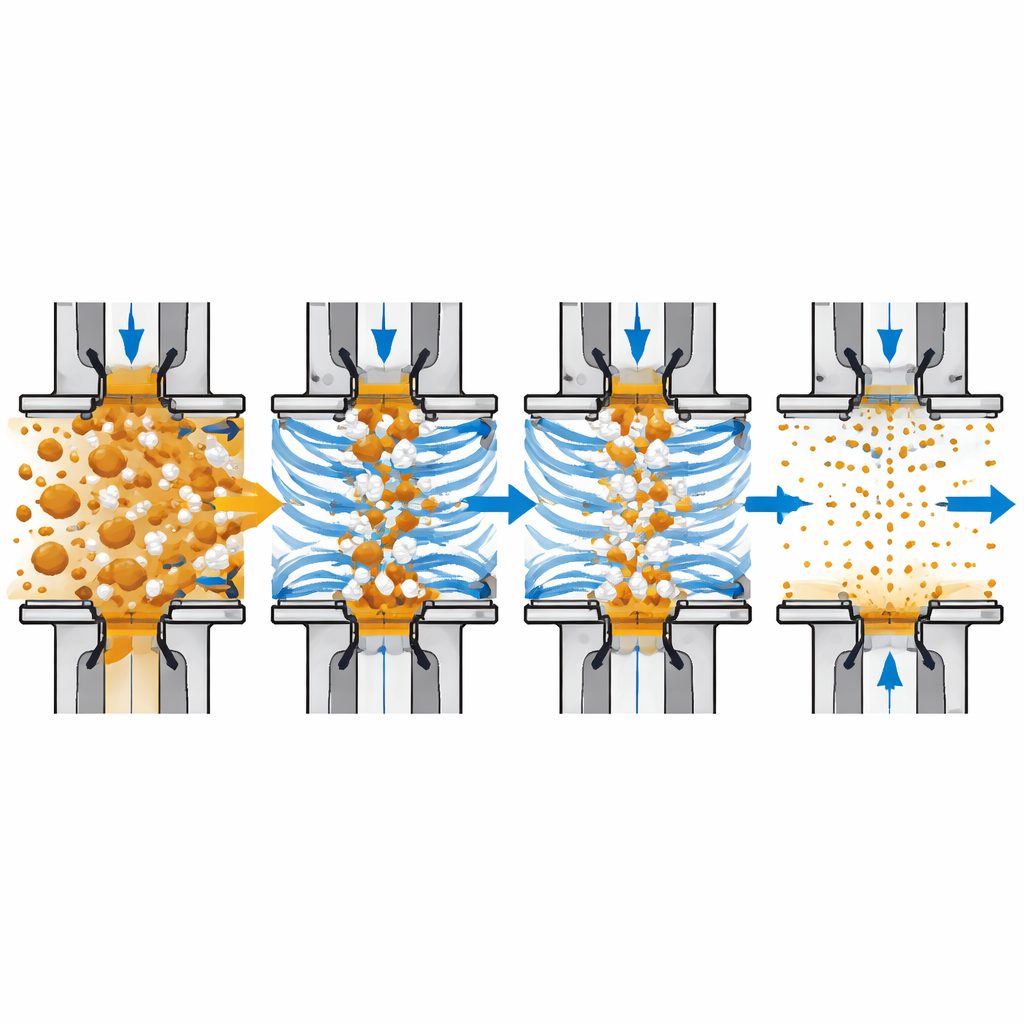
Rather than relying on trial and error, the researchers followed a stepwise engineering path. They first drafted an overall process layout and patented the machine concept. Then they built a detailed 3D computer model of the rotor and stator and used advanced flow-simulation software to predict how liquid and bubbles would move inside. These simulations guided the exact size and placement of openings so that cavitation—the formation of vapor bubbles that collapse with tiny shock waves—would occur where it does the most useful work. Finally, they manufactured the metal parts on a computer-controlled milling machine and assembled a full test rig with sensors to track temperature, motor power, and liquid properties over time.
Testing how design choices shape the feed
On the test bench, the team prepared small batches of liquid feed from wheat, barley, or soybeans mixed with water to a fixed solids level. They systematically varied three key settings: how fast the rotor spun, how wide the stator openings were, and how long the mixture was processed. For each run they measured the share of very fine particles (0–0.5 millimeters), how strongly the mixture tended to separate into layers, the final temperature, the motor’s power draw, and total and per‑kilogram energy use. Statistical tools were used to turn these many measurements into mathematical relationships that show, in simple form, how each setting pushes the process toward smoother feed, more stable mixing, or higher energy demand.
Finding the sweet spot between smoothness and energy use
The results show clear trade‑offs. Faster rotor speeds and smaller openings produce more fine particles and better mixing, but they also heat the feed and raise power consumption. The researchers identified a practical target for homogeneity: a stratification index below 5 percent, meaning the liquid remains nearly uniform after standing. For wheat, barley, and soy, this level of uniformity occurs at rotor speeds just under 2,300–2,450 revolutions per minute and with moderately narrow openings. They also found that processing longer than about 45–50 minutes brings little extra grinding benefit but steadily increases energy use. Within this window, specific energy use is lowest for soy-based feed, followed by wheat and then barley, reflecting how easily each grain breaks apart.
From lab measurements to farm savings
By combining all the tested relationships into a single set of formulas, the authors created a kind of digital twin of the process that can guide automatic control. Given a desired smoothness and stability, a controller could adjust rotor speed, run time, and stator opening size to keep energy use down while maintaining feed quality. The team also compared their prototype to two commercial systems on a model pig farm. Although the new unit costs a bit more to buy, its lower power rating and higher efficiency cut yearly operating costs enough that the extra investment pays back in well under a year. The work shows that carefully shaping flow and cavitation inside a compact mixer can turn simple grains and water into a consistent, easy‑to‑digest liquid feed, while saving energy and money for pig producers.
Citation: Aliiev, E., Malehin, R., Aliieva, O. et al. Development of a homogenizer-disperser of liquid fodder for pigs. Sci Rep 16, 14127 (2026). https://doi.org/10.1038/s41598-026-44547-9
Keywords: liquid pig feed, cavitation mixing, rotor–stator homogenizer, energy-efficient feed processing, swine nutrition technology