Clear Sky Science · en
Analysis of segment uplift during shield tunnel construction considering stratum seepage effects
Why tunnel uplift matters to city life
Modern cities increasingly rely on underground rail lines to ease traffic and free up space at street level. But digging long tunnels beneath buildings is not risk free. When a tunnel is bored by a giant shield machine, the concrete rings that line the tunnel can sometimes rise, or "uplift," more than expected. Too much uplift can crack the lining, let water leak in, and even disturb the ground and structures above. This study looks closely at how the mix of injected grout and natural groundwater causes tunnel uplift, using a real section of the Dalian Metro in China as a test case.
A closer look beneath the streets
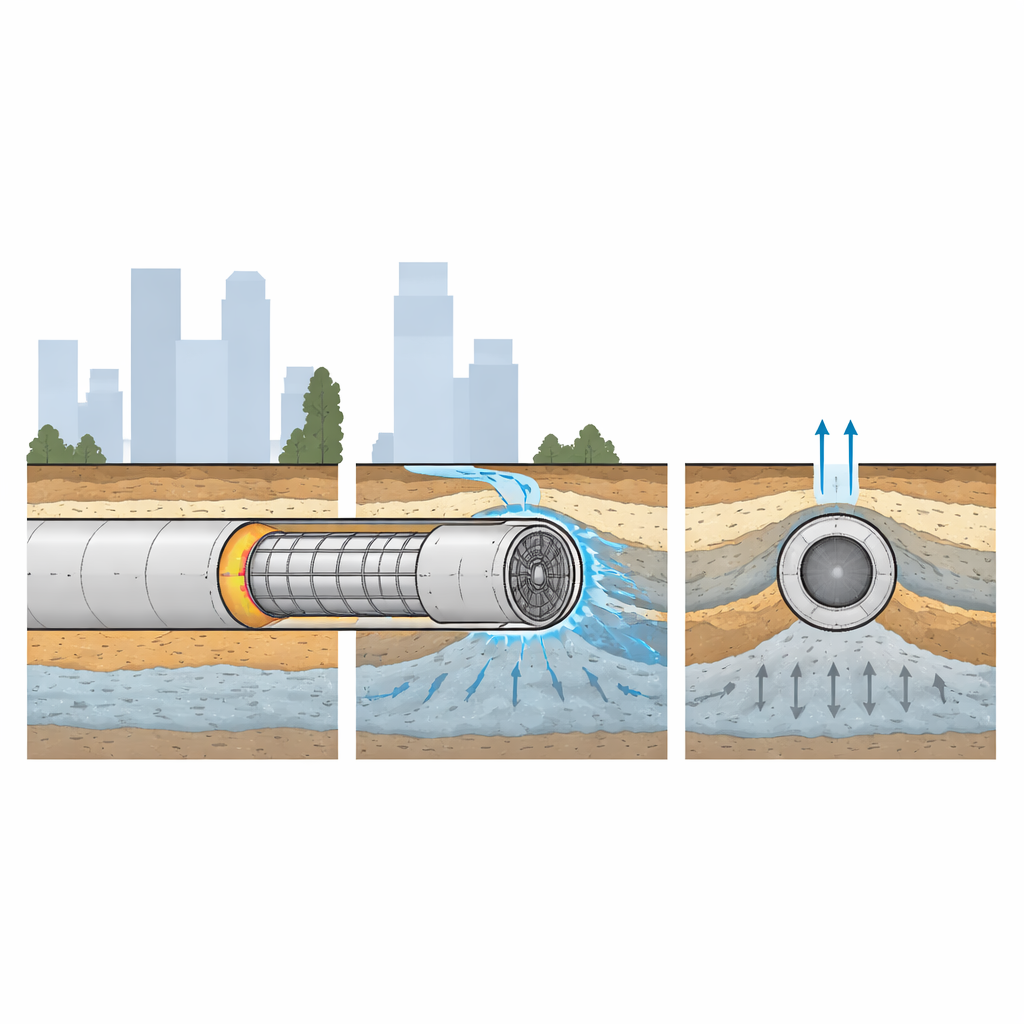
The researchers focused on a tunnel section running under urban ground made of layered fill, clays, and gravelly soils that contain groundwater. As the shield machine advances, it leaves a small gap between the circular concrete lining and the surrounding soil. That gap is immediately filled with a fluid grout to support the ground and keep the tunnel stable. Because the grout is lighter and more fluid than the soil, and because the ground is water-bearing, the lining can be pushed upward by a combination of grout pressure and water pressure. Earlier studies often treated this effect in simplified ways and did not fully account for how water moves through the soil while the grout is injected and hardens.
Building a virtual tunnel in the computer
To untangle these processes, the team built a three-dimensional computer model of the tunnel, the grout, and the surrounding ground. The model mimicked real geological layers and allowed water to seep through the soil according to well-known flow laws. It also reproduced the step-by-step advance of the shield machine: excavating soil, supporting the tunnel face, installing each ring of segments, and injecting grout around them. Different stiffness levels were assigned to the grout as it changed from freshly pumped fluid to a hardened material. The model was checked against careful field measurements taken with surface monitoring points and a laser-based guidance system that tracked the tunnel lining as the machine moved forward.
How water and grout team up to lift the tunnel
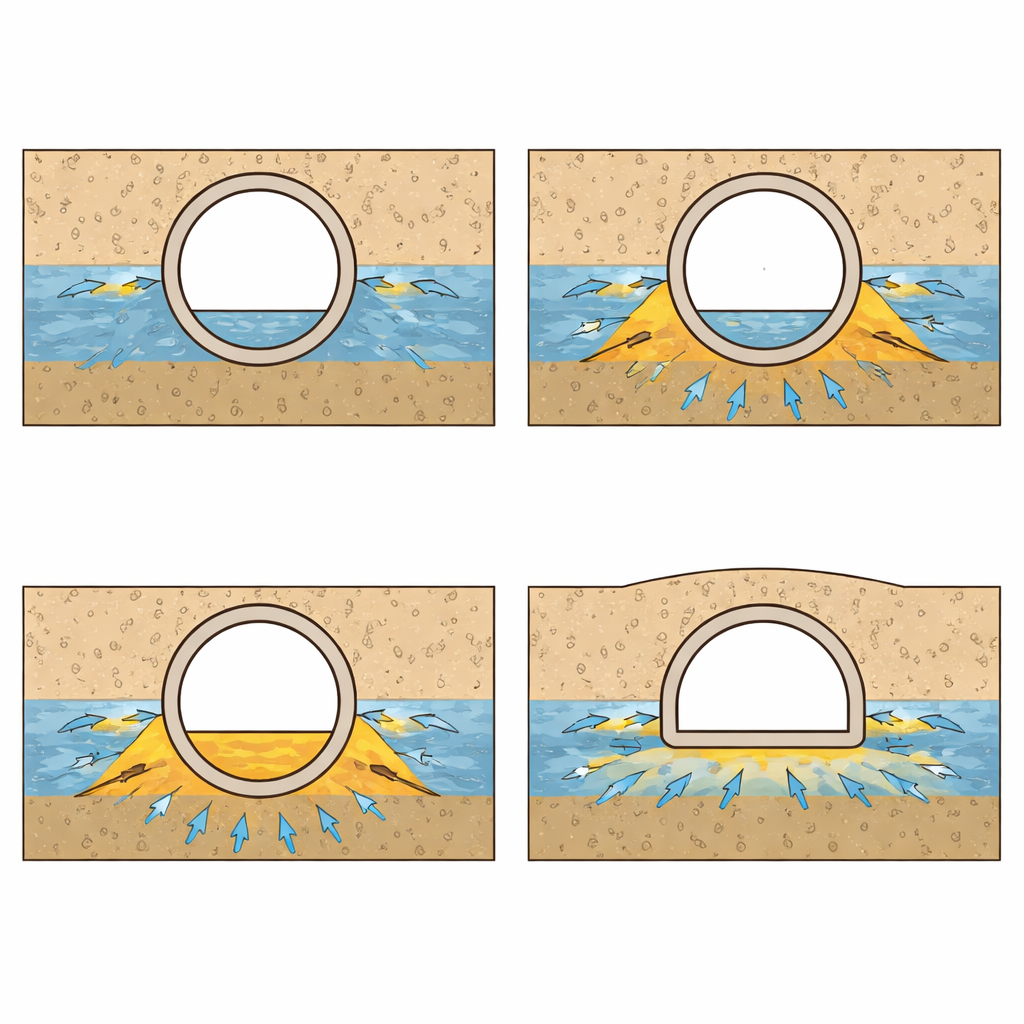
The simulations showed that water pressure around the tunnel lining changes sharply as the machine passes and grout is injected. The strongest swings in pore water pressure occur at the bottom of the lining, weaker changes appear at the sides, and the smallest at the top. Uplift follows a similar pattern: the tunnel invert (bottom) rises the most, the sides somewhat less, and the crown (top) the least. Most of the total uplift happens in the first five rings behind the shield tail, during the phase when the grout is still very fluid and its pressure is high. As the grout begins to set and the soil stress readjusts, uplift growth slows and eventually levels off. When groundwater seepage is included, the final uplift is noticeably larger—about one fifth of the total uplift in the model is due to seepage acting together with grout pressure rather than grout alone.
Which construction choices make uplift worse
Using the validated model, the authors then varied key factors under otherwise similar conditions. Deeper tunnels experienced more uplift, mainly because groundwater pressure grows with depth and helps expand the grout and lift the lining. Higher grouting pressures produced stronger uplift as well, although this effect was smaller than that of depth. Another important factor was how quickly and how close to the machine the grout began to set. If the initial setting point occurred farther behind the shield, the grout stayed fluid around the lining for longer, allowing more time for uplift to develop. The study combined these trends into simple empirical formulas that relate uplift to burial depth, grouting pressure, and the distance from the tunnel face, giving engineers a practical way to estimate uplift under similar ground conditions.
Implications for safer underground travel
For non-specialists, the main message is that tunnel uplift is not just a matter of how hard engineers pump grout—it also depends strongly on how groundwater moves through the soil and how quickly the grout stiffens. By capturing the combined action of grout pressure and water seepage, and by checking the results against real-world measurements, this work offers a more realistic picture of how and when tunnel linings rise during construction. The findings can help designers choose safer burial depths, grouting pressures, and grout formulations, reducing the risk of cracks, leaks, and surface heave as new subway lines are built beneath our cities.
Citation: Guo, J., Li, Z., Liu, J. et al. Analysis of segment uplift during shield tunnel construction considering stratum seepage effects. Sci Rep 16, 14501 (2026). https://doi.org/10.1038/s41598-026-44530-4
Keywords: shield tunnel uplift, groundwater seepage, synchronous grouting, metro tunnel construction, numerical modeling